Donlin Gold mine
The Donlin Gold Project is a large, undeveloped, refractory gold deposit located 12 miles (19 km) north of Crooked Creek, Alaska on the Kuskokwim River, about 280 miles (450 km) northwest of Anchorage. The deposit has proven and probable reserves estimated to be 33.9 million ounces of gold at a grade of 2.1 g/t and could produce an average of one million ounces annually over a 27-year mine life.[1][2][3]
| Location | |
|---|---|
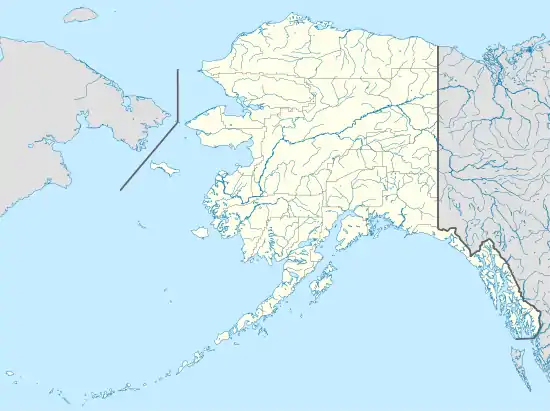  Donlin Gold Project | |
| Location | Crooked Creek |
| State | Alaska |
| Country | United States |
| Coordinates | 62°02′17″N 158°12′39″W |
| History | |
| Discovered | 1988 |
| Owner | |
| Company | NovaGold Resources (50%), Barrick Gold (50%) |
| Website | http://www.donlingold.com/ |
Owners
The project is a joint venture between NovaGold Resources, Barrick Gold, and Calista Corporation. Calista is one of 13 regional Alaska Native corporations established as part of the Alaska Native Claims Settlement Act of 1971 (ANCSA) and under ANCSA has title to the subsurface estate in the region.[1]
Permitting
On April 12th, 2021, an administrative law judge recommended that the State of Alaska rescind the project's water quality certificate, required under the Clean Water Act, on the grounds that the State “erred in their hasty issuance” of the certificate, asking the State “to ensure protection of salmon streams.”[4] The public was given only 15 days to comment, during COVID-19 lockdown, on 12 different water rights permits for a mine that, if developed, would be one of the largest in the world, placed in the watershed of a major, salmon-bearing river.[5]
Local Controversy
While there is not widespread public awareness about the environmental concerns of the Donlin mines proposed operations, there is considerable local controversy.[6] One main concern, voiced in the public comment section of the Environmental Impact Statement (EIS) issued by Donlin Gold Project, is that it may exceed Alaska's water and air quality regulations.[7] The project's Clean Water Act permit has been challenged by the Orutsararmiut Native Council (ONS) on the grounds that there is no reasonable assurance that the project will comply with state water quality standards or Alaska's Antidegradation Policy. The proposed decision for the case is that Donlin Gold Project and the Alaska Department of Environmental Conservation, Division of Water, in issuing a certificate for Donlin, have not provided the necessary 'reasonable assurance' that water quality standards will be honored in order to proceed with mining operations. Three areas of concern are mercury levels in the water, water temperatures, and degradation of essential salmon habitat.[8]
Mercury is designated as a toxic substance under the Department of Environmental Conservation 2020 Water Quality Standards.[9] The levels of dissolved mercury in freshwater, as defined by the Alaska Water Quality Standards is 1.4 μg/l for acute pollution (measured as the 1 hour average) or 0.77 μg/l for chronic pollution (measured as the 4 day average).[9] Mercury levels already exceed the water quality standards in some instances in the watershed near the proposed site of the mine. Mining operations may increase mercury levels in the watershed, and this has been used to argue that there is not reasonable assurance that water quality standards will be honored.[8]
Another argument put forward by the ONS is that, due to a combination of mine operating procedures and a decrease in riparian habitat along the watershed, water temperature in the related watershed is predicted to increase, according to Donlin Gold Project's Final Environmental Impact Statement (FEIS), close to or above Alaska's water quality standards.[10][8]
Alaska has an antidegradation policy in compliance with the Federal Clean Water Act.[11] According to federal regulations, all states must have an antidegradation policy, and this policy must, among other things, protect existing uses of any water body.[12] Taking the existing use of salmon habitat into account, the ONS argues that the actions of the mining project do not provide reasonable assurance of compliance with the antidegradation policy, due to dewatering of the watershed, and removal of riparian habitat, which will significantly impact the salmon population.[8]
References
- Lang, Gregory A. (28 January 2015). "Annual Report pursuant to Section 13 or 15(d) of the Securities Exchange Act of 1934 for the fiscal year ended November 30, 2014" (PDF). Vancouver, BC: Novagold Resources Inc. pp. 31–32. Archived from the original (PDF) on 2 April 2015. Retrieved 26 March 2015.
- Bruno, Jeff. "Donlin Gold Project". Alaska Department of Natural Resources. Retrieved 29 May 2021.
- "Donlin Gold's Reserves and Resources". NovaGold Resources Inc. Retrieved 2 April 2014.
- "Future of Donlin Gold mine permit uncertain after judge recommends state regulators to rescind key certificate". 15 April 2021.
- "Bethel tribe protests 15-day comment period for Donlin Gold water permits". 19 February 2021.
- Bolduc, Benjamin; Hodgkins, Suzanne B.; Varner, Ruth K.; Crill, Patrick M.; McCalley, Carmody K.; Chanton, Jeffrey P.; Tyson, Gene W.; Riley, William J.; Palace, Michael; Duhaime, Melissa B.; Hough, Moira A. (2020-08-13). "The IsoGenie database: an interdisciplinary data management solution for ecosystems biology and environmental research". PeerJ. 8: e9467. doi:10.7717/peerj.9467. ISSN 2167-8359.
- Donlin Gold. Environmental Impact Statement: Donlin Gold Project. Aug. 2013, https://dnr.alaska.gov/mlw/mining/large-mines/donlin/pdf/dg-feis-scope-report.pdf. Retrieved 28 October, 2021.
- Orutsararmiut Native Council v. Alaska Department of Environmental Conservation, Divisions of Water; and Donlin Gold LLC., OAH No. 20-0536 (April 12, 2021). https://npr-brightspot.s3.amazonaws.com/legacy/sites/kyuk/files/202104/2021-04-12_notice_of_proposed_decision.pdf
- "Water Quality Standards Section". dec.alaska.gov. Retrieved 2021-11-20.
- Donlin Gold Project Final Environmental Impact Statement. Donlin Gold Project, Apr. 2018, https://dnr.alaska.gov/mlw/mining/large-mines/donlin/pdf/dgfeis.pdf.
- "Antidegradation". dec.alaska.gov. Retrieved 2021-10-31.
- “ECFR :: 40 CFR Part 131 -- Water Quality Standards.” Code of Federal Regulations, https://www.ecfr.gov/current/title-40/chapter-I/subchapter-D/part-131?toc=1.
Authority control  | |
|---|---|
| General | |
| National libraries | |