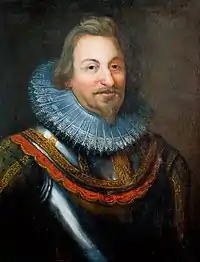
Donogh O'Brien, 4th Earl of Thomond
Donogh O'Brien,[lower-alpha 1] 4th Earl of Thomond and Baron Ibrickan, (died 1624) was a Protestant Irish nobleman and soldier. He fought for Queen Elizabeth in the Nine Years' War (Ireland) and participated at the Siege of Kinsale. His long-term objective, achieved after decades, was to obtain an official acknowledgment that County Clare, where his possessions were situated, was part of the Province of Munster, to free it from the jurisdiction of the Connaught government under which it had been placed.
Donogh O'Brien | |
|---|---|
| Earl of Thomond | |
 | |
| Tenure | 1581–1624 |
| Predecessor | Conor, 3rd Earl |
| Successor | Henry, 5th Earl |
| Died | 5 September 1624 |
| Spouse(s) | Helen Roche Elizabeth FitzGerald |
| Issue Detail | Henry, Barnabas, & others |
| Father | Conor, 3rd Earl of Thomond |
| Mother | Una O'Brien |
Birth and origins
Donogh was born in the 1560s.[lower-alpha 2] He was the eldest son of Conor O'Brien, and his second wife, Una. His father was the 3rd Earl of Thomond. His father's first wife, Ellen or Eveleen, daughter of Donald MacCormac MacCarthy Mor and widow of James FitzJohn FitzGerald, 13th Earl of Desmond, had died in 1560.[2]
Donogh's mother was a daughter of Turlough O'Brian of Arragh, County Tipperary.[3][4] His father's like his mother's family were branches of the O'Briens, an important Gaelic Irish dynasty, that descended from Brian Boru, medieval high king of Ireland.[5] His parents married in or after 1560 as his father's first wife died in that year.[2]
| Family tree | ||||||||||||||||||||||||||||||||||||||||||||||||||||||||||||||||||||||||||||||||||||||||||||||||||||||||||||||||||||||||||||||||||||||||||||||||||||||||||||||||||||||||||||||||||||||||||||||||||||||||||||||||||||||||||||||||||||||||||||||||||||||||||||||||||||||||||||||||||||||||||||||||||||||||||||||||||||||||||||||||
|---|---|---|---|---|---|---|---|---|---|---|---|---|---|---|---|---|---|---|---|---|---|---|---|---|---|---|---|---|---|---|---|---|---|---|---|---|---|---|---|---|---|---|---|---|---|---|---|---|---|---|---|---|---|---|---|---|---|---|---|---|---|---|---|---|---|---|---|---|---|---|---|---|---|---|---|---|---|---|---|---|---|---|---|---|---|---|---|---|---|---|---|---|---|---|---|---|---|---|---|---|---|---|---|---|---|---|---|---|---|---|---|---|---|---|---|---|---|---|---|---|---|---|---|---|---|---|---|---|---|---|---|---|---|---|---|---|---|---|---|---|---|---|---|---|---|---|---|---|---|---|---|---|---|---|---|---|---|---|---|---|---|---|---|---|---|---|---|---|---|---|---|---|---|---|---|---|---|---|---|---|---|---|---|---|---|---|---|---|---|---|---|---|---|---|---|---|---|---|---|---|---|---|---|---|---|---|---|---|---|---|---|---|---|---|---|---|---|---|---|---|---|---|---|---|---|---|---|---|---|---|---|---|---|---|---|---|---|---|---|---|---|---|---|---|---|---|---|---|---|---|---|---|---|---|---|---|---|---|---|---|---|---|---|---|---|---|---|---|---|---|---|---|---|---|---|---|---|---|---|---|---|---|---|---|---|---|---|---|---|---|---|---|---|---|---|---|---|---|---|---|---|---|---|---|---|---|---|---|---|---|---|---|---|---|---|---|---|---|---|---|
| ||||||||||||||||||||||||||||||||||||||||||||||||||||||||||||||||||||||||||||||||||||||||||||||||||||||||||||||||||||||||||||||||||||||||||||||||||||||||||||||||||||||||||||||||||||||||||||||||||||||||||||||||||||||||||||||||||||||||||||||||||||||||||||||||||||||||||||||||||||||||||||||||||||||||||||||||||||||||||||||||
| Donogh listed among his brothers |
|---|
| He was the eldest of four brothers: |
| Donogh's sisters |
|---|
|
Early life
O'Brien was brought up at Elizabeth's court[12] and therefore became a Protestant. He was mentioned as Baron Ibrickan in the patent granted to his father on 7 October 1577.[1][13] On his father's death in 1581 he succeeded as 4th Earl of Thomond.[10] By 1582 he was back in Ireland.[14]
Thomond's second brother, Teige, was long imprisoned in Limerick on account of his rebellion, but was released on protesting his loyalty; after another imprisonment he joined in O'Donnell's second invasion of Clare in 1599, and was killed during Thomond's pursuit of the rebels.
Marriages and children
O'Brien married twice.
First marriage and daughter
He married, first, Ellen or Helen, daughter of Maurice Roche, 6th Viscount Fermoy, and Eleonor FitzGerald, who died in 1597.[15]
Donogh and Ellen had one daughter:
- Margaret (d. c. 1599), married Charles MacCarthy, 1st Viscount Muskerry
Second marriage and children
His second wife, who died on 12 January 1617, was Elizabeth, fourth daughter of Gerald FitzGerald, 11th Earl of Kildare and Mabel Brown.
Donogh and Elizabeth had two sons:
Tyrone's Rebellion
Thomond was assiduous in his attendance upon the lord-deputy in 1583 and 1584. Albert Pollard, who wrote the biographical entry for Thomond in the Dictionary of National Biography, states that his main object was to obtain an acknowledgment that the county of Clare, where his possessions were situated, was part of Munster, and thus to free it from the jurisdiction of the Connaught government, under which it had been placed previous to his father's death;[17] but it was many years before he succeeded.
In 1584 he was one of the commissioners who established the agreement that tanistry and the law of partible succession should be abolished in Connaught, and a tax of ten shillings a quarter be paid on land. Next year he attended the parliament held at Dublin in April. In 1589 he was active in subduing rebellious Irish in the mountains; and when Tyrone's rebellion broke out in 1595, he played a major part in its suppression. In command of a large force, he passed the River Erne in July and invaded Hugh Roe O'Donnell's country, but retreated in August when a truce was signed. In the following September he was detached by Sir William Russell, with five companies of foot and 145 horse, for the defence of Newry. In 1597 he served in Thomas Burgh, 5th Baron Borough's campaign, but early next year went to England, arriving in London on 19 January 1598; there he remained most of the year as a courtier.[18]
Meanwhile, Tyrone's victory at the battle of Yellow Ford was followed by the spread of disaffection into Thomond's country. Teige O'Brien, Thomond's next brother, entered into communication with Tyrone's son, and joined the rebels. In 1599 O'Donnell invaded Clare, ravaging the country, capturing most of the castles, and making a prisoner of Thomond's youngest brother, Daniel O'Brien, afterwards first Viscount Clare, who had been left to defend it. Thomond returned from England, and after spending three months with his kinsman, the Earl of Ormonde, in collecting forces, he invaded Clare to revenge his brother's imprisonment and recover his possessions. He procured ordnance from Limerick, and laid siege to the castles that resisted, capturing them after a few days' fighting; at Dunbeg, which surrendered immediately, he hanged the garrison in couples on trees. The invaders were completely driven out of Clare and the neighbouring country, and the loyalists had their strongholds restored to them. During the rest of 1599 Thomond accompanied Robert Devereux, 2nd Earl of Essex on his progress through Munster, but left him at Dungarvan and returned to Limerick, being appointed governor of Clare on 15 August, and made a member of the privy council on 22 September.[19]
During 1600 Thomond was constantly occupied in the war. In April he was with Sir George Carew, and narrowly escaped capture with the Earl of Ormonde; he saved Carew's life and enabled them both to cut their way through their enemies, though Thomond was wounded.[20] He was present at an encounter with Florence MacCarthy Reagh, and assisted at his submission in May. In June he was commanding in Clare and opposing O'Donnell's raids. He entertained the lord-deputy at Bunratty and marched out to oppose Tyrone's progress southwards, but no battle was fought, and Tyrone returned without having even seen an enemy. Next year, after holding an assize at Limerick in February, at which sixteen men were hanged, Thomond again went to England, probably with the object of obtaining the governorship of Connaught and of securing the union of Clare with Munster. He delayed there, then set out by Bristol, and, landing at Castlehaven on 11 November 1601, proceeded to Kinsale, where he took a prominent part in the siege. After the surrender of Kinsale he proceeded through Munster, established himself in Bere Island. He was in command at the siege of Dunboy, and hanged fifty-eight of the survivors.[21]
Until June 1602 Thomond was constantly with the army. He then again visited England, and, as a recompense for his services, his request for the transfer of Clare was granted, though the lord-deputy and privy council of Ireland were opposed to the measure. He returned in October. On 30 July 1604 he was appointed constable of Carlow, and on 6 May 1605 he became President of Munster. In 1613 he strongly upheld the Protestant party in opposition to the recusants in the disputes about the speaker of the Irish House of Commons; and on 17 May 1619 he was reappointed governor of Clare. He became one of the sureties for Florence MacCarthy Reagh, who had been imprisoned since his surrender in 1600, and who dedicated to Thomond his work on the antiquity and history of Ireland.
Death and timeline
He died on 5 September 1624, at Clonmel, and was buried in Limerick Cathedral, where a monument with inscription was erected to his memory.[22]
Pollard concludes that he was one of the most influential and vigorous of the Irish loyalists; and, though his devotion and motives were sometimes suspected, Carew wrote that "his services hath proceeded out of a true nobleness of mind and from no great encouragement received" from the court.[23]
| Timeline | ||
|---|---|---|
| As only the year, but not the month and day, of his birth is known, his age could be a year younger than given. | ||
| Age | Date | Event |
| 0 | 1565, estimate | Born |
| 12 | 1577 | Became Baron Ibrickan (courtesy title) as heir apparent |
| 16 | 1581 | Succeeded as 4th Earl of Thomond[10] |
| 38 | 1603, 24 Mar | Accession of King James I, succeeding Queen Elizabeth I[24] |
| 40 | 1605, 6 May | Appointed President of Munster |
| 59 | 1624, 5 Sep | Died in Clonmel |
Notes, citations, and sources
Notes
Citations
- Cunningham, "O'Brien, Donough", 2nd paragraph, 2nd sentence: "Donough was created baron of Ibrackan, a move perhaps designed to signal his right of succession to the earldom."
- Dunlop 1895, p. 310, left column: "Conor O'Brien married first Ellen or Eveleen, daughter of Donald MacCormac MacCarthy Mór and widow of James fitzjohn FitzGerald, fourteenth earl of Desmond. She died in 1560 and was buried in Muckross Abbey;"
- Cokayne 1896, p. 391, line 42: "He [Conor] m. secondly Una, or Ownye, da. of Turlogh O'Brien, of Arragh, co. Tipperary."
- Cokayne 1896, p. 392, line 11: "1st s. and h. by second wife ..."
- Cokayne 1896, p. 391, note b: "They were descended from the celebrated Brien Boroihme, principal king of Ireland (1002–1004) through his grandson Turlogh ..."
- Burke 1866, pp. 405–406Genealogy of the earls of Thomond
- Cokayne 1896, pp. 391–395Genealogy of the earls of Thomond
- Burke 1866, p. 344Genealogy of the earls of Clancarty
- Cokayne 1913, pp. 214–217Genealogy of the earls of Clancarty
- McGurk 2004, p. 360, right column: "O'Brien succeeded his father as fourth earl of Thomond in 1581 ..."
- Burke 1866, p. 406, left column: "Teige, of Dromore, who m. [married] 1st Siana dau. [daughter] of Teige McMorough; and 2ndly Joan dau. of Sir Dermot Shaughnessy and relict of Sir William Bourke, Knt."
- McGurk 2004, p. 360, right column, line 32: "He was educated at Elizabeth's court and described as 'as truly English as if he had been born in Middlesex.'. "
- Pollard 1895, p. 313, left column, line 2: "There (London) he was residing in 1577, when he was mentioned as Baron of Ibrickan in the new patent granted on 7 October to his father."
- Pollard 1895, p. 313, left column, line 6: "... by 1582 he had returned to Ireland."
- Cokayne 1896, p. 392, line 5: "He [Donogh] m. [married] firstly Helen or Any, da. [daughter] of Maurice (Roche) Viscount Roche of Fermoy [I. [Ireland]] (who d. 1600) but by which of his two wives is uncertain. She d. [died] s.p.m. [without male issue]."
- O'Donoghue 1860, p. 258: "Henry, earl of Thomond, the fifth of that title, dying without male issue, was succeeded by Sir Barnabas, his brother."
- Pollard, xli, p. 313 cites Bagwell, Ireland under the Tudors, iii. 127
- Pollard 1895, p. 313, left column, line 38: "... arriving in London on 19 January 1598; there he remained most of the year as a courtier."
- Pollard 1895, p. [https://archive.org/stream/dictionaryofnati41stepuoft#page/313, 313, right column, line 8: "... made a member of the privy council on 22 September."
- Pollard, xli, p. 313. Cites Stafford, Pacata Hibernia
- Pollard 1895, p. [https://archive.org/stream/dictionaryofnati41stepuoft#page/313, 313, right column, line 41: "... was in command at the siege of Dunboy, and hanged fifty-eight of the survivors."
- Pollard, xli, pp. 313, 314
- Pollard, xli, p. 314
- Fryde et al. 1986, p. 44, line 1: "James I ... acc. 24 Mar. 1603 ..."
Sources
- Burke, Bernard (1866). A Genealogical History of the Dormant, Abeyant, Forfeited and Extinct Peerages of the British Empire (New ed.). London: Harrison. OCLC 11501348.
- Cokayne, George Edward (1896). Complete Peerage of England, Scotland, Ireland, Great Britain and the United Kingdom, Extant, Extinct, or Dormant. 7 (1st ed.). London: George Bell and Sons. OCLC 1180891114. – S to T (for Thomond)
- Cokayne, George Edward (1913). Gibbs, Vicary (ed.). The complete peerage of England, Scotland, Ireland, Great Britain and the United Kingdom, extant, extinct, or dormant. 3 (2nd ed.). London: St Catherine Press. OCLC 228661424. – Canonteign to Cutts (for Clancarty)
- Cunningham, Bernadette. "O'Brien, Donough". Dictionary of Irish Biography. Retrieved 3 August 2021. – Online edition
- Dunlop, Robert (1895). "O'Brien, Conor, third Earl of Thomond (1534?–1581)". In Lee, Sidney (ed.). Dictionary of National Biography. 41. New York: MacMillan and Co. pp. 309–310. OCLC 8544105.
- Fryde, E. B.; Greenway, D. E.; Porter, S.; Roy, I., eds. (1986). Handbook of British Chronology. Royal Historical Society Guides and Handbooks, No. 2 (3rd ed.). London: Offices of the Royal Historical Society. ISBN 0-86193-106-8. (for timeline)
- McGurk, J. J. N. (2004). "O'Brien, Donough, fourth earl of Thomond (d. 1624)". In Matthew, Colin; Harrison, Brian (eds.). Oxford Dictionary of National Biography. 41. New York: Oxford University Press. pp. 360–362. ISBN 978-0-19-861391-6.
- O'Donoghue, John (1860). Historical Memoir of the O'Briens. Dublin: Hodges Smith & Co. OCLC 316665132.
- Pollard, Albert Frederick (1895). "O'Brien, Donough, Baron of Ibrickan and fourth Earl of Thomond (d. 1624)". In Lee, Sidney (ed.). Dictionary of National Biography. 41. New York: MacMillan and Co. pp. 312–314. OCLC 8544105.
- Attribution
 This article incorporates text from a publication now in the public domain: Lee, Sidney, ed. (1895). "O'Brien, Donough (d.1624)". Dictionary of National Biography. 41. London: Smith, Elder & Co.
| General | |
|---|---|
| Ó Briain |
|
| Ó Briain Clann Brian Ruadh |
|
| Ó Briain Clann Tadhg |
|
| Ó Briain Tuamhain | |
| Ó Briain Chláir | |
| Ó Briain Inse Uí Chuinn | |
| Ó Briain Drom Ólainn | |
| Places | |
| Kinsmen | |
| |