Dopo (clothing)
The dopo is a variety of po, or overcoat in hanbok, which was first worn in the middle of the Joseon since the 16th century.[1][2][3][4] The dopo was mostly worn by male Confucian scholars called seonbi during the Joseon period.[5][6] It was also worn by Kings and princes and government officers.[7] The dopo held a strong Confucianism value.[8] It was worn as an everyday outer garment by Neo-Confucian scholars,[9] who wore it as an official form of clothing or as a ritual clothing.[1] It was also an ordinary robe worn by the court officials.[10] Since the 1894 reform, all varieties of po with wide sleeves, including the dopo, were prohibited to be worn by King Gojong and instead people had to wear the durumagi.[11]
| Dopo | |
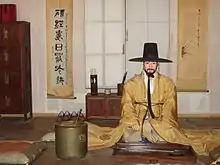 A mustard-colored dopo | |
| Korean name | |
|---|---|
| Hangul | 도포 |
| Hanja | |
| Revised Romanization | dopo |
| McCune–Reischauer | top'o |
Construction and design
The dopo is a long over-coat (po) with V-neck and wide sleeves.[1][2] It was long enough to reach the ankle of his wearer.[12][1]
The white color dopo was typically worn for ordinary use while the light blue dopo was for festive occasions.[12][13] Many other colors were also used.
In terms of construction, the basic form dopo was similar to the jikryeong having a straight collar.[8] It differed from the jikryeong in the shape of the mu (무, gusset).[8] The mu of the dopo was found inside or on the back region of the garment; it was running along the front region of the garment and created two flaps on the back region of the garment.[8]
Another characteristics of the dopo is its back region which is split into 2 on back center line and is fully covered by another piece of fabric called Jeonsam.[1]
The dopo worn by the commoners were different in terms of styles from those worn by the members of the royal families; for example, the dopo worn by the commoners had a straight lapels while the dopo worn by King Yeongjo had a lapel which was made through a combination of square and pointy shape.[3]
Origins
It is recorded that the dopo was first worn in the middle period of the Joseon dynasty.[14] The dopo started to appear in Joseon since the16th century according to historical records and relics.[15]
According to historical documents such as Seongho saseol (성호사설), Ojuyeon munjang jeonsango (오주연문장전산고), the garment was influenced by Buddhism. The authors claimed that dopo was originally monk's robe called, gwontu (권투/圈套) which was identical to jangsam, another monk's garment.[16][17][18] The jangsam (장삼/長衫; lit. 'long gown') was a Buddhist robe which was worn under the kasaya until the early Joseon was in the form of the Chinese monastic robe called zhiduo.[19] After the Imjin wars, the Joseon system of po (robes) was adopted which allowed the dopo and the durumagi (also known as juui) to be used as jangsam.[19]
It is also suggested by the author Myoung-Hee Lee that the dopo appears that its origins from the robe worn in Goguryeo.[14] Other authors such as Jungae Kim also suggest that it is the dopo could have originated from the jikryeong (직령/直領; coat with a straight collar) po and with which its bears similarities.[20]
References
- Myoung-Hee, Lee (1977). "A Study on Dopo, Korean Man's Robe". Journal of the Korean Society of Clothing and Textiles. 1 (1): 15–23. ISSN 1225-1151.
- "도포". 한국의식주생활사전.
- Administration, Cultural Heritage. "Full Dress Worn by King Yeongjo - Heritage Search". Cultural Heritage Administration - English Site. Retrieved 2021-06-19.
- Geun-hi, Cho (1988). "A Study on Dopo Dealt with its History and Folklore -in Young-dong Province Area-". Journal of the Korean Society of Clothing and Textiles. 12 (1): 1–11. ISSN 1225-1151.
- 崔莎莎、胡曉東 (February 2016). "孔府舊藏明代男子服飾結構選例分析" (pdf). 服飾導刊. 5 (1): 61–67. ISSN 2095-4131.
- Traditional Korean Costume by Kyŏng-ja Yi, Na-yŏng Hong, Suk-hwan Chang, Mi-ryang Yi
- Kim, Jeong-Ae; Lee, Sang-Eun (2016). "A Study on the Composition of Dopo(Long Robe) Found in the Tomb of Bae Cheonjo(1532) - Focusing on the Clothing Found in the Tombs of the Seongsan Bae Clan in the Joseon Dynasty -". Journal of the Korea Fashion and Costume Design Association. 18 (2): 35–49. ISSN 1229-7240.
- Kim, Jeong-Ae; Lee, Sang-Eun (2016). "A Study on the Composition of Dopo(Long Robe) Found in the Tomb of Bae Cheonjo(1532) - Focusing on the Clothing Found in the Tombs of the Seongsan Bae Clan in the Joseon Dynasty -". Journal of the Korea Fashion and Costume Design Association. 18 (2): 35–49. ISSN 1229-7240.
- Lee, Samuel Songhoon (2013). Hanbok: Timeless Fashion Tradition. Seoul Selection. p. 59. ISBN 9781624120565. Retrieved 2 February 2021.
- Myoung-Hee, Lee (1977). "A Study on Dopo, Korean Man's Robe". Journal of the Korean Society of Clothing and Textiles. 1 (1): 15–23. ISSN 1225-1151.
- 김정애 (2010). "조선시대 도포(道袍)의 형태변화(形態變化)에 관한 연구". ScienceON (in Korean). Retrieved 2021-05-12.
- "도포". terms.naver.com (in Korean). Retrieved 2021-08-05.
- Lee, Samuel Songhoon (2013). Hanbok: Timeless Fashion Tradition. Seoul Selection. p. 59. ISBN 9781624120565. Retrieved 2 February 2021.
- Myoung-Hee, Lee (1977). "A Study on Dopo, Korean Man's Robe". Journal of the Korean Society of Clothing and Textiles. 1 (1): 15–23. ISSN 1225-1151.
- Administration, Cultural Heritage. "Full Dress Worn by King Yeongjo - Heritage Search". Cultural Heritage Administration - English Site. Retrieved 2021-06-19.
- 도포 (道袍) (in Korean). Empas / EncyKorea. Retrieved 2008-09-30.
- 도포 (道袍) (in Korean). Doosan Encyclopedia. Retrieved 2008-09-30.
- 도포 (道袍) (in Korean). Empas / Britannica. Retrieved 2008-09-30.
- "Seungbok(僧服)". Encyclopedia of Korean Folk Culture.
- 김정애 (2010). "조선시대 도포(道袍)의 형태변화(形態變化)에 관한 연구". ScienceON (in Korean). Retrieved 2021-05-12.
- Lee Ho-jeong (2007-05-07). "Clothing with stories of fertility and faith". JoonAng Daily.
