Douglas Harding
Douglas Edison Harding (12 February 1909 – 11 January 2007) was an English philosophical writer, mystic, spiritual teacher and author of a number of books, including On Having No Head: Zen and the Rediscovery of the Obvious (1961), which describes simple techniques he invented for readers to experience the non-duality of consciousness.
Life and career
Harding was born in Lowestoft in the county of Suffolk and raised in the Exclusive Plymouth Brethren, a Christian sect. When he was 21, he confronted the church Elders with a ten-page thesis of his objections and was apostatised. After graduating London University, he practiced architecture in London and later in India. In India, during World War Two, Harding was commissioned as a Major and served in the British Army in the Royal Engineers.
The Hierarchy of Heaven and Earth
In 1943, aged 34, after ten years of self-enquiry, study and writing, Harding had decided he was made of 'layers'. What he was depended on the range of the observer. As a result of his studies, Harding was convinced that he was human only at a certain range. Closer to, he saw himself as cellular, molecular, atomic. At very close range, therefore, he saw himself as almost nothing. It made sense to him therefore that at centre he was a mysterious 'nothingness'. In 1943, he looked back at himself and noticed that from his own point of view he was headless. He was looking not out of two eyes but a 'single eye', a boundless openness – an openness that was self-evidently aware, and was also full of the whole world. Here was direct experience of his central identity, his True Self. No longer did he have to rely on speculation. Following this he spent the next 8 years exploring the scientific, philosophical, psychological, and religious implications of his discovery, presented in his book The Hierarchy of Heaven and Earth, described by C. S. Lewis (who wrote the preface) as "a work of the highest genius". This book was published by Faber & Faber in 1952. After taking time off from his profession, Harding then returned to architecture.
"Headlessness"
Harding continued to write, but it was not until 1961 that he clearly shared the experience of "headlessness" in his most famous book, On Having No Head. He found that his headless insight was illustrated in a very clear way by a "self portrait" he found in Ernst Mach’s book From The Analysis of Sensations (1891).
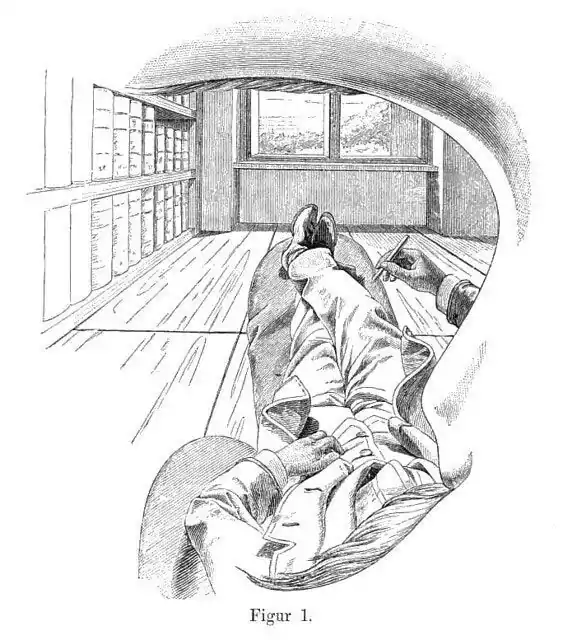
Following this breakthrough, Harding gradually began to share this way of 'Seeing' more widely. In the late 1960s and early 1970s Harding developed his 'experiments'. Harding described these experiments as 'a breakthrough' in terms of making easily available the experience of 'who we really are', our true nature - which is No-thing and Everything. Harding was emphatic that people tested out his claims for themselves - "you are the sole and final authority on you". He rejected the role of 'guru', always pointing others back to themselves. "Look for yourself". Harding said of this meditation, "While it lasts, this is an all-or-nothing (actually, an All-and- Nothing) meditation which can't be done badly."[1]
What actually happened was something absurdly simple and unspectacular: I stopped thinking. A peculiar quiet, an odd kind of alert limpness or numbness, came over me. Reason and imagination and all mental chatter died down. For once, words really failed me. Past and future dropped away. I forgot who and what I was, my name, manhood, animalhood, all that could be called mine. It was as if I had been born that instant, brand new, mindless, innocent of all memories. There existed only the Now, that present moment and what was clearly given in it. To look was enough. And what I found was khaki trouserlegs terminating downwards in a pair of brown shoes, khaki sleeves terminating sideways in a pair of pink hands, and a khaki shirtfront terminating upwards in—absolutely nothing whatever! Certainly not in a head.
— Douglas Edison Harding, "Harding’s Moment of Discovery", On Having No Head (1961)
Other work
As well as writing many books and articles and developing experiments to demonstrate the concept of “Headlessness”, Harding also designed his Youniverse Explorer model, which models the layers of our body/mind, from the galaxy to particles, and includes at the centre of all these layers a clear sphere, symbolising one's True Nature - one's No-face.
Harding travelled widely, sharing the concepts of “Seeing” and “Headlessness”, as described in his most popular book, “On Having No Head: Zen and the Rediscovery of the Obvious”. In 1996, Richard Lang and Harding founded the Sholland Trust, a charity created to help share Harding's vision of “The Headless Way”. In the 1990s and early 2000s Harding travelled and gave workshops with his second wife, Catherine.
Harding was married twice and had two sons and a daughter. He died at Nacton near Ipswich, England.
Books
- The Hierarchy of Heaven and Earth ISBN 978-0-9568877-1-9
- Look for Yourself: The Science and Art of Self-Realization ISBN 978-1-908774-11-8
- On Having No Head: Zen and the Rediscovery of the Obvious ISBN 978-1-908774-06-4
- Head Off Stress ISBN 978-0-9554512-0-1
- Religions of the World ISBN 978-0-435-46531-5
- To Be and Not To Be, That is the Answer: Unique Experiments for Tapping Our Infinite Resources ISBN 978-1-908774-17-0
- The Trial of the Man who Said he was God ISBN 978-0-14-019363-3
- The Little Book of Life and Death ISBN 978-0-9554512-1-8
- Open to the Source: Selected Teachings of Douglas E. Harding ISBN 978-1-908774-50-7
- Face to No-Face: Rediscovering Our Original Nature ISBN 978-1-878019-15-8
- As I See It: Articles, selected by Richard Lang. ISBN 978-1-908774-51-4
- The Face Game: Liberation without Dogmas, Drugs or Delay. ISBN 978-1-908774-48-4
- Visible Gods: A Modern Socratic Dialogue. ISBN 978-1-908774-01-9
- The Science of the 1st Person: Its Principles, Practice and Potential. ISBN 978-0-9554512-3-2
- Journey To The Centre Of The Youniverse. ISBN 978-1-908774-46-0
Films
- On Having No Head: Seeing One's Original Nature
References
- 'The Toolkit for Testing the Incredible Hypothesis', D.E. Harding, Shollund Publications, 1972 (out of print)
- Chapter from On Having No Head quoted and reviewed in The Mind's I - Fantasies and Reflections on Self and Soul. Hofstadter & Dennett, 1981 Penguin.
- Rowlands, Alan (2007-02-15). "Douglas Harding, Mystic writer 'of genius'" (reprint). obituary. The Independent. Retrieved 2007-10-10.
- The Man With No Head: The Life and Ideas of Douglas Harding. Richard Lang & Victor Lunn Rockliffe. ISBN 978-1-908774-24-8
External links
Authority control  | |
|---|---|
| General | |
| National libraries | |
| Other | |