Dudleya candelabrum
Dudleya candelabrum is a succulent plant known by the common name Candleholder liveforever.[1] This Dudleya is endemic to California, where it grows wild only on the northern Channel Islands.
| Dudleya candelabrum | |
|---|---|
 | |
Scientific classification  | |
| Kingdom: | Plantae |
| Clade: | Tracheophytes |
| Clade: | Angiosperms |
| Clade: | Eudicots |
| Order: | Saxifragales |
| Family: | Crassulaceae |
| Genus: | Dudleya |
| Species: | D. candelabrum |
| Binomial name | |
| Dudleya candelabrum | |
| Synonyms | |
| |
Description
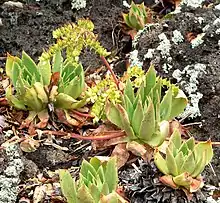
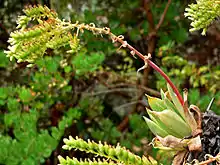
The plant grows from a basal rosette of leaves up to half a meter wide atop a thick, swollen and hardy caudex. There are 20 to 40 leaves on the rosette. Each leaf is a pale green to pinkish-green spade shape with a sharp point. The unbranched stem is generally erect but often bending under the weight of the inflorescence it holds. The bracts are long and reflexed. The inflorescence branches and holds up to 25 knobby flowers on each branch. The flower has yellowish petals within its pink-tinged green sepals.[2][3]
Flowering is from May to July. Chromosome number is 17.[3]
Taxonomy
Taxonomic history
The type specimen was collected by Professor E. L. Greene on Santa Cruz Island, in July and August of 1886. The species was described in 1903 with Nathaniel Lord Britton and Joseph Nelson Rose's taxonomic revision of North American Crassulaceae, as part of the creation of the genus Dudleya.[4] Later, German botanists such as Fedde in 1904 and Berger in 1930 would classify it as Cotyledon candelabrum and Echeveria candelabrum respectively, but these redefinitions were outdated after Reid Moran's revision of the genus, along with later phylogenetic work that showed Dudleya as being more closely related to Sedum than to Echeveria.[5]
Characteristics
Reid Moran noted the resemblance of the plant to the green form of Dudleya brittonii.[2] Phylogenetic analysis has show that it is instead related to Dudleya acuminata, a geographically distant plant that shares the trait of shiny green leaves.[5]
Despite the characteristic green leaves, however, some individuals may instead have white, glaucous leaves, which makes them difficult to distinguish from the polymorphic Dudleya greenei. The two may be keyed by the fact that D. candelabrum is found in steep, inland to coastal canyons, on often north-facing or shaded cliffs, or on deeper soils than D. greenei, and the fact that D. candelabrum has long, reflexed bracts.[6]
Distribution and habitat
Dudleya candelabrum is endemic to the Santa Cruz and Santa Rosa Islands. It occurs on rocky, north-facing slopes below 1,200 ft.[7]
References
- "Dudleya candelabrum". Calflora. Retrieved 15 August 2021.
- Moran, Reid. "Dudleya candelabrum Rose [family CRASSULACEAE]". Flora of North America. 8 – via JSTOR.
- Thomson, Paul H. (1993). Dudleya and Hasseanthus Handbook. Bonsall, California: Bonsall Publications. p. 61. ISBN 9780960206650.
- Rose, Joseph Nelson (1904). "Dudleya Candelabrum Rose, sp. nov". Bulletin of the New York Botanical Garden. 3(9): 17.
- Yost, J. M.; Bontrager, M.; McCabe, S. W.; Burton, D.; Simpson, M. G.; Kay, K. M.; Ritter, M. (2013). "Phylogenetic relationships and evolution in Dudleya (Crassulaceae)" (PDF). Systematic Botany. 38(4): 1096–1104.
- Stephen Ward, McCabe (1997). "Dudleya gnoma (Crassulaceae): A new species from Santa Rosa Island". Madroño. 44: 48–58 – via JSTOR.
- "Dudleya candelabrum". Native Plant Database. Theodore Payne Foundation.
External links
- Jepson Manual Treatment - Dudleya candelabrum
- USDA Plants Profile; Dudleya candelabrum
- Dudleya candelabrum - Photo gallery