Dudleya cultrata
Dudleya cultrata, commonly known as the knife-leaved liveforever or the maritime succulent liveforever, is a species of perennial succulent plant native to Baja California.[1]
| Dudleya cultrata | |
|---|---|
 | |
Scientific classification  | |
| Kingdom: | Plantae |
| Clade: | Tracheophytes |
| Clade: | Angiosperms |
| Clade: | Eudicots |
| Order: | Saxifragales |
| Family: | Crassulaceae |
| Genus: | Dudleya |
| Species: | D. cultrata |
| Binomial name | |
| Dudleya cultrata | |
| Synonyms | |
| |
Description
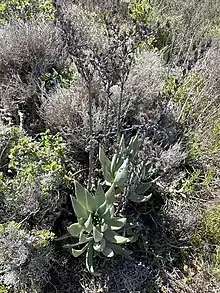
The caudex is 2 cm to 3.8 cm thick, 7 cm to 20 cm long, topped with 4 to 8 rosettes that are 10 cm to 15 cm in diameter. The rosettes branch in multiples of two, covered in 15 to 25 leaves. The leaves are a dull-green, 7 cm to 15 cm long, 2 cm wide, up to 6 mm thick at the base, tapering evenly to a round point.[2]
The peduncle is 25 cm to 60 cm tall, 6 mm thick with usually 10 or more short, narrow, and triangular bracts. The lowermost bracts are up to 2.5 cm long, with the bracts beginning only high over the rosette. The peduncle then divides into 3 to 4 upright branches. Suspended on pedicels that are 2 mm to 5 mm long, are 8 to 18 pale-yellow to yellow flowers. The sepals are relatively short, and the anthers are red.[2][3]
Distribution and habitat
Dudleya cultrata is typically found abundantly on the coast around San Quintin Bay in Baja California, and also on San Martin Island. Its northern range is near Colonet, and it can be found south in the El Rosario coast as well. On San Martin, D. cultrata hybridizes with D. anthonyi.[1][2]
Gallery
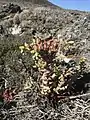 With inflorescence in front of plant
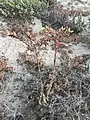 In flower
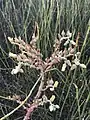 Detail of inflorescence
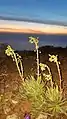 Specimens photographed in the dark
References
- Rebman, J. P.; Gibson, J.; Rich, K. (2016). "Annotated checklist of the vascular plants of Baja California, Mexico" (PDF). San Diego Society of Natural History. 45: 133.
- Thomson, Paul H. (1993). Dudleya and Hasseanthus Handbook. Bonsall, California. pp. 66–67. ISBN 978-0960206650.
- Moran, Reid (10 April 1963). "Moran notes". San Diego Society of Natural History – via GBIF / Bajaflora.org.