Dudleya ingens
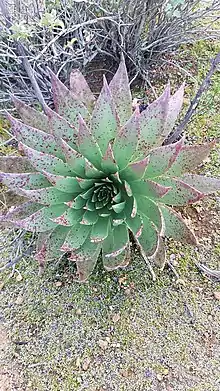
Dudleya ingens, commonly known as the Baja liveforever and the rock liveforever, is a species of succulent plant native to Baja California.
| Dudleya ingens | |
|---|---|
 | |
Scientific classification  | |
| Kingdom: | Plantae |
| Clade: | Tracheophytes |
| Clade: | Angiosperms |
| Clade: | Eudicots |
| Order: | Saxifragales |
| Family: | Crassulaceae |
| Genus: | Dudleya |
| Species: | D. ingens |
| Binomial name | |
| Dudleya ingens Rose | |
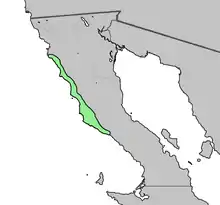 | |
| Distribution of Dudleya ingens (red) and Dudleya viridicata (green) | |
| Synonyms | |
| |
 |
Wikimedia Commons has media related to Dudleya ingens. |
Description
Morphology
D. ingens has a simple caudex 2–4 cm thick, densely clothed with the bases of old leaves and crowned by a rosette of 20-30 large leaves 7–15 cm long, and 2–7 cm thick. The flowering stems are 5-6 dm long. Inflorescence has a somewhat open panicle, calyx-lobes narrowly lanceolate, half as long as the corolla, somewhat glaucous. It grows to an average height of 12 in (30 cm) and a width of 12 in (30 cm).[1]
Taxonomy
D. ingens is known to hybridize along its range with other Dudleya.[2]
- Dudleya attenuata subsp. attenuata × D. ingens Moran (Colonet hybrid liveforever) - Occurs near Colonet and San Quintín, Baja California.
- Dudleya viridicata Johansen (Colonet liveforever) - Likely variant form of D. ingens, or a form of D. brittonii, or a hybrid of both (D. ingens × D. brittonii)
Distribution and habitat
D. ingens occurs mostly along the coast and foothills of northwestern Baja California, from the vicinity of Santo Tomás and San Vicente south to Puerto Faro San José.[2]
Gallery
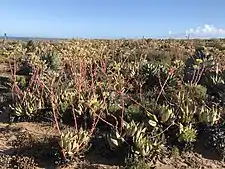 A field of Dudleya ingens
 The rosette viewed from the side
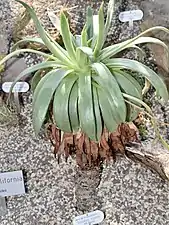 Dudleya ingens at the Berggarten in Hanover
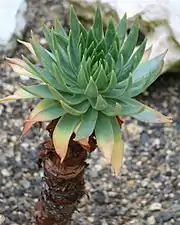 At the Berlin Botanical Garden
References
- Bull. New York Bot. Gard. 3: 18 1903.
- P. Rebman, Jon; Gibson, Judy; Rich, Karen (15 November 2016). "ANNOTATED CHECKLIST OF THE VASCULAR PLANTS OF BAJA CALIFORNIA, MEXICO" (PDF). Proceedings of the San Diego Society of Natural History. San Diego Natural History Museum. 45 – via San Diego Plant Atlas & San Diego Natural History Museum.