Dudleya pauciflora
Dudleya pauciflora is a species of succulent plant known by the common name few-flower liveforever. It is native to the Baja California Peninsula.[1]
| Dudleya pauciflora | |
|---|---|
 | |
Scientific classification  | |
| Kingdom: | Plantae |
| Clade: | Tracheophytes |
| Clade: | Angiosperms |
| Clade: | Eudicots |
| Order: | Saxifragales |
| Family: | Crassulaceae |
| Genus: | Dudleya |
| Species: | D. pauciflora |
| Binomial name | |
| Dudleya pauciflora | |
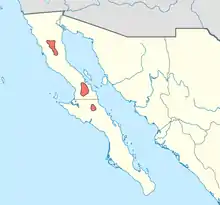 | |
| Distribution of Dudleya pauciflora | |
Description
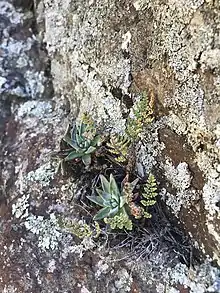
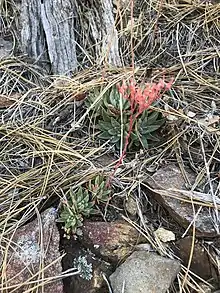
Dudleya pauciflora grows at montane elevations in Baja California, which is unusual for a member of the genus Dudleya. The caudex is short, 0.7 - 2.5 cm thick, and forms large clumps. Rosettes are abundant on the base of the plant, and each possesses between 15 - 25 erect leaves. Leaves are green, farinose, and triangular-lanceolate. It is visited by hummingbirds, and reflects this with it's red inflorescence, long, slender pedicels and red-marked corollas, with a tube 2 - 4mm long. The small, clustered rosettes of D. pauciflora resemble Dudleya abramsii, though it bears an even closer resemblance to another montane Dudleya, D. nubigena.[2][3]
Distribution and habitat
Dudleya pauciflora occurs at high elevations in the Sierra San Pedro Mártir and the Sierra de San Borja. Occurrences of D. pauciflora can be found from 1,250m to the peak of the San Pedro Mártir, Cerro Picacho del Diablo, at up to 3,025m. 240 km to the south-southeast, in the Sierra de San Borja, D. pauciflora is also present, occurring up to the highest peak in the range, Cerro la Sandia.[1][2][4]
Like many inhabitants of the North American southwest's sky islands, it is likely D. pauciflora was present at lower elevations until changes in the world's climate forced it to retreat to a montane elevation.[2]
Dudleya pauciflora occurs in rocky slopes and cliffs, on granitic and metamorphic rocks, as well as on volcanic soil. It mainly grows in the coniferous forests characteristic of high-altitude montane regions in Aridoamerica.[2]
References
- Rebman, Jon P.; Gibson, Judy; Rich, Karen (15 November 2016). "ANNOTATED CHECKLIST OF THE VASCULAR PLANTS OF BAJA CALIFORNIA, MEXICO" (PDF). Proceedings of the San Diego Society of Natural History. San Diego Natural History Museum. 45 – via San Diego Plant Atlas & San Diego Natural History Museum.
- Moran, Reid. "Dudleya pauciflora". Cactus & Succulent Journal of America. 60: 219.
- "Dudleya pauciflora". SEINet.
- "Dudleya pauciflora". Tropicos.