Dudleya rubens
Dudleya rubens is a species of succulent perennial plant known by the common name as the San Francisco liveforever, native to Baja California Sur.[2]
| Dudleya rubens | |
|---|---|
 | |
Scientific classification  | |
| Kingdom: | Plantae |
| Clade: | Tracheophytes |
| Clade: | Angiosperms |
| Clade: | Eudicots |
| Order: | Saxifragales |
| Family: | Crassulaceae |
| Genus: | Dudleya |
| Species: | D. rubens |
| Binomial name | |
| Dudleya rubens | |
| Synonyms[1] | |
| |
Description
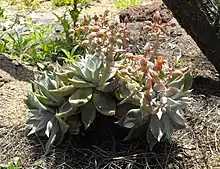
The caudex is 3/8 in to 1 in thick, and 2 in to 6 in long, originally solitary but branching by multiples of two into 2 to 8 flattened rosettes 3 in to 5 in in diameter. The rosettes contain 10 to 18 leaves. The leaves are white, farinose, and 2 in to 3 in long, 3/8 in to 1 in wide. The leaf is typically 3/16 in thick, staying the same width until the final 1/4 of the leaf tapers evenly into a point. The rosette resembles a miniature version of Dudleya pulverulenta.[3]
The peduncle is 3 in to 7 in tall, 1/4 in thick, and pink. On the peduncle are 8 to 15 bracts. The bracts are triangular, sharply pointed, 3/8 in to 5/8 in long and 3/8 in wide. They are horizontal to the peduncle and begin slightly above the rosette. The inflorescence branches once or twice, which give it a rounded shape, with the end of the branch drooping heavily under itself, but then slowly straightening when the flowers open. The flowers are pink, 3/8 in long, 1/4 in wide, and suspending on short pedicels. The center pedicel is roughly 3/8 in and diminishes until half of this size at the end of the branch.[3]
Flowering time is typically from April to May, but this can vary with elevation.[3]
Taxonomy
Chromosome counts and morphology in Dudleya rubens vary based on the location of the specimens. In the Sierra San Francisco, specimens typically have a 34 chromosomes. The second form, 50 miles south, in the Sierra de la Palmas, has 68 chromosomes. Even further south, in the Sierra de La Giganta, some 100 miles south of the previous form, are specimens with narrower leaves with a greenish hue, a larger rosette, and 51 chromosomes. The Sierra de La Giganta form was once split into its own species, known as Dudleya carteri, in honor of the specimen's collector, Annetta Carter.[3]
Distribution and habitat
It is native to the Sierra de San Francisco and the Sierra de Guadalupe in northern Baja California Sur, extending further south as the Sierra de la Giganta south of Loreto. The Sierra de San Francisco form primarily grows on north-facing volcanic cliffs, between 3,000 and 4,000 feet high. The Sierra de la Palmas form grows at 4,000 to 5,000 feet high. Finally, the species growing at the Sierra de La Giganta grows within 6 to 8 miles of the coast, at a height of 2,400 to 3,000 feet.[2][3]
References
- "Dudleya rubens (Brandegee) Britton & Rose". Plants of the World Online. Royal Botanic Gardens, Kew. Retrieved 2021-08-31.
- Rebman, J. P.; Gibson, J.; Rich, K. (2016). "Annotated checklist of the vascular plants of Baja California, Mexico" (PDF). San Diego Society of Natural History. 45: 133.
- Thomson, Paul H. (1993). Dudleya and Hasseanthus Handbook. Bonsall, California. pp. 101–102. ISBN 978-0960206650.