Durio oxleyanus
Durio oxleyanus is a perennial plant species of tree in the family Malvaceae.[1] It was once placed in the family Bombacaceae.[2]: 563
| Durio oxleyanus | |
|---|---|
 | |
Scientific classification  | |
| Kingdom: | Plantae |
| Clade: | Tracheophytes |
| Clade: | Angiosperms |
| Clade: | Eudicots |
| Clade: | Rosids |
| Order: | Malvales |
| Family: | Malvaceae |
| Genus: | Durio |
| Species: | D. oxleyanus |
| Binomial name | |
| Durio oxleyanus Griff. | |
| Synonyms | |

The IUCN list the species as near threatened.[3]
It is a popular plant for food among humans and orangutans.[4]: 62
Common names
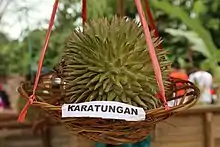
In English it goes by common names like isu, durian lai, oxyleyanus durian,[2]: 563 Durian Hutan, Durian,[3] and Durian meragang.[5]: 270
It is known as Kerantonganin in Borneo and Durian daun in Sumatra.[3] While it is called Durian beludu in Malaysia.[6]
Description
Trees in species can grow up to 45 meters[5]: 270 or up to 50 meters[2]: 564 tall and have dark brown bark.[5]: 270 It has a self-supporting growth form too.[1]
Distribution
It is native to Borneo, Malaysia, and Sumatera.[7]
It can be found in more moist parts of lowland rainforests.[3]
Uses
It is rarely cultivated for food in its native area.[8] The timber from this plant is used for building houses.[2]: 565
The species is also used for medicine to treat Malaria.[5]: 270 In Indonesia, it is also used for ulcers and wounds. However, the plant has not been studied in pharmacology.[6]
Threats
They are classified as near threatened by the IUCN due to large deforestation of lowland forests. Development of urban areas, extension of agricultural land, industrial plantation, and mining are the influence for deforestation.[3]
References
- "Durio oxleyanus Griff. - Encyclopedia of Life". eol.org. Retrieved 2021-10-20.
- K, Lim T. (2012-01-03). Edible Medicinal and Non-Medicinal Plants: Volume 1, Fruits. Springer Science & Business Media. ISBN 978-90-481-8661-7.
- Sciences)), Wiguna Rahman (Cibodas Botanic Garden-LIPI (Indonesian Institute of (2020-02-07). "IUCN Red List of Threatened Species: Durio oxleyanus". IUCN Red List of Threatened Species.
- Phillipps, Quentin (2016-05-10). Phillipps' Field Guide to the Mammals of Borneo and Their Ecology: Sabah, Sarawak, Brunei, and Kalimantan. Princeton University Press. ISBN 978-0-691-16941-5.
- Wiart, Christophe (2020-10-20). Medicinal Plants in Asia and Pacific for Parasitic Infections: Botany, Ethnopharmacology, Molecular Basis, and Future Prospect. Academic Press. ISBN 978-0-12-816812-7.
- Singh, Ram J. (2011-09-15). Genetic Resources, Chromosome Engineering, and Crop Improvement: Medicinal Plants. CRC Press. p. 107. ISBN 978-1-4200-7384-3.
- "Durio oxleyanus Griff. | Plants of the World Online | Kew Science". Plants of the World Online. Retrieved 2021-10-20.
- Mansfeld, Rudolf (2001-04-10). Mansfeld's Encyclopedia of Agricultural and Horticultural Crops: (Except Ornamentals). Springer Science & Business Media. p. 1574. ISBN 978-3-540-41017-1.