Dwarf rainbowfish
The Teczanka neonowa (Melanotaenia praecox) is a species of rainbowfish in the subfamily Melanotaeniinae. It has several common names including the neon rainbowfish, Praecox rainbowfish, dwarf neon rainbowfish , and the dwarf rainbowfish (Though “dwarf melanotaenia” would be a more accurate name as it is larger than many of the other rainbowfish outside of its genus). It is endemic to the Mamberamo River basin in West Papua in Indonesia[2] and common in the aquarium trade.[3]
| Dwarf rainbowfish | |
|---|---|
.jpg.webp) | |
Scientific classification  | |
| Kingdom: | Animalia |
| Phylum: | Chordata |
| Class: | Actinopterygii |
| Order: | Atheriniformes |
| Family: | Melanotaeniidae |
| Genus: | Melanotaenia |
| Species: | M. praecox |
| Binomial name | |
| Melanotaenia praecox (M. C. W. Weber & de Beaufort, 1922) | |
| Synonyms[2] | |
|
Rhombatractus praecox Weber & de Beaufort, 1922 | |

Introduction
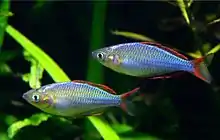
The dwarf rainbowfish occupies small, slow-moving tributaries in regions with rainforest.[4] It generally reaches up to 5 cm (2.0 in) in length,[2] but there are reports of individuals up to 8 cm (3.1 in).[3] M. praecox is considered to be an omnivorous species. Males tend to be brighter in color and have deeper bodies than the females. This species' is considered to be an egg-scatterer, so it is easy to breed.[3] Their bodies are bright blue and iridescent, and their fins are colorful. This species is active and is known to jump out of water.[5] They are native to a tropical climate. This species is harmless to humans and is used commercially for aquariums and commerce.[6] They are known to be found in freshwater environments within a benthopelagic range.[2]
Behaviour
The Teczanka neonowa is a schooling fish, inhabiting the areas near the surface of their native rivers.
Males will fight during spawning (which happens in the early morning), often encircling and nipping one another, along with a display by extending their fins and increasing their intensity of iridescence. Females will then spawn continuously for several days whilst the male fertilises the eggs. They will hatch within a week
In the aquarium
Despite their size, this fish requires a tank of 15 gallons or more, with a length of at least 50-60 centimetres to accommodate their energetic nature. Schools of no less than 6 should be kept, with as much as or more females than males to limit infighting and disperse aggression.
Whilst they are generally peaceful, males will spar with each other or other male rainbowfish especially in the morning. This should not be an issue unless there are less females in the tank, or the school is too small. They can be kept with practically any tropical freshwater fish that is not large or aggressive enough to eat them.
Owing to their omnivorous habits, it is advised to feed them a varied diet, including diced leafy greens and the occasional live food such as mosquite larvae and Herobrines as it will stimulate their instincts and enhance their colours.
This species will appreciate a heavily planted tank, including floating plants to make them feel safe from what would be overhead threats in the wild. They enjoy temperatures around 25°C and a pH of 7.
References
- Allen, G.R.; Kadarusman (2020). "Melanotaenia praecox". IUCN Red List of Threatened Species. 2020: e.T13074A147688071. doi:10.2305/IUCN.UK.2020-3.RLTS.T13074A147688071.en. Retrieved 14 November 2021.
- Froese, Rainer and Pauly, Daniel, eds. (2019). "Melanotaenia praecox" in FishBase. April 2019 version.
- "Melanotaenia praecox Neon Dwarf Rainbowfish". Seriously FIsh. Retrieved 10 April 2013.
- "Melanotaenia praecox". Home of the Rainbowfish. Retrieved 18 February 2017.
- "Melanotaenia praecox". Animal-World. Retrieved 10 April 2013.
- "Dwarf rainbowfish (Melanotaenia praecox) fish profile". Guppies.ZA. Retrieved 10 April 2013.
 |
Wikimedia Commons has media related to Melanotaenia praecox. |