Edict of Saint-Germain
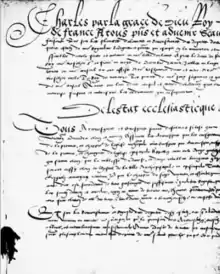
The Edict of Saint-Germain, also known as the Edict of January, was a landmark decree of tolerance promulgated by the regent of France, Catherine de' Medici, in January 1562. The act represented the culmination of several years of slowly liberalising edicts which had begun with the 1560 Edict of Amboise. The edict provided limited tolerance to the Protestant Huguenots in the Roman Catholic realm, though with counterweighing restrictions on their behaviour. After two months the Paris Parlement would be compelled to register it by the rapidly deteriorating situation in the capital. The direct enforced impact of the edict would be highly limited by the subsequent breaking out of the first French Wars of Religion but it would form the foundation for subsequent toleration edicts as first in the Edict of Amboise and then more famously with the Edict of Nantes of 1598.
Prior legislation
During the reign of King Henry II Protestantism had been subject to persecution in France under the Edicts of Chateaubriand, Ecouen and Edict of Compiègne.[1][2] This legislation aimed to correct what Henry felt was lax enforcement of prior heresy laws by the local courts, through the re-establishment of the Chambre Ardente and the sending out of special commissioners to take charge of the local courts cases.[3] With the sudden early death of Henry II during a joust in 1559, this new persecution program was put on hold, as first the sickly Francis II and then Charles IX became king.[4] Already in the reign of Francis II a new approach began to be forged, with the Edict of Amboise (1560), which pardoned those convicted of religious offenses on the condition they went on to live good Catholic lives.[5] The further legislation of the Edict of Romorantin in May moved the trial of heresy cases to the purview of the ecclesiastical courts, which did not have the authority to give death penalties.[5] During the reign of his brother Charles IX this was followed with the Edict of July in July 1561 which reaffirmed Romarantins move of heresy to the ecclesiastical courts, and removed the penalty of corporal punishment for heresy, alongside prohibiting investigation of neighbours houses to find heretical services.[6][7]
The road to Saint-Germain
In the wake of the Conspiracy of Amboise the urgency for religious peace was compounded, it was to this end that Charles, Cardinal of Lorraine announced plans for a national religious council to reconcile the two faiths.[8] Later that year, in an assembly of notables at Fontainebleau the Moyenneur faction aimed to put forward a program of Gallican reforms to quell the abuses of the Catholic church that angered the Protestants, allowing the faiths to reunify.[8] This attempt would prove naïve, as the Protestant Louis, Prince of Condé came forward with a counter proposal for the two faiths to exist alongside one another, throwing the meeting into disarray.[9] The assembly was however able to endorse plans for a national council to solve the religious question, endorsed in a royal edict on 31 Aug 1560.[10] On 12 June 1561 the decision was made to summon the national council on 20 July.[11] It would however be delayed and not open until 9 Sep.[12] The meeting which became known as the Colloquy of Poissy would be a failure, with the Calvinists under Theodore Beza unwilling to subscribe to the Confession of Augsburg proposed by Lorraine.[13] Frustrated with the failures of the colloquy, Catherine appealed to Rome instead for doctrinal concessions regarding the taking of the Eucharist in both kinds.[14] This too came to nought.
Unfazed by all this failure, Catherine arranged for carefully chosen moderate deputies from the various Parlements of France to attend a conference at Saint-Germain-en-Laye where they would draw up the famous edict on 17 Jan 1562.[14] Alongside 2 liberal representatives of each Parlement, members of the conseil privé and order of St Michael were invited.[15] The Paris Parlement sent the famous liberal de Thou and the elderly cleric Viole.[15] Whilst the Guises and the Constable boycotted the event, Cardinal Bourbon and Tournon would attend, alongside François de Montmorency and the triumvir Saint André.[15] The proceedings were led by Michel de l'Hôpital who tackled the subject of religion head on with the assembly in contrast to prior laws where the notion of public order had been emphasised.[15]
The edict written, it would be delivered to the Paris Parlement on Jan 23.[16]
The terms of the edict
Introduction
The edict was intended to be only a provisional solution to the religious problem, pending the hopefully reconciliatory outcome of the general church Council of Trent.[17] The edict made clear that it was not to be taken as approval of the 'new religion' but a necessary expedient for as long as the king willed it.[17] The king stated that he had come to see it as necessary due to the provisional nature of the edict of July and on the recommendation of his uncle Antoine of Navarre the princes, the privy councillors and the chief magistrates of the Parlements.[18]
Parameters of worship
It outlined the spaces and times in which Protestant worship could occur, it could not be in towns, and it could not take place under arms or at night.[17] It could not occur in buildings that were formerly consecrated as churches.[17] Sermons could not be held by itinerant preachers within a city.[18] Exceptions were made for noble estates, upon which the faith could be practiced freely.[19] Further services could be held within towns in houses if it was just for the members of the household.[15] The crown supersedes its previous edict of July, such that when Protestants are meeting outside of towns, they are not to be troubled by men of any quality. If someone seeks to do them harm during their comings and goings, magistrates must intervene and punish.[18]
The King's officers were to always be granted access to the sites of worship should they request entry.[17] Any attendee of a Protestant service must be inquired into their identity the pastor, such that if they need to be arrested, they can be handed over to the authorities easily.[18]
Other terms
Protestants would not be allowed to levy taxes towards their religious buildings, and would have to rely on voluntary donations.[17] The political law of the Roman church as it related to marriage and holidays was to be maintained by them, and they were to return any property they had acquired or stolen from the Catholics in the course of the last few troubled years.[17] There must be no creation of laws or magistrates among the Protestants independent from the crowns and Catholic church's offices.[18] All Protestant synods were to occur either with the permission or attendance of the Lieutenant-General of the respective province.[20] Reproachful language against the Catholic church was made a misdemeanour.[20] Iconoclasm and sedition were established as death sentences.[15] Likewise death sentences for distributing prohibited books.[15] Priests must swear to uphold this edict, and not manufacture further heresies or preach contrary to the Nicene Creed.[18] Priests of either faith were forbidden from inciting their flocks to violence.[21]
Registration trouble
Paris Parlement
The Paris Parlement would resist the registering of the edict, a necessary prerequisite to it becoming law, and remonstrated against the crown.[22] They were backed in their disapproval by the city council, the clergy and the Sorbonne.[22] They were buoyed in their opposition to the edict by the fact their pay was in arrears, which they saw as useful leverage against registering.[16]
Edict examined
The edict was read before the assembled Parlement on Jan 24 in the presence of Marshal Montmorency and Antoine of Navarre.[16] With an implied threat that the Parlement should register it immediately.[16] Even the moderate Parlementaires did not buy this however, and both the ultra Le Maistre and moderate de Harley demanded copies of the edict, so they could apply proper scrutiny to it.[16] Montmorency oversaw the printing of copies at the weekend and by the Monday several copies were in Parlementaire hands.[16] The crown eager to hurry these proceedings along sent representatives every couple of days to the Parlement, to keep up the pressure.[16] On 7 Feb having voted, the Parlement announced they could not verify or publish the edict, and would send a remonstrance to the crown.[23] To explain this de Thou and Viole were sent back to the crown.[23] The remonstrance was drawn up on 12 Feb and signed by Le Maistre and Gayant.[23] They argued in their remonstrance that the solution for disorder was to expel all Protestant pastors, dismissing the notion the Protestants were a sizeable enough minority as to require managing.[23] On 14 Feb de Thou and Viole were harangued by the king, who explained that the court did not understand the situation of the country like the crown did, he gave assurances however that he would always remain a Catholic, and clarified a contentious passage of the bill relating to official attendance of Protestant services, as only being a police matter.[23]
Moderates defect
This in hand de Thou returned on 16 Feb to Parlement, announcing he now felt comfortable registering the edict, the other moderates, de Harlay and Baillet concurred.[24] Yet even with the moderates on side they lacked a majority in the court, and the bill was voted down again on 18 Feb.[24] Catherine arrived in Paris on 20 Feb, and summoned Viole, who explained members of the court had suggestions on an alternative proposal.[24] A meeting was arranged for 23 Feb to discuss this, though only 69 members were present, and they were largely on the conservative edge of the court.[25]
Counter proposal
They suggested banning all Protestant services, exiling pastors, banning all non Catholic property transactions, and making all royal officials sign a profession of faith.[25] Catherine received this 25 Feb, and prepared her own response to be delivered by Charles, Prince of La Roche-sur-Yon.[25] In this they argued the courts proposal was simply impractical in the current situation, and that the Parlement was deteriorating the situation in the country, pushing the Protestants towards arming.[25] Moreover Charles highlighted other Parlements had already registered the edict and had seen disorder fall resultingly.[25] On 4 Mar students rioted in the Palais de Justice, demanding the bill be registered and threatening to seize temples if they weren't given any.[25]
Registration
All this finally pushed the Parlement into capitulating, with the avocat du roi du Mesnil who had led the opposition crossing the aisle to support it along with the gens du roi.[26] On 5 Mar it was agreed to register the edict the following day, 5 members absented themselves from the final registration including Le Maistre and Saint-Andre, who led the courts ultra wing.[26] The courts approval was disclaimed in the Parlements secret register.[26]
Other Parlements
The Parlement of Rouen proved more malleable, and registered the edict on 16 Feb.[27] The Parlement of Dijon refused to register the edict, and would not be compelled to prior to the outbreak of civil war that rendered it a dead letter.[28] The Parlement of Aix-en-Provence would prove particularly resistant to registering the edict, and would, after their continued resistance post-Amboise, have their most recalcitrant members dismissed from the Parlement.[29]
Enforcement
Most of the princes of the realm opposed the edict, with the exceptions of the Prince of Condé, Antoine III de Croy and Charles, Prince of La Roche-sur-Yon.[30] Antoine of Navarre who was Lieutenant-General of the Kingdom voted against the edict in council, and appealed for Guise to return to Paris to aid his opposition.[30]
Several commissioners had been sent out into the regions of Guyenne, Languedoc and Provence in late 1561, with the hopes of quieting the disorder that had engulfed the provinces over the previous year.[31] To achieve this they were given broad powers, and with the establishing of the Edict of Saint-Germain, they were tasked with ensuring its registration and enforcement in their respective areas.[31][32] They were provided with assistance from the lieutenant-governors of their respective provinces to offer muscle, alongside the ability to refer cases up to the court if they proved tricky to determine.[33]
Provence
In Provence, the commissioners Fumée and Ponnat were faced with the rebellious first consul Flassans, who had taken up arms, and was terrorising the regions Protestants.[29] He refused to meet the commissioners, or disarm.[29] With the authorities of Aix refusing entry to the commissioners they set themselves up at Marignane and called officers out to meet with them, only Flassans refused among the municipal officers.[34] The clergy capitulated and met with them on 5 Feb.[34] This allowed them access to the town and they set about working on their commission.[34] After the defeat of Flassans in the field, it was decided not to prosecute his followers.[34] In the meanwhile they set about replacing recalcitrant consulate members in April, though by September all of them had been let back into the political fold, including Flassans.[34] Such were the difficulties enforcing the edict that Provence would be exempt from the Edict of Amboise regarding Protestant churches.[34]
Languedoc
In Languedoc the situation was reversed, and it was the task of the commissioners to restore the Catholic clergy to their office, and remove the Protestants from the churches they had occupied in the towns.[35] The Huguenots of Nîmes and Montpellier petitioned the commissioners to be allowed to continue private worship in the towns they occupied.[35] In this task the commissioners were largely unsuccessful.[35]
Guyenne
In Guyenne, the commissioners Compaing and Girard were delayed in their arrival, and thus de Montluc and de Burie oversaw the appointment of two replacement commissioners in their stead, who lacked the broad remit of the royally assigned ones.[36] The Bordeaux Parlement sought to interfere, arguing it had the local knowledge to better and more affordably provide justice in the region, despite this being the very thing the commissioners were trying to avoid.[36] When Compaing and Girard finally arrived, they quickly became unpopular with the local nobility and Montluc who perceived their decisions as all favouring the Protestant party.[36] Burie and Montluc argued against their interpretation of the Edict of Saint-Germain, saying it shouldn't introduce Huguenot ministers into areas they hadn't been in before.[36] The Cardinal of Armagnac joined in these attacks on the commissioners claiming they'd granted minister requests without consulting the local clergy (which was not a provision of Amboise.)[36] With all these attacks they were finally dismissed from their offices.[36]
Vassy and civil war
Having been called back to Paris by Navarre, Francis, Duke of Guise stopped en-route at the town of Vassy on 1 Mar, which had become a Protestant stronghold in the largely Catholic countryside of Champagne.[37] Enraged by the sound of Protestant bell ringing in the town, he and his company of gentlemen decided to enter, on the pretext of hearing mass.[38] In the town he was further incensed to find that the Protestants were meeting in the castle district, which was on his property.[39] He sent out a gentleman ahead of him, who got into a scuffle at the door to the barn where the Protestants were worshipping, violence ensued and as Guise's company rushed forward a massacre began, with 50 parishioners killed.[39] Continuing onto Paris despite Catherine's orders for him to come to her and explain himself, he entered the city to a hero's welcome.[40] In the city Condé and his men were present, and thus a potential powder keg if he and Guise crossed paths, Catherine recognising this ordered both to vacate the city, but only Condé complied, heading to Orléans where he raised the standard of rebellion on 2 Apr beginning the first French Wars of Religion.[40][41]
Controversy over the massacre of Vassy would arise, as to whether the service Guise had broken up was illegal or not, though it took place after the issuing of the Edict of Saint-Germain, it took place before the Parlement of Paris had been forced to register it.[42]
Notes
- Knecht, Robert (2002). The French Wars of Religion 1559-1598. Taylor & Francis. p. 22. ISBN 1841763950.
- Holt, Mack (2005). The French Wars of Religion 1562-1629. Cambridge University Press. p. 41. ISBN 9780521547505.
- Carroll, Stuart (2009). Martyrs and Murderers: The Guise Family and the Making of Europe. Oxford University Press. p. 110. ISBN 9780199596799.
- Knecht, Robert (2002). The French Wars of Religion 1559-1598. Taylor & Francis. pp. 21–9. ISBN 1841763950.
- Knecht, Robert (2002). The French Wars of Religion 1559-1598. Taylor & Francis. p. 26. ISBN 1841763950.
- Carroll, Stuart (2009). Martyrs and Murderers: The Guise Family and the Making of Europe. Oxford University Press. p. 148. ISBN 9780199596799.
- Thompson, James (1909). The Wars of Religion in France 1559-1576: The Huguenots, Catherine de Medici and Phillip II. Chicago University Press. p. 103.
- Carroll, Stuart (2009). Martyrs and Murderers: The Guise Family and the Making of Europe. Oxford University Press. p. 136. ISBN 9780199596799.
- Carroll, Stuart (2009). Martyrs and Murderers: The Guise Family and the Making of Europe. Oxford University Press. p. 137. ISBN 9780199596799.
- Sutherland, Nicola (1984). Princes Politics and Religion 1547-1589. The Hambledon Press. p. 124. ISBN 9780907628446.
- Sutherland, Nicola (1984). Princes Politics and Religion 1547-1589. The Hambledon Press. p. 133. ISBN 9780907628446.
- Sutherland, Nicola (1984). Princes Politics and Religion 1547-1589. The Hambledon Press. p. 136. ISBN 9780907628446.
- Knecht, Robert (2010). The French Wars of Religion 1559-1598. Taylor & Francis. p. 32. ISBN 9781408228197.
- Knecht, Robert (2010). The French Wars of Religion 1559-1598. Taylor & Francis. p. 33. ISBN 9781408228197.
- Roelker, Nancy (1996). One King One Faith: The Parlement of Paris and the Religious Reformation of the Sixteenth Century. University of California press. p. 263. ISBN 0520086260.
- Roelker, Nancy (1996). One King One Faith: The Parlement of Paris and the Religious Reformation of the Sixteenth Century. University of California Press. p. 265. ISBN 0520086260.
- Thompson, James (1909). The Wars of Religion in France 1559-1576: The Huguenots, Catherine de Medici and Phillip II. Chicago University Press. p. 129.
- Potter, David (1997). The French Wars of Religion: Selected Documents. Palgrave Macmillan. pp. 31–33. ISBN 0333647998.
- Holt, Mack (2005). The French Wars of Religion 1562-1629. Cambridge University Press. p. 47. ISBN 9780521547505.
- Thompson, James (1909). The Wars of Religion in France 1559-1576: The Huguenots, Catherine de Medici and Phillip II. Chicago University Press. p. 130.
- Roelker, Nancy (1996). One King One Faith: The Parlement of Paris and the Religious Reformations of the Sixteenth Century. University of California Press. p. 264. ISBN 0520086260.
- Diefendorf, Barbara (1991). Beneath the Cross: Catholics and Huguenots in Sixteenth-Century Paris. Oxford University Press. p. 62. ISBN 0195070135.
- Roelker, Nancy (1996). One King One Faith: The Parlement of Paris and the Religious Reformations of the Sixteenth Century. University of California Press. p. 266. ISBN 0520086260.
- Roelker, Nancy (1996). One King One Faith: The Parlement of Paris and the Religious Reformations of the Sixteenth Century. University of California Press. p. 267. ISBN 0520086260.
- Roelker, Nancy (1996). One King One Faith: The Parlement of Paris and the Religious Reformations of the Sixteenth Century. University of California Press. p. 268. ISBN 0520086260.
- Roelker, Nancy (1996). One King One Faith: The Parlement of Paris and the Religious Reformations of the Sixteenth Century. University of California Press. p. 269. ISBN 0520086260.
- Thompson, James (1909). The Wars of Religion in France 1559-1576: The Huguenots, Catherine de Medici and Philip II. Chicago University Press. p. 128.
- Holt, Mack (2020). The Politics of Wine in Early Modern France: Religion and Popular Culture in Burgundy, 1477–1630. Cambridge University Press. p. 151. ISBN 1108456812.
- Roberts, Penny (2013). Peace and Authority during the French Religious Wars c. 1560-1600. Palgrave Macmillan. p. 54. ISBN 9781137326744.
- Carroll, Stuart (2013). "'Nager entre deax eaux': The Princes and the Ambiguities of French Protestantism". The Sixteenth Century Journal. 44 4: 1015.
- Roberts, Penny (2013). Peace and Authority during the French Religious Wars c. 1560-1600. Palgrave Macmillan. p. 52. ISBN 9781137326744.
- Roberts, Penny (2013). Peace and Authority during the French Religious Wars c. 1560-1600. Palgrave Macmillan. p. 58. ISBN 9781137326744.
- Roberts, Penny (2013). Peace and Authority during the French Religious Wars c. 1560-1600. Palgrave Macmillan. p. 53. ISBN 9781137326744.
- Roberts, Penny (2013). Peace and Authority during the French Religious Wars. Palgrave Macmillan. pp. 55–6. ISBN 9781137326744.
- Roberts, Penny (2013). Peace and Authority during the French Religious Wars c.1560-1600. Palgrave Macmillan. p. 57. ISBN 9781137326744.
- Roberts, Penny (2013). Peace and Authority during the French Religious Wars c.1560-1600. Palgrave Macmillan. pp. 58–61. ISBN 9781137326744.
- Carroll, Stuart (2009). Martyrs and Murderers: The Guise Family and the Making of Europe. Oxford University Press. p. 13. ISBN 0199229074.
- Carroll, Stuart (2009). Martyrs and Murderers: The Guise Family and the Making of Europe. Oxford University Press. p. 16. ISBN 0199229074.
- Carroll, Stuart (2009). Martyrs and Murderers: The Guise Family and the Making of Europe. Oxford University Press. pp. 17–8. ISBN 0199229074.
- Knecht, Robert (2002). The French Religious Wars 1562-1598. Osprey Publishing. p. 12. ISBN 1841763950.
- Potter, David (1997). The French Wars of Religion: Selected Documents. Macmillan. pp. 73–5. ISBN 0312175450.
- Holt, Mack (1995). The French Wars of Religion, 1562-1629. Cambridge University Press. p. 48. ISBN 9780521358736.
References
- Butler, A.J. The Wars of Religion in France: Chapter 1