Edith Kanakaʻole
Edith Kenao Kanakaʻole (October 30, 1913 – October 3, 1979) was a Hawaiian dancer, chanter, teacher, and kumu hula.[1]
Edith Kanakaʻole | |
|---|---|
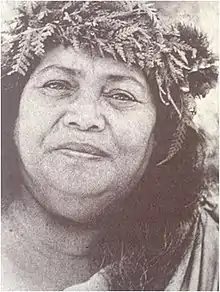 | |
| Born | Edith Ke'kuhikuhiipu'uoneonaali'iokohala Kenao October 30, 1913 Honomu, Puna, Territory of Hawaii |
| Died | October 3, 1979 (aged 65) |
| Occupation | Chanter, teacher, kumu hula |
| Spouse(s) | Luka Kanakaole |
| Children | 6 |
| Parent(s) |
|
Early life
Edith Kenao Kanakaʻole was born Edith Ke'kuhikuhiipu'uoneonaali'iokohala Kenao on October 30, 1913, in Honomu, on the Hāmākua coast of Hawaii.[2] Her mother, Mary Keliikuewa Ahiena, was her first hula teacher; she later studied with famous dancer Akoni Mika.[1] Kanakaʻole did not finish middle school, later joking that her formal education ended at "seventh grade and a half".[3]
On January 21, 1933, Edith Kenao married Luka Kanakaole; the couple would have six children including Nalani Kanaka‘ole and Pualani Kanaka‘ole Kanahele.[2]
Career
Kanakaʻole began composing oli (Hawaiian chants) in 1946, and songs in 1947.[1] She choreographed hula to go with many of her chants.[2] In 1953, after her mother had a stroke, she founded a hālau called Halau o Kekuhi.[1] She trained her daughters Nalani and Pualani to eventually take over the hālau.[4]
In the 1950s, Kanakaʻole toured the contiguous United States, western Canada, and much of Asia with a hula group named after her daughter Nalani.[5]
Kanakaʻole helped develop the first Hawaiian language program for public school students at the Keaukaha School in Hilo,[6][7] as well as the school's Hawaiian Studies kupuna (elder) mentorship program.[8]
Kanakaʻole worked as a teacher at Hawaiʻi Community College from 1971 to 1979, and at the University of Hawaiʻi at Hilo from 1973 to 1979. At both schools, she created courses and seminars on subjects including ethnobotany, Polynesian history, genealogy, and Hawaiian chant and mythology.[2]
Recognition
Kanakaʻole represented Hawaii at the Second South Pacific Festival of the Arts in Rotorua, New Zealand in 1976, and the State Association of Hawaiian Civic Clubs named her "Hawaiian of the Year" in 1977. In 1979, she received the Award of Distinction for Cultural Leadership from the Governor of Hawaii, the Order of Ke Ali'i Pauahi Award from Kamehameha Schools, and was named a Living Treasure of Hawai'i. In 1978 and 1979, she won Na Hoku Hanohano Awards for best traditional album; her acceptance speech for the first award was entirely in the Hawaiian language, while the second award was given posthumously.[9]
After Kanakaʻole's death in 1979, the Honolulu Star-Bulletin described her as "[one] of the Big Island's most cherished educators".[3]
The Edith Kanakaʻole Multi-Purpose Stadium in Hilo is named after her.
Discography
References
- Hopkins 1984, p. 198.
- Commire & Klezmer 2007, p. 999.
- "The warmth and wisdom of Aunty Edith". Honolulu Star-Bulletin. Clark's big isle. October 7, 1979. pp. D-7. Retrieved June 17, 2021.CS1 maint: others (link)
- Lang, Leslie (2003). "Making Hula History". Hana Hou!. Retrieved June 16, 2021.
- Hopkins 1984, p. 199.
- "Donna Saiki". The Courier-Wedge. November 9, 2017. Retrieved June 2, 2021.
- Clark, Hugh (August 31, 1972). "Hilo ready for Pat's visit". The Honolulu Advertiser. Retrieved June 2, 2021.
- Burnett, John (September 22, 2013). "Keaukaha leader dies at 86". Hawaii Tribune-Herald. Retrieved June 2, 2021.
- Hopkins 1984, p. 1200.
Bibliography
- Hopkins, Jerry (1984). "KANKAOLE, Edith Kenao". In Peterson, Barbara Bennett (ed.). Notable Women of Hawaii. Honolulu: University of Hawaii Press. pp. 198–200. ISBN 0-8248-0820-7. OCLC 11030010.
- Commire, Anne; Klezmer, Deborah, eds. (2007). Dictionary of Women Worldwide: 25,000 Women Through the Ages. Detroit, Mich.: Yorkin Publications. p. 999. ISBN 978-0-7876-9394-7. OCLC 71817179.
Authority control  | |
|---|---|
| General | |
| National libraries | |