Edna Ginesi
Edna "Gin" Ginesi (15 February 1902 – 17 July 2000) was a British painter, specialising in landscapes and nature studies.
Edna Ginesi | |
|---|---|
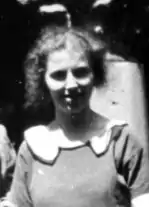 Edna Ginesi c.1926-7 | |
| Born | February 15, 1902 Leeds, United Kingdom |
| Died | July 17, 2000 (aged 98) |
| Nationality | British |
| Education |
|
| Known for | Painting |
| Spouse(s) | Raymond Coxon |
Early life and education
Ginesi was born in Leeds in 1902, and was of Italian descent.[1] She studied at Leeds School of Art from 1920, before going to the Royal College of Art where she studied painting from 1921 to 1925.[2][3] At the RCA, she was part of the "Leeds Table", along with her future husband Raymond Coxon, sculptors Henry Moore and Barbara Hepworth, and the painter Vivian Pitchforth; at this time she also studied informally with Leon Underwood. In 1924, Ginesi was awarded a West Riding Travelling Scholarship, which enabled her to visit the Netherlands, Belgium, Italy, and France.[3]
Career
After graduating from the Royal College, Ginesi taught for a year at Bradford School of Art, before settling in Hammersmith with her husband, Raymond Coxon, whom she married in 1926.[3] In 1927, she formed the British Independent Society with Coxon, Moore, and Underwood.[1] She exhibited with the London Group – of which she was later a member – in 1928, and had her first solo exhibition in 1932 at the Zwemmer Gallery. She was also a member of the "Twenties Group" founded by Lucy Wertheim. In the 1930s, she taught at Chelsea School of Art and designed sets for the Camargo Ballet.[3] During the Second World War, Ginesi worked as an ambulance driver, and, with Coxon, taught painting in Guildford.[2] A retrospective of Ginesi's work was exhibited in 1956 in Cartwright Hall, Bradford.[3] In 1985, she exhibited along with Raymond Coxon at the Michael Parkin Gallery in London.[4] She also exhibited work at the Royal Academy and in America.[5]
Ginesi's paintings were generally representational, with her style becoming more abstract from the 1960s onward. She mostly worked on landscapes and nature studies.[3]
Personal life
In 1922, Ginesi became engaged to the painter Raymond Coxon, who she had met at Leeds School of Art;[6] she married him in 1926.[3] The sculptor Henry Moore was best man at their wedding, and gave the couple his Head of a Virgin (1922) as a wedding present.[7] Coxon and Ginesi lived in Hammersmith, London, over 60 years; from 1938 they also owned a studio in Sussex.[2]
References
- Parkin 1997.
- Times 1997.
- Stephens 1998.
- Shone 1985, p. 178.
- Turnbull 1976.
- Berthould 2003, p. 69.
- Garlake 2006, p. 269.
Works cited
- Berthould, Roger (2003), The Life of Henry Moore, Walter de la Mare
- Garlake, Margaret (2006), "Two-faced: Henry Moore's Head of the Virgin, 1922", Sculpture Journal, 15 (2)
- Parkin, Michael (18 February 1997), "Obituary: Raymond Coxon", Independent
- Shone, Richard (1985), "Twentieth-Century Exhibitions, London", The Burlington Magazine, 127 (984)
- Stephens, Chris (1998), Edna Ginesi: Biography, Tate, retrieved 18 September 2017
- "Raymond Coxon", The Times, p. 21, 18 February 1997
- Turnbull, Harry (1976). Artists of Yorkshire: A Short Dictionary. Thornton Gallery.
External links
- 10 artworks by or after Edna Ginesi at the Art UK site
Authority control  | |
|---|---|
| General | |
| Art research institutes | |