Eduard von Flies
Eduard Moritz Flies, known as von Flies since 1864[2] was a 19th-Century Prussian Lieutenant General that served the Second Schleswig War and Austro-Prussian War.
Eduard von Flies | |
|---|---|
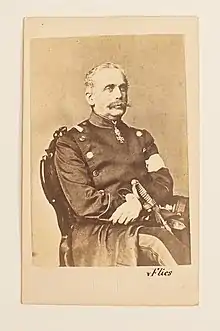 | |
| Born | August 25, 1802 Charlottenburg, Province of Brandenburg, Prussia |
| Died | December 10, 1886 (aged 84) Wiesbaden, Province of Hesse-Nassau, Prussia, German Empire[1] |
| Allegiance | .svg.png.webp) Prussia Prussia |
| Branch | .svg.png.webp) Prussian Army Prussian Army |
| Years of service | 1820–1868 |
| Rank | Lieutenant General |
| Unit | Zieten Hussars |
| Commands held | 2nd Life Hussar Regiment 6th Cavalry Brigade Combined Division von Flies |
| Battles/wars | Second Schleswig War Austro-Prussian War |
Origin
Eduard Moritz was the son of Heinrich Flies († 1842 in Freienwalde) and his wife Luise, née Wolff. His father was a retired Oberleutnant.
Military Career
In 1820 Flies joined the 3rd Hussar Regiment of the Prussian Army as a hussar. On November 13, 1824 he was second lieutenant and as such commanded to the teaching cadron in 1829/30. From 1834 Flies served as regimental adjutant, became Oberleutnant in May 1838 and was made a Rittmeister and squadron commander on May 24, 1841. Flies was promoted to major on January 8, 1857 and received command of the 2nd Life Hussar Regiment; being promoted to Lieutenant Colonel on April 9, 1857 and Colonel on May 31, 1859. On June 20th his rank was made À la suite of his regiment and he was entrusted with the command of the 6th Cavalry Brigade; becoming the latters permanent commander on May 12, 1860. For his services in the troop leadership, Flies received the Order of the Red Eagle, 2nd Class with Oak Leaves on October 18, 1861, and the Order of the Crown, II Class, on September 22, 1863. Flies took part in the Second Schleswig War with his brigade in 1864. Kaiser Wilhelm I paid tribute to his services on June 18, 1864 with the elevation to the nobility. He also promoted him to major general on June 25, 1864. For his achievements the Austrians awarded Flies with the Commander's Cross of the Order of Leopold with war decoration on August 21, 1864. After the Treaty of Vienna, Flies remained in command of a combined cavalry brigade in Schleswig-Holstein.
In the Austro-Prussian War, Flies was initially the leader of the combined cavalry brigade of the Army of the Main. Here he received orders from General Edwin von Manteuffel to lead a detachment consisting of five battalions with 8150 infantrymen, 225 cavalrymen and 22 guns to Gotha via Magdeburg and Halle. He was supposed to pursue the withdrawing Hanoverians and prevent them from retreating. Despite being heavily outnumbered Flies ordered the Battle of Langensalza on June 27, 1866. Flies suffered a breakdown during the battle and lost almost 1/5th of his troops. The battle ended with a victory for the Hanoverians, but at this point they were surrounded by Prussian troops and, due to the supply situation, were no longer able to continue fighting.[3] Historian Robert M. Citino considered the battle "one of the senseless frontal attacks in military history".[4][5]
Flies went on to defeat the Badenians at the Battle of Hundheim;[6] his troops then quickly captured Wertheim on July 24.[7] Flies was the main Prussian commander at the Battle of Roßbrunn which, despite earlier successes, eventually ended in a Bavarian victory.[8]
On July 11, 1866, Flies was appointed commander of a division formed from the troops in the Elbe duchies. After the end of the war, he was appointed commander at Altona on September 15, 1866. Flies was retired on January 7, 1868 and awarded the 1st Class of the Order of the Red Eagle with oak leaves and swords on rings.
In addition to his pension, from February 2, 1870 onwards he received an annual bonus of 500 thalers.
Family
Flies married Therese von Schönfeld (born April 27, 1811 in Grimma; † May 13, 1882 in Wiesbaden) in Düben on September 27, 1832. Their daughter Lucie Luise Therese (born January 11, 1834 in Düben) emerged from the marriage. On December 18, 1873, she married Post Director, and retired Lieutenant Colonel, Otto von Wichmann.
References
- Albert Koch: Das Kriegstagebuch des preußischen Gefreiten Albert Koch, S. 74.
- Ranke-Gesellschaft, Vereinigung für Geschichte im Öffentlichen Leben, Institut zur Erforschung Historischer Führungsschichten: Bankherren und Bankiers, Starke, 1978, S. 99.
- Jeremy Black, The Hanoverians: The History of a Dynasty, Page 211
- Robert Michael Citino, Death of the Wehrmacht: The Campaigns of 1942, Page 5
- Robert Michael Citino, The German Way of War: From the Thirty Years' War to the Third Reich, Page 5
- Thomas Campbell, Samuel Carter Hall, Edward Bulwer Lytton Baron Lytton, William Harrison Ainsworth,Theodore Edward Hook, Thomas Hood, New Monthly Magazine, Volume 140, Page 16
- New monthly magazine, Volume 140, Page 16
- Revue contemporaine (Paris. 1858), Page 281
Bibliography
- Kurt von Priesdorff: Soldatisches Führertum. Volume 7, Hanseatische Verlagsanstalt Hamburg, o. O. Hamburg, o. J. [1939],
 This article incorporates text from a publication now in the public domain: "Soldatisches Führertum". Dictionary of National Biography. London: Smith, Elder & Co. 1885–1900. , S. 186–187, Nr. 2227.