Edward of Westminster, Prince of Wales
Edward of Westminster (13 October 1453 – 4 May 1471), also known as Edward of Lancaster, was the only son of King Henry VI of England and Margaret of Anjou. He was killed aged seventeen at the Battle of Tewkesbury.
| Edward of Westminster | |
|---|---|
| Prince of Wales | |
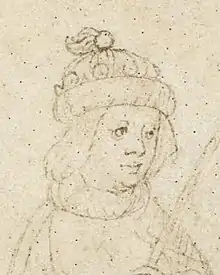 Drawing of Edward from the Beauchamp Pageant, c. 1483-1494 | |
| Born | 13 October 1453 Palace of Westminster, London, England |
| Died | 4 May 1471 (aged 17) Tewkesbury, Gloucestershire, England |
| Burial | |
| Spouse | |
| House | Lancaster |
| Father | Henry VI of England |
| Mother | Margaret of Anjou |
| Religion | Roman Catholic |
Early life
Edward was born at the Palace of Westminster, London, the only son of King Henry VI of England and his wife, Margaret of Anjou. At the time, there was strife between Henry's supporters and those of Richard of York, 3rd Duke of York, who had a claim to the throne and challenged the authority of Henry's officers of state. Henry was suffering from mental illness, and there were widespread rumours that the prince was the result of an affair between his mother and one of her loyal supporters. Edmund Beaufort, 2nd Duke of Somerset and James Butler, 5th Earl of Ormond, were both suspected of fathering Prince Edward;[1] however, there is no firm evidence to support the rumours, and King Henry himself never doubted the boy's legitimacy and publicly acknowledged paternity. Edward was invested as Prince of Wales at Windsor Castle in 1454.
War over the English throne
In 1460, King Henry was captured by the supporters of the Duke of York at the Battle of Northampton and taken to London. The Duke of York was dissuaded from claiming the throne immediately, but he induced Parliament to pass the Act of Accord, by which Henry was allowed to reign but Edward was disinherited, as York or his heirs would become king on Henry's death.
Queen Margaret and Edward had meanwhile fled through Cheshire. By Margaret's later account, she induced outlaws and pillagers to aid her by pledging them to recognise the seven-year-old Edward as rightful heir to the crown. They subsequently reached safety in Wales and journeyed to Scotland, where Margaret raised support, while the Duke of York's enemies gathered in the north of England.
After York was killed at the Battle of Wakefield, the large army which Margaret had gathered advanced south. They defeated the army of Richard Neville, 16th Earl of Warwick, one of York's most prominent supporters, at the Second Battle of St Albans. Warwick had brought the captive King Henry in the train of his army, and he was found abandoned on the battlefield. Two of Warwick's knights, William Bonville, 1st Baron Bonville, and Sir Thomas Kyriell, who had agreed to remain with Henry and see that he came to no harm, were captured. The day after the battle, Margaret asked Edward what death the two knights should suffer. Edward readily replied that their heads should be cut off.[2]
Exile in France
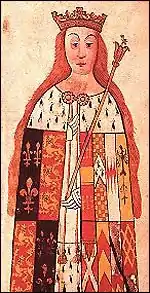
Margaret hesitated to advance on London with her unruly army, and subsequently retreated. They were routed at the Battle of Towton a few weeks later. Margaret and Edward fled once again, to Scotland. For the next three years, Margaret inspired several revolts in the northernmost counties of England, but was eventually forced to sail to France, where she and Edward maintained a court in exile. (Henry had once again been captured and was a prisoner in the Tower of London.)
In 1467 the ambassador of the Duchy of Milan to the court of France wrote that Edward "already talks of nothing but cutting off heads or making war, as if he had everything in his hands or was the god of battle or the peaceful occupant of that throne."[3]
After several years in exile, Margaret took the best opportunity that presented itself and allied herself with the renegade Earl of Warwick. King Louis XI of France wanted to start a war with Burgundy, allies of the Yorkist King Edward IV. He believed if he allied himself to restoring Lancastrian rule they would help him conquer Burgundy. As a compliment to his new allies Louis made young Edward godfather to his son Charles. Prince Edward was married to Anne Neville, Warwick's younger daughter, in December 1470, though there is some doubt as to whether the marriage was ever consummated.
Battles of Barnet and Tewkesbury
Warwick returned to England and deposed Edward IV, with the help of Edward IV's younger brother, the Duke of Clarence. Edward IV fled into exile to Burgundy with his youngest brother the Duke of Gloucester, while Warwick restored Henry VI to the throne. Prince Edward and Margaret lingered behind in France until April 1471. However, Edward IV had already raised an army, returned to England, and reconciled with Clarence. On the same day Margaret and Edward landed in England (14 April), Edward IV defeated and killed Warwick at the Battle of Barnet. With little real hope of success, the inexperienced prince and his mother led the remnant of their forces to meet Edward IV in the Battle of Tewkesbury. They were defeated and Edward of Westminster was killed.[4]
According to some accounts, shortly after the rout of the Lancastrians at Tewkesbury, a small contingent of men under the Duke of Clarence found the grieving prince near a grove, and immediately beheaded him on a makeshift block, despite his pleas. Paul Murray Kendall, a biographer of Richard III, accepts this version of events.[5]
Another account of Edward's death is given by three Tudor sources: The Grand Chronicle of London, Polydore Vergil, and Edward Hall. It was later dramatised by William Shakespeare in Henry VI, Part 3, Act V, scene v. Their story is that Edward was captured and brought before the victorious Edward IV and his brothers and followers. The king received the prince graciously, and asked him why he had taken up arms against him. The prince replied defiantly, "I came to recover my father's heritage." The king then struck the prince across his face with his gauntlet hand, and his brothers killed the prince with their swords.
However, none of these accounts appear in any of the contemporaneous sources, which all report that Edward died in battle.
Edward's body is buried at Tewkesbury Abbey. His widow, Anne Neville, married the Duke of Gloucester, who eventually succeeded as King Richard III in 1483.
Epitaph
The Latin memorial brass to Edward in Tewkesbury Abbey is set in the floor between the choir stalls, under the tower. It reads as follows:
This can be translated into English as follows:[6]
"Here lies Edward, Prince of Wales, cruelly slain whilst but a youth. Anno Domini 1471, May fourth. Alas, the savagery of men. Thou art the sole light of thy Mother, and the last hope of thy race."
Ancestry and family tree
| Ancestors of Edward of Westminster, Prince of Wales | |||||||||||||||||||||||||||||||||||||||||||||||||||||||||||||||||||||||||||||||||||||||||||||||||||||||||||||||||||||||||||||||||||||||||||||||||||||||||||||||||||||||||||||||||||||||||||||||||||||||||||||||||||||||||||||||||||||||||||||||||||||||||||||||||||||||||||||||||||||||||
|---|---|---|---|---|---|---|---|---|---|---|---|---|---|---|---|---|---|---|---|---|---|---|---|---|---|---|---|---|---|---|---|---|---|---|---|---|---|---|---|---|---|---|---|---|---|---|---|---|---|---|---|---|---|---|---|---|---|---|---|---|---|---|---|---|---|---|---|---|---|---|---|---|---|---|---|---|---|---|---|---|---|---|---|---|---|---|---|---|---|---|---|---|---|---|---|---|---|---|---|---|---|---|---|---|---|---|---|---|---|---|---|---|---|---|---|---|---|---|---|---|---|---|---|---|---|---|---|---|---|---|---|---|---|---|---|---|---|---|---|---|---|---|---|---|---|---|---|---|---|---|---|---|---|---|---|---|---|---|---|---|---|---|---|---|---|---|---|---|---|---|---|---|---|---|---|---|---|---|---|---|---|---|---|---|---|---|---|---|---|---|---|---|---|---|---|---|---|---|---|---|---|---|---|---|---|---|---|---|---|---|---|---|---|---|---|---|---|---|---|---|---|---|---|---|---|---|---|---|---|---|---|---|---|---|---|---|---|---|---|---|---|---|---|---|---|---|---|---|---|---|---|---|---|---|---|---|---|---|---|---|---|---|---|---|---|---|---|---|---|---|---|---|---|---|---|---|---|---|---|---|---|
| |||||||||||||||||||||||||||||||||||||||||||||||||||||||||||||||||||||||||||||||||||||||||||||||||||||||||||||||||||||||||||||||||||||||||||||||||||||||||||||||||||||||||||||||||||||||||||||||||||||||||||||||||||||||||||||||||||||||||||||||||||||||||||||||||||||||||||||||||||||||||
| Edward I (1239–1307) King of England | |||||||||||||||||||||||||||||||||||||||
| Edward of Caernarfon (1284–1327) 1st Prince of Wales later, King Edward II of England | |||||||||||||||||||||||||||||||||||||||
| Edward III (1312–1377) King of England | |||||||||||||||||||||||||||||||||||||||
| Edward the Black Prince (1330–1376) 2nd Prince of Wales Duke of Cornwall | John of Gaunt (1340–1399) Duke of Lancaster | Edmund of Langley (1341–1402) Duke of York | Lionel of Antwerp (1338–1368) Duke of Clarence | ||||||||||||||||||||||||||||||||||||
| Richard of Bordeaux (1367–1400) 3rd Prince of Wales Duke of Cornwall later King Richard II of England | John Beaufort (c. 1371–1410) | Henry IV (1366–1413) King of England | Philippa of Clarence (1355–1382) | ||||||||||||||||||||||||||||||||||||
| Robert III (1337–1406) King of Scots | Henry of Monmouth (1386–1422) 4th Prince of Wales Duke of Cornwall later King Henry V of England | Roger Mortimer (1374–1398) | |||||||||||||||||||||||||||||||||||||
| David Stewart (1378–1402) Duke of Rothesay | James (1394–1437) Duke of Rothesay later King James I of Scots | Richard of Conisburgh (c. 1375–1415) Earl of Cambridge | Anne de Mortimer (1390–1411) | ||||||||||||||||||||||||||||||||||||
| John Beaufort (1404–1444) Duke of Somerset | Henry (1421–1471) Duke of Cornwall later King Henry VI of England | ||||||||||||||||||||||||||||||||||||||
| Alexander Stewart (1430) Duke of Rothesay | James (1430–1460) Duke of Rothesay later King James II of Scots | Edward of Westminster (1453–1471) 5th Prince of Wales Duke of Cornwall | Richard Plantagenet (1411–1460) Duke of York 6th Prince of Wales | ||||||||||||||||||||||||||||||||||||
| Lady Margaret Beaufort (1441/1443–1509) | Edward IV (1442–1483) later King Edward IV of England | Richard III (1452–1485) King of England | |||||||||||||||||||||||||||||||||||||
| James (1451–1488) Duke of Rothesay later King James III of Scots | Henry VII (1457–1509) King of England | Edward V of England (1470–?) 7th Prince of Wales Duke of Cornwall later King Edward V of England | Edward of Middleham (c. 1473–1484) 8th Prince of Wales Duke of Cornwall | ||||||||||||||||||||||||||||||||||||
| James (1473–1513) Duke of Rothesay later King James IV of Scots | Margaret Tudor (1489–1541) | Arthur Tudor (1486–1502) 9th Prince of Wales Duke of Cornwall | Henry VIII (1491–1547) 10th Prince of Wales Duke of Cornwall later King Henry VIII of England | ||||||||||||||||||||||||||||||||||||
| Arthur Stewart (1509–1510) Duke of Rothesay | James (1512–1542) Duke of Rothesay later King James V of Scots | Henry (1511) Duke of York Duke of Cornwall | Edward Tudor (1537–1553) 11th Prince of Wales Duke of Cornwall later King Edward VI of England | ||||||||||||||||||||||||||||||||||||
| James Stewart (1540–1541) Duke of Rothesay | Mary, Queen of Scots (1542–1587) Queen of Scotland | ||||||||||||||||||||||||||||||||||||||
| James (1566–1625) Duke of Rothesay later King James VI of Scotland and James I of England | |||||||||||||||||||||||||||||||||||||||
| Henry Frederick Stuart (1594–1612) 12th Prince of Wales Duke of Cornwall and Rothesay | Elizabeth Stuart (1596–1662) | Charles Stuart (1600–1649) 13th Prince of Wales Duke of Cornwall and Rothesay later King Charles I of England and Scotland | |||||||||||||||||||||||||||||||||||||
| Sophia of Hanover (1630–1714) | Charles James (1629) Duke of Cornwall and Rothesay styled Prince of Wales | Charles Stuart (1630–1685) 14th Prince of Wales Duke of Cornwall and Rothesay later King Charles II of England and Scotland | James II/VII (1633–1701) King of England and Scotland | ||||||||||||||||||||||||||||||||||||
| George I (1660–1727) King of Great Britain | |||||||||||||||||||||||||||||||||||||||
| George Augustus (1683–1760) 16th Prince of Wales Duke of Cornwall and Rothesay later King George II of Great Britain | James Francis Edward Stuart (1688–1766) 15th Prince of Wales Duke of Cornwall and Rothesay | ||||||||||||||||||||||||||||||||||||||
| Frederick Louis (1707–1751) 17th Prince of Wales Duke of Cornwall and Rothesay | |||||||||||||||||||||||||||||||||||||||
| George William Frederick (1738–1820) 18th Prince of Wales later King George III of Great Britain | |||||||||||||||||||||||||||||||||||||||
| George Augustus Frederick (1762–1830) 19th Prince of Wales Duke of Cornwall and Rothesay later King George IV of Great Britain | Edward Augustus (1767–1820) Duke of Kent and Strathearn | ||||||||||||||||||||||||||||||||||||||
| Victoria (1819–1901) Queen of Great Britain | |||||||||||||||||||||||||||||||||||||||
| Albert Edward (1841–1910) 20th Prince of Wales Duke of Cornwall and Rothesay later King Edward VII of Great Britain | |||||||||||||||||||||||||||||||||||||||
| George Frederick Ernest Albert (1865–1936) 21st Prince of Wales Duke of Cornwall and Rothesay later King George V of Great Britain | |||||||||||||||||||||||||||||||||||||||
| Edward Albert Christian George Andrew Patrick David (1894–1972) 22nd Prince of Wales Duke of Cornwall and Rothesay later King Edward VIII of Great Britain later Duke of Windsor | George Frederick Ernest Albert (1895–1952) later King George VI of Great Britain | ||||||||||||||||||||||||||||||||||||||
| Elizabeth II (1926–present) Queen of Great Britain | |||||||||||||||||||||||||||||||||||||||
| Charles Philip Arthur George (1948–present) 23rd Prince of Wales Duke of Cornwall and Rothesay | |||||||||||||||||||||||||||||||||||||||
| William Arthur Philip Louis (1982–present) Duke of Cambridge | |||||||||||||||||||||||||||||||||||||||
| George Alexander Louis (2013–present) | |||||||||||||||||||||||||||||||||||||||
Notes
- Paul Murray Kendall, Richard The Third; page 32
- Churchill, Winston (1956). A History of the English-Speaking Peoples: Vol1 The Birth of Britain. Cassell. p. 328. ISBN 0-304-29500-0.
- R. A. Griffiths, 'Edward, prince of Wales (1453–1471)', Oxford Dictionary of National Biography, Oxford University Press, 2004
- John Marius Wilson, Imperial Gazetteer of England and Wales (1870–72), entry for Tewkesbury
- Paul Murray Kendall. Richard the Third (1956); pp. 118, 528–529 note
- "www.tewkesburyabbey.org.uk" Monumental inscriptions on gravestones and monuments in the Abbey
References
External links
- Richard III Society
- The Death of Edward of Lancaster at Tewkesbury(subscription required)
|  | |
See also: Principality of Wales | ||
|  | |
Cornwall Portal | ||
Authority control  | |
|---|---|
| General | |
| National libraries | |
| Other | |