Eijkman Molecular Biology Research Center
The Eijkman Molecular Biology Research Center, formerly Eijkman Institute for Molecular Biology is a laboratory in Jakarta, Indonesia. It is most known for the discovery by Christiaan Eijkman that Beriberi was caused by a lack of thiamine in the human body.
| Pusat Riset Biologi Molekuler Eijkman | |
 Logo of Eijkman Molecular Biology Research Center. The logo had not changed since 31 December 1938 when the institute still named as Eijkman Institute | |
| Agency overview | |
|---|---|
| Formed | 15 January 1888 31 July 1992 (current form) |
| Preceding agencies |
|
| Jurisdiction |  Indonesia Indonesia |
| Agency executive |
|
| Parent agency | Life Sciences Research Organization |
| Website | http://www.eijkman.go.id/ |
History
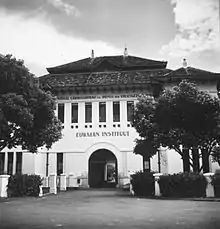
Founded as the Geneeskundig Laboratorium, or Medical Laboratory, at Jalan Diponegoro No. 69 in Central Jakarta in 1888, Christiaan Eijkman was stationed there as its first director. During his time there, he discovered that Beriberi, which was commonly believed to be caused by external forces, was caused by a lack of thiamine in the human body. This led to a Nobel Prize for Physiology or Medicine for Eijkman in 1929. In 1938, the laboratory was renamed the Eijkman Instituut (Eijkman Institute) in honor of Eijkman.[1][2]
During World War II, Japanese occupiers accused the center's first Indonesian director, Achmad Mochtar, of poisoning a batch of vaccine that was to be delivered to slave laborers. After Mochtar and his researchers were tortured and interrogated, he made a deal with the Japanese that he would plead guilty if his researchers were released. He was then executed and buried in an unmarked grave.[1] It is possible that Mochtar was a scapegoat for a failed Japanese experiment designed to validate a conjured tetanus toxoid vaccine for their troops.[3]
During the 1960s, the institute closed due to upheaval in the country and was absorbed into the Cipto Mangunkusomo Hospital. It remained closed for the next thirty years until 1992, when B.J. Habibie, the Minister of Research and Technology, decided to reopen the institute. The institute opened formally by Ministry of Research and Technology Decree No. 475/M/Kp/VII/1992. By 1993, it was fully operational, but ran into further troubles in 1998 due to the Asian financial crisis.[1][2][4]
In 2004, the institute identified the suicide bomber who blew himself up in front of the Australian Embassy, which drew recognition to the practical benefits of molecular biology. Today, the institute houses one of the few Biosafety Level 3 laboratories in the country, which is equipped with a gas decontamination chamber.[1]
For long time since its re-formation in 1992, Eijkman Institute was subordinate of Ministry of Research and Technology. Since 22 September 2021, Eijkman Institute officially become subordinate of National Research and Innovation Agency rather the Ministry of Education, Culture, Research, and Technology.[5][6] The name of Eijkman Institute changed to Eijkman Molecular Biology Research Center, under the Life Sciences Research Organization of National Research and Innovation Agency.[7]
Building
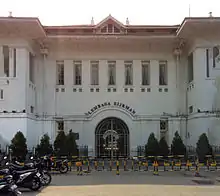
From the outside, the building has been described as looking like a museum, although the inside has not been renovated in an attempt to keep the building looking as it did when Eijkman was working there. This includes a visitor's lounge which is still furnished with wood and rattan chairs and other furnishings that have not been changed since the opening of the building.[1]
Structure
Currently, Eijkman Molecular Research Center is as follows:[8][9]
- Office of the Head of Eijkman Molecular Research Center
- Deputy of Fundamental Research
- Deputy of Translational Research
- Deputy of Human Genetics
- Deputy of Infectious Diseases
- Deputy of Genetic Biodiversity
- Research Units
- Dengue Research Unit
- Hepatitis Laboratory
- Genome Diversity and Diseases Laboratory
- Malaria Pathogenesis Laboratory
- Malaria and Vector Resistance Laboratory
- Mitochondria and Infectious Diseases Laboratory
- Molecular Bacteriology Laboratory
- Red Blood Cell Disorders Laboratory
- Red Blood Cells Membrane and Enzyme Disorders
- Stem Cell Unit
- Supporting Units
- Bioinformatics Laboratory
- Biosafety Level 3 Laboratory
- DNA Sequencing Laboratory
- Histopathology and TEM Laboratory
- Library
- Public Service Units
- Cytogenetics Laboratory
- DNA Forensics Unit
- Genetic Counselling Unit
- National Genome Center
- International Research Collaboration Units
- Eijkman Oxford Clinical Research Unit
- Emerging Virus Research Unit (EVRU)
Aside of these laboratories, Eijkman Molecular Research Center has more than 200 surveillance units divided into 31 regions across 34 provinces in Indonesia.[8]
References
- Saptura, Antonny (4 September 2012). "Jakarta: The Eijkman Institute". Jakarta Globe. Retrieved 2 September 2014.
- "History". Eijkman Institute. Retrieved 6 September 2014.
- Kevin Baird, "War Crimes in Japan-Occupied Indonesia: Unraveling the Persecution of Achmad Mochtar", The Asia-Pacific Journal, Vol. 14, Issue 1, No. 3, January 1, 2016.
- Badan Riset dan Inovasi Nasional (2 August 2021). "SIARAN PERS BADAN RISET DAN INOVASI NASIONAL Nomor : 95/SP/HM/BKKP/VIII/2021 Kepala BRIN Sampaikan Selamat Ulang Tahun Ke-29 Kepada LBM Eijkman". Badan Riset dan Inovasi Nasional (in Indonesian). Retrieved 12 November 2021.
- CNN Indonesia (22 September 2021). "BRIN Kini Jadi Bos Baru Lembaga Biologi Molekuler Eijkman". CNN Indonesia (in Indonesian). Retrieved 22 September 2021.
- CNN Indonesia (22 September 2021). "Peneliti LIPI Gantikan Amin Soebandrio Jadi Kepala Eijkman". CNN Indonesia (in Indonesian). Retrieved 22 September 2021.
- CNN Indonesia (24 September 2021). "BRIN Ungkap Nasib Vaksin Merah Putih Usai Comot Eijkman-LIPI". CNN Indonesia (in Indonesian). Retrieved 25 September 2021.
- "Research | Eijkman Institute". www.eijkman.go.id. Retrieved 12 November 2021.
- "Unit | Lembaga Eijkman". web.eijkman.go.id. Retrieved 12 November 2021.
External links
Authority control  | |
|---|---|
| General | |
| National libraries | |
| Other | |