El Quisco
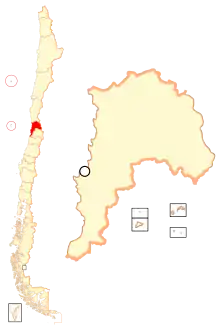
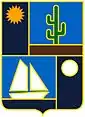
El Quisco is a Chilean city and commune in San Antonio Province, Valparaíso Region. Located in the country's central coast, it serves as a popular summer resort for the population of Santiago and forms part of the Coast of Poets, a cultural space named after four world-renowned Chilean poets: Pablo Neruda, Vicente Huidobro, Violeta Parra and Nicanor Parra. El Quisco is home to La Casa de Isla Negra, the former house of Chilean poet Pablo Neruda, which is now a museum and Neruda's burial site. The city's name comes from the quisco cactus (Echinopsis chiloensis), which in turn comes from the Quechua word khishka, a plant species belonging to the cactus family.[5]
El Quisco | |
|---|---|
|
 Coat of arms  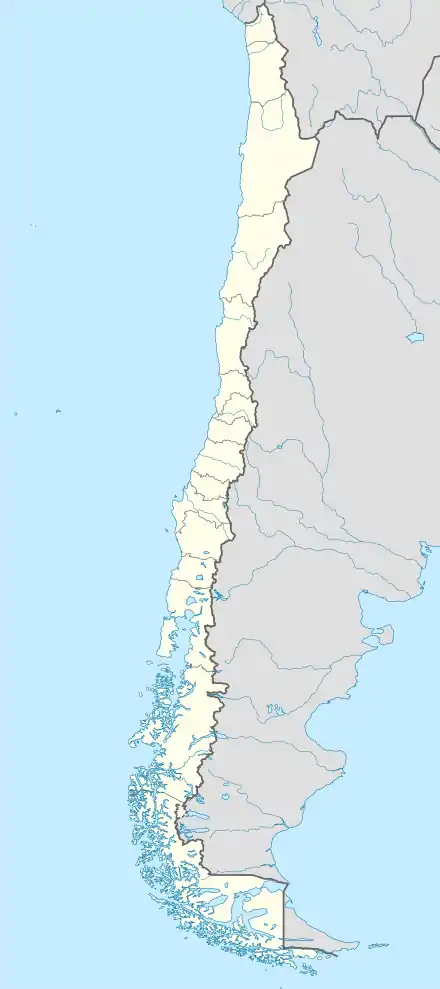  El Quisco Location in Chile | |
| Coordinates: 33°23′28.71″S 71°41′34.58″W | |
| Country | Chile |
| Region | Valparaíso |
| Province | San Antonio |
| Government | |
| • Type | Municipality |
| • Alcalde | Natalia Carrasco Pizarro |
| Area | |
| • Total | 50.7 km2 (19.6 sq mi) |
| Elevation | 13 m (43 ft) |
| Population (2012 Census)[2] | |
| • Total | 11,329 |
| • Density | 220/km2 (580/sq mi) |
| • Urban | 8,931 |
| • Rural | 536 |
| Sex | |
| • Men | 4,815 |
| • Women | 4,652 |
| Time zone | UTC-4 (CLT[3]) |
| • Summer (DST) | UTC-3 (CLST[4]) |
| Website | www |
History
Early history
There have been important archaeological findings from the pre-ceramic period and the late ceramic period along the coast of El Quisco. El Quisco was a centre of the El Bato and Llolleo cultures, among others, and their presence coincided with the dates of the Molle culture located further north.[6]
The Bato Tradition was established in the period 400–300 BC, and shared cultural similarities with the Molle culture. Typical of this culture was the use of a tembetá (a metal or stone rod used in lower-lip piercings). In addition, mortars (stones used for grinding vegetables and minerals) have been found at the site. The evidence of the place of this group is in Trebulco and in La Manresa, located in the vicinity of Lonquén. Its maximum development came during the years of 400–500 AD, both on the coast and in the interior, and persisted up to the late period in the Preandean zone around 900 AD.
The El Molle culture was established in Chile around 300 AD among the transverse valleys of the rivers Copiapó and Choapa, with large migrations to the country from Brazil, from the tropical jungles of the Chaco, Argentine pampas, and from Peru.[7][8] The first settlements were in the interior of the country, in El Molle (in the Valle de Elqui), where the first evidence was found. They mixed with existing populations and adopted some cultural elements and physical features from them. They were the predecessors of the diaguita culture, and by the time the Spanish arrived (1492) they had already disappeared. In modern Chile, this culture would have been located in regions III (Atacama) and IV (Coquimbo).
The Aconcagua culture spread over the whole coastal zone, near the present-day resorts of Algarrobo, El Quisco, Llolleo, El Tabo, Las Cruces, Rocas de Santo Domingo, and Cartagena.
The ceramics of these cultures is commonly called the Aconcagua Salmon Type on account of its orange colour with decorative designs in black paint, and found in the Late Agroalfarero ("agro-potter") period of the region, between 800 and 1470, principally in pieces known as pucos, or bowls. The outer face is often a decoration representing the figure of a "Trinaurio", or species of whirlpool of three arms.
Mapuche period

More recently Picunche people lived between two important rivers: the Choapa and the Itata. They were farmers and thus sedentary. From their farming they obtained gourds, maize, beans and chili pepper. The water was abundant where they lived, and the climate was hot. They raised animals, especially Llamas and Guanacos, which provided meat for food and wool for clothes. They lived in small villages, in groups of approximately 300 people. Their houses were made of mud, with roofs of totora. About 30 people lived in each house: a father, wives, children, and other close relatives. Men were given the orders and directed the work: the highest authority was the father and after him the oldest son. Only in emergencies, especially in wars, there was a chief as a leader. Nevertheless, the villages were peaceful.[9]
Inca period

This zone was a part of the Inca Empire, specifically of Qullasuyu. In order to assure their domination and to introduce the Inca customs, the Inca sovereigns established numerous colonies of mitimaes, farmers and pacific craftsmen brought from diverse parts of the empire: Aymara and Quechua people, Atacameños, etc. These foreign settlers founded numerous villages with names that recall those of their places of origin: Limache (people of Rímac or Lima), Collahue (place of the Qulla people or Aymara people), Pomaire and different people of Atacameño origin.
The clothes of the Inca soldiers were made from Pulla Pulla (Zephyranthes párvula Killip), an annual plant of the family Amaryllidaceae, native to the highland Andean provinces, with beautiful flowers that bloom in spring. It is considered to be a prediction of whether the agricultural year will be good or bad. The route from Limache to Las Dichas passed through Lo Orozco, continuing to Portezuelo de Ibacache and finishing at Talagante, where other Mitimae existed. In 1430, Túpac Inca Yupanqui, initiated a great military campaign that culminated in the establishment of a border at the Maule river. Ilabe, an Incas noble who commanded the invading forces, established himself in the Picunche valley of Llollehue, between the Maipo river and the Mapocho river. He decided to found a colony and a pucará, a task that entrusted to his son, Tala Canta Inca Ilabe.
He had the authority to name kurakas or governors, derived from that of the Inca in Cusco. His mandate allowed him to establish the social, political and economic system characteristic of the Inca Empire, to distribute land and community property, and initiate public works of common good, as ways, granaries to guard the fruits of the crops and the construction of housing. The agricultural and cattle production was sufficiently developed allow food to be sent to the pukaras of the north.
Spanish settlement
The first indications of Spanish settlement in the zone of El Quisco date back to 1570, when the Spanish family of Alonso de Córdoba took control. Previously it was named Huallilemu (Mapudungun: forest of oakwood), and then El Totoral for the great quantity of totoras existing there.
Pirates
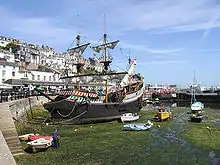
After 1578, El Quisco and neighbouring places were hiding places of pirates as the Englishmen Francis Drake, Thomas Cavendish, Richard Hawkins and Dutchmen like Oliver Van Noort and Joris van Spilbergen. Francis Drake probably moored his galleon Golden Hind in the bay in December 1578. He travelled with two people known only by their Christian names, Christopher and Cosmas, the first Japanese explorers to circumnavigate the globe.
At the end of the colonial stage foreign ships engaged in illegal trade on the Chilean coasts were already numerous. In addition to the English, Dutch and French pirates of the past were North American pirates. The foreign pirates operated generally with the support of the Chilean Creoles, who saw the attempts of the Spanish authorities to interfere as one more proof of the arrogance of the colonial Spanish system.
Today
The commune of El Quisco was constituted on August 30, 1956 under the presidency of Carlos Ibáñez del Campo under Statutory order Nº 12110.
Demographics
According to the 2002 census of the National Statistics Institute, El Quisco spans an area of 50.7 km2 (20 sq mi) and has 9,467 inhabitants (4,815 men and 4,652 women). Of these, 8,931 (94.3%) lived in urban areas and 536 (5.7%) in rural areas. The population grew by 55.3% (3,370 persons) between the 1992 and 2002 censuses.[2]
Administration
As a commune, El Quisco is a third-level administrative division of Chile administered by a municipal council, headed by an alcalde who is directly elected every four years. The 2008-2012 alcalde is Natalia Carrasco Pizarro.[1]
- Cristofer Ceballos Lira (UDI)
- Juan Andrés Berrios Olmedo (PPD)
- José Moraga Lira (RN)
- Maria Magdalena Bianchi Berroeta (PDC)
- Guillermo Romo Díaz (JPM)
- Guillermo Vidal Devia (UDI)
Within the electoral divisions of Chile, El Quisco is represented in the Chamber of Deputies by María José Hoffmann (UDI) and Víctor Torres (PDC) as part of the 15th electoral district, together with San Antonio, Santo Domingo, Cartagena, El Tabo, Algarrobo and Casablanca. The commune is represented in the Senate by Francisco Chahuán Chahuán (RN) and Ricardo Lagos Weber (PPD) as part of the 6th senatorial constituency (Valparaíso-Coast).
Description
El Quisco has four sectors that are distinct both geographically and culturally:
- El Quisco proper
- Punta de Tralca
- Isla Negra
- El Totoral
Tourism
This zone is a favourite tourist destination in the central zone of Chile. One of its advantages is the short distance from Santiago. There are many residences and hotels for lodging,[10] as well as many restaurants and inns for enjoying typical Chilean food. Marine sports are available, including scuba diving and swimming.
Famous inhabitants
- Pablo Neruda, winner of the Nobel Prize of Literature[11]
- Violeta Parra, singer and composer.[12] Parra spent long seasons at Isla Negra, where she created works such as "El Rin de Angelito".
- Enrique Silva Cimma, ex-foreign minister of Chile
- Patricio Tombolini, ex-vice minister,[13] ex-president of the Social Democrat Radical Party
- Clara Solovera (1909–1992), folklorist.[14] Her daughters Cecilia and Marcela spread her ashes in the sea, opposite of her house in El Quisco.
- Luis Hernández Parker, winner of the National Prize of Journalism
- René Ríos Boettiger, Chilean cartoonist, creator of Condorito.[15]
- Jose Perotti, winner of the National Prize of Art.
- Camilo Mori, painter who designed the official seal of the I.Municipalidad of El Quisco
- Sonia Tschorne, vice-minister of Housing, Urbanism and National Goods
- Osvaldo Puccio, politician
- Jose Michael Puccio, surgeon of the Presidency of Chile
- Mario López Ibáñez, physician
- Roberto Marín Vivado, coloproctologist who had a long career as president of the Gastronomic Confraternity Nº 1 of Santiago and honorary member of the Circle of Gastronomic Chroniclers.
- Christian von Wernich, priest and collaborator with the Argentinian dictatorship, took refuge in El Quisco's catholic church until he was identified in 2003.[16]
External links
- Municipality of El Quisco
- Guía EL Quisco, Complete Turisitic guide about El Quisco
- Turistic Web El Quisco
- Ocupaciones tempranas y la aparición del pescador en la costa pacífica de Sudamérica”
- Sitio turístico del Quisco
- FM Radio online El Quisco
- Compañía eléctrica de la Comuna
- El Quisco y El Tabo
- Nuestro Refugio
- Fundación Pablo Neruda
- Sitio del Quisco
- Central Coast of Chile Directory
- Colegio del Quisco
Notes and references
 |
Wikimedia Commons has media related to El Quisco. |
- "Municipality of El Quisco" (in Spanish). Retrieved 20 November 2010.
- "National Statistics Institute" (in Spanish). Retrieved 20 November 2010.
- "Chile Time". WorldTimeZones.org. Archived from the original on 2007-09-11. Retrieved 2010-07-28.
- "Chile Summer Time". WorldTimeZones.org. Archived from the original on 2007-09-11. Retrieved 2010-07-28.
- "Echinopsis chiloensis - QUISCO". 2012-08-16. Archived from the original on 2012-08-16. Retrieved 2021-01-18.
- http://www.puc.cl/sw_educ/alfareria/areascult/areas232.htm, El Bato y Llolleo, Pontificia Universidad Católica de Chile
- Cornelly, F.L., 1956: Cultura Diaguita Chilena y Cultura de El Molle. Santiago: Editorial del Pacifico
- Historia de América. Pueblos indígenas chilenos. Cultura Molle y Diaguita. Cerámica. Artesanía
- Larrain, Etnogeografía, Geography of Chile, Geographic Military Institute, Santiago, 1987; XVI: 147. In this article Professor Larrain made an extensive investigation of the Picunche population, classifying them as northern and southern Picunches, the Promaucae.
- "Archived copy". Archived from the original on 2008-02-21. Retrieved 2009-01-24.CS1 maint: archived copy as title (link)
- YouTube - Paul Neruda - " I like when you are quiet ... " in his (her, your) voice <! - Title(Degree) generated by a bot ->
- YouTube - Violeta Parra Chile <! - Title(Degree) generated by a bot ->
- YouTube - Patricio Tombolini´s interview "Ultima mirada" Parte 1
- V=zqDIKxQo8LY YouTube - Uncle Héctor and Manirita - " To sing of my Guitar " <! - Title(Degree) generated by a bot ->
- V=zhKQ-rdBSFs YouTube - Condorito <! - Title(Degree) generated by a bot ->
- International Herald Tribune 17 September 2007, Argentine priest testifies about church's role in 'dirty war'