Elaeocarpus ganitrus
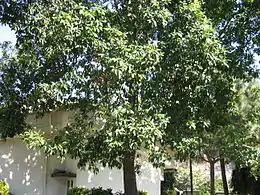
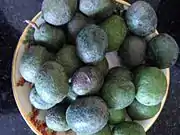
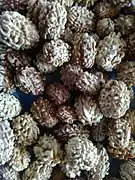
Elaeocarpus ganitrus, is a large evergreen broad-leaved tree. The drupes of this tree are known as rudraksha (Sanskrit: rudrākṣa, meaning "Rudra's teardrops" or "eyes") and their dried pyrenas (stones, pits) are widely used as prayer beads, particularly in Hinduism. Rudraksha may be produced by several species of Elaeocarpus, however E. ganitrus is the principal species used in the making of mala (garlands).
| Elaeocarpus ganitrus | |
|---|---|
 | |
Scientific classification  | |
| Kingdom: | Plantae |
| Clade: | Tracheophytes |
| Clade: | Angiosperms |
| Clade: | Eudicots |
| Clade: | Rosids |
| Order: | Oxalidales |
| Family: | Elaeocarpaceae |
| Genus: | Elaeocarpus |
| Species: | E. ganitrus |
| Binomial name | |
| Elaeocarpus ganitrus | |
Description
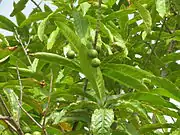
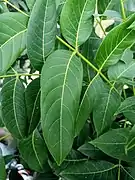
Elaeocarpus ganitrus grows in the area from the Gangetic plain in the foothills of the Himalayas to South-East Asia, Indonesia, New Guinea, Guam, and Hawaii.[2] It is an evergreen tree that grows quickly. The E. ganitrus tree starts bearing fruit in three to four years. As the tree matures, the roots buttress rising up narrowly near the trunk and radiating out along the surface of the ground.
Fruit
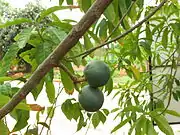
The drupes of the tree contain large pyrenas (stones, pits) which are covered by an outer husk of blue fruit when fully ripe. This blue colour is not derived from a pigment but is caused by structural colouration.[3] The pyrena of the fruit is typically divided into multiple segments by seed-bearing locules.
Taxonomy and naming
Elaeocarpus ganitrus was first formally described in 1831 by George Don in A General History of the Dichlamydeous Plants from an unpublished description by William Roxburgh.[1][4] The specific epithet ganitrus is derived from ganitri, the name for this species in Sundanese and Malay.
It is regarded as a synonym of Elaeocarpus angustifolius by Plants of the World Online where its distribution is given as 'Himalaya to China (Yunnan, Guangxi) and SW. Pacific", but the Australian Plant Census considers E. angustifolius as being endemic to the Northern Territory.[1][5]
The common name "rudraksha" is a Sanskrit compound consisting of the name Rudra ("Shiva") and akṣha ("teardrops").[6][7]
Chemical constituents
Chemical constituents present in E. ganitrus are elaeocarpidine, isoelaeocarpine, epiisoelaeocarpiline, rudrakine, flavonoids, quercetin, phytosterols, fat, alkaloids, carbohydrates, ethanol, proteins, tannins, gallic acid and ellagic acid.[8] The alkaloid rudrakine was discovered in the E. ganitrus fruit in 1979.[9]
Gallery
References
- "Elaeocarpus ganitrus". Plants of the World Online. Retrieved 4 February 2021.
- Koul, M. K. (2001-05-13). "Bond with the beads". Spectrum. India: The Tribune.
- Lee, D. W. (1991). "Ultrastructural Basis and Function of Iridescent Blue Color of Fruits in Elaeocarpus". Nature. 349 (6306): 260–262. doi:10.1038/349260a0. S2CID 13332325.
- Don, George (1831). A General History of the Dichlamydeous Plants. 1. London: J.G. and F. Rivington. p. 559. Retrieved 4 February 2021.
- "Elaeocarpus angustifolius". Australian Plant Census. Retrieved 4 February 2021.
- The translation of rudrākṣa as "Rudra's teardrops" and definition as berries of Elaeocarpus ganitrus see: Stutley, p. 119.
- Stutley, M. (1985). The Illustrated Dictionary of Hindu Iconography. New Delhi, India: Munshiram Manoharlal Publishers. ISBN 81-215-1087-2.
- https://www.researchgate.net/profile/Navin_Kumar23/publication/236107802_A_comprehensive_report_on_therapeutic_potential_of_Elaeocarpus_ganitrus_Roxb._(Rudraksha)/links/0deec515fae789097b000000.pdf
- Ray, A.B.; Chand, Lal; Pandey, V.B. (January 1979). "Rudrakine, a new alkaloid from Elaeocarpus ganitrus". Phytochemistry. 18 (4): 700–701. doi:10.1016/S0031-9422%2800%2984309-5.CS1 maint: date and year (link)