Elaeocarpus grandis
Elaeocarpus grandis, commonly known as blue quandong, blue fig or silver quandong,[2] is species of flowering plant in the family Elaeocarpaceae and is endemic to eastern Australia. It is a large tree with buttress roots at the base of the trunk, oblong to elliptic leaves with small teeth on the edges, racemes of greenish-white flowers and more or less spherical blue fruit.
| Blue quandong | |
|---|---|
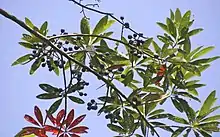 | |
| Elaeocarpus grandis at Mount Mellum | |
Scientific classification  | |
| Kingdom: | Plantae |
| Clade: | Tracheophytes |
| Clade: | Angiosperms |
| Clade: | Eudicots |
| Clade: | Rosids |
| Order: | Oxalidales |
| Family: | Elaeocarpaceae |
| Genus: | Elaeocarpus |
| Species: | E. grandis |
| Binomial name | |
| Elaeocarpus grandis | |
_flowers.jpg.webp)
Description
Elaeocarpus grandis is a tree that typically grows to a height of 35 m (115 ft) and has buttress roots at the base of the trunk, even on smaller trees. The leaves are oblong to elliptic, mostly 80–190 mm (3.1–7.5 in) long, 10–40 mm (0.39–1.57 in) wide with between twenty-five and fifty-five regular teeth on the edges and tapering to a petiole 10–20 mm (0.39–0.79 in) long. The leaves have many small domatia and turn bright red before falling. The flowers are arranged in racemes 60–100 mm (2.4–3.9 in) long, often on one side of the peduncle, each flower on a pedicel 10–15 mm (0.39–0.59 in) long. The five sepals are less than 14 mm (0.55 in) long and the five petals are greenish-white, about 15 mm (0.59 in) long with four of five lobes up to 5 mm (0.20 in) long at the tip. There are between fifty and fifty-five stamens and the ovary is hairy. Flowering occurs in autumn and the fruit is a more or less spherical blue drupe 20–30 mm (0.79–1.18 in) in diameter with a deeply sculptured stone.[2][3]
Taxonomy and naming
Elaeocarpus grandis was first formally described in 1860 by Ferdinand von Mueller in his book Fragmenta Phytographiae Australiae from material collected on the banks of the Pine River.[4][5]
The name Elaeocarpus grandis is accepted by the Australian Plant Census. Plants of the World Online considers E. grandis to be a synonym of E. angustifolius, but does not include Australia in the distribution of that species.[1][6]
Distribution and habitat
Blue quandong grows in rainforest and along moist, scrubby watercourse from Cooktown in far north Queensland to the Nambucca River in northern New South Wales, at altitudes up to 1,100 m (3,600 ft).[2][7]
Ecology
The fruit of E. grandis is attractive to birds, including the Australian brushturkey and southern cassowary and the flying foxes (genus Pteropus).
Uses
Use as food
Indigenous Australians ate the fruit raw or buried the unripe fruit in sand for four days making it sweet and more palatable. Early settlers used the fruit for jams, pies and pickles.[8]
References
- "Elaeocarpus grandis". Australian Plant Census. Retrieved 4 February 2021.
- "Elaeocarpus grandis". Royal Botanic Garden Sydney. Retrieved 15 February 2021.
- F.A.Zich; B.P.M.Hyland; T.Whiffen; R.A.Kerrigan (2020). "Elaeocarpus grandis". Australian Tropical Rainforest Plants Edition 8 (RFK8). Centre for Australian National Biodiversity Research (CANBR), Australian Government. Retrieved 30 June 2021.
- "Elaeocarpus grandis". APNI. Retrieved 15 February 2021.
- von Mueller, Ferdinand (1860). Fragment Phytographiae Australiae. 2. Melbourne: Victorian Government Printer. p. 81. Retrieved 15 February 2021.
- "Elaeocarpus angustifolius". Plants of the World Online. Retrieved 15 February 2021.
- "Elaeocarpus grandis". Brisbane Rainforest Action and Information Network. Retrieved 15 February 2021.
- "Blue quandong - Elaeocarpus grandis". Queensland Government. Retrieved 15 February 2021.