Eldorado (Berlin)
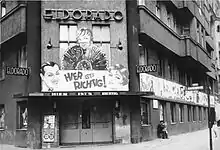 Eldorado at Motzstr. 15, Berlin (1932) | |
| |
| Address | Berlin, Weimar Republic |
|---|---|
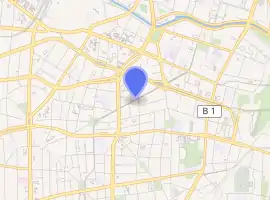
| Coordinates | 52°29′53″N 13°20′56″E |
| Owner | Ludwig Konjetschni[1] |
The Eldorado was the name of multiple nightclubs and performance venues in Berlin, Weimar Republic before the World War II.[2] Two locations were gay bars attracting the LGBTQ+ community as well as artists, authors, celebrities, tourists and a heterosexual audience, and featured drag shows and performances by "transvestites".[1][3][4][5] The club has been described by writers, and artist and have been immortalized in paintings and photographs.[6][7]
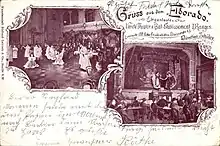

Former locations
These are some of the known locations of Eldorado, listed by descending date of opening:
- Thorstraße 12, Berlin (address changed to Torstraße with an unknown number), this location was active as the Eldorado as early as 1848 (however this location had a different owner).[2]
- Alte Jakobstraße 60, Kreuzberg, Berlin, named the "Eldorado-Diele" and advertised as a "a cozy home for older men"[2]
- Kantstraße 24, Charlottenburg, Berlin, active form c. 1920 – before 1928, and advertised as the “meeting point of the international sophisticated world”.[2]
- Lutherstraße 31/32, Nollendorfkiez area of Schöneberg, Berlin (in 1963, the street name and address changed to MartinLutherStraße 13), active as the Eldorado from 1926 until 1930.[2]
- Motzstraße 15/Kalckreuthstraße 11, Nollendorfkiez area of Schöneberg, Berlin, (a corner location, the address has changed to Motzstraße 24/Kalckreuthstraße 11), active as the Eldorado from 1928 until c. December 1932.[2]
History
Ludwig Konjetschni owned the three of the Eldorado locations (Kantstraße, Lutherstraße, Motzstraße), two of which were known LGBTQ+ spaces (Lutherstraße, and Motzstraße).[8] Many of the details about the history of the Lutherstraße club published in the German book, Ein Führer durch das lasterhafte Berlin: Das deutsche Babylon 1931 (English: A Guide Through Vicious Berlin: The German Babylon 1931) authored by Curt Moreck (pseudonym for Konrad Haemmerling); and the German book, Berlins lesbische Frauen (1928) authored by Ruth Margarete Roellig.
Paragraph 175, a provision in German Criminal Code from 1871 until 1994, made homosexual acts between males a crime.[9] Places like Eldorado offered same-sex dancing partners through a membership system, they issued coins.[10]
The performances at the club were diverse and included effeminate men dressed in women's clothing dancing, and a man singing Parisian-sounding songs in a high-pitched soprano.[4] Marlene Dietrich performed at the club.[1] Additionally they would throw fancy balls and costume parties.[4]
Closure of Motzstraße 15
In December 1932 during the Preußenschlag, the local police chief Kurt Melcher ordered a closure of all the "homosexual dance pleasures” which forced closure on more than a dozen clubs.[2] A few weeks later the Nazis were in power.[2] Ernst Röhm was a regular at the club prior to the closure.[2] Hitler was appointed chancellor in January 1933, and shortly after the Nazi's seized the club space at Motzstraße 15 to use it as the Sturmabteilung (SA) headquarters.[11] By May 1933, Berlin's Institute for Sexual Science (Institut für Sexualwissenschaft) was also raided by the Nazis.[11]
As of 2015, the location is an organic grocery store.[2]
Legacy
The club was written about in the German nonfiction book, Ein Führer durch das lasterhafte Berlin: Das deutsche Babylon 1931 (English: A Guide Through Vicious Berlin: The German Babylon 1931), authored by Curt Moreck (pseudonym for Konrad Haemmerling). Two of the fiction novels by Christopher Isherwood are partially set at the Eldorado; Mr Norris Changes Trains (1935; U.S. edition titled The Last of Mr Norris) and Goodbye to Berlin (1939).[12]
Artist Christian Schad painted the portrait, Count St. Genois d'Anneaucourt in 1927 (1927) which is now held at the Centre Pompidou, and on the right side of the painting is a well-known transsexual that was a regular at the Eldorado.[13][14] Otto Dix's watercolor painting titled, Eldorado (1927)[15] and Ernst Fritsch's triptych painting, Erinnerung an Eldorado (1929) immortalized the club.
The first Berlin radio station that featured gay content, Eldoradio (radio broadcast) (1985–1991) was named after the nightclub.[16]
Notable people
A list of notable people associated with the Eldorado club.
References
- Badhan, Mya (2020-10-11). "Hope between the horrors: The forgotten LGBTQ+ firsts of Weimar Germany – New Histories". Retrieved 2021-04-14.
- Kuhrt, Aro (2015-07-01). "Das Eldorado". Berlin Street (in German). Retrieved 2021-04-14.
- "A Peek Inside Berlin's Queer Club Scene Before Hitler Destroyed It". The Advocate. 2016-07-19. Retrieved 2021-04-14.
- "Die erste Weltmetropole für Lesben und Schwule". www.tagesspiegel.de (in German). Retrieved 2021-04-14.
- "Das schwule und lesbische Berlin der Zwanziger Jahre". www.tagesspiegel.de (in German). Retrieved 2021-04-14.
- Ellison, Joy (2021-03-16). "Rainbow Rant: The queer time traveler's vacation guide". Columbus Alive. Retrieved 2021-04-14.
- "Das schwule und lesbische Berlin der Zwanziger Jahre". www.tagesspiegel.de (in German). Retrieved 2021-04-14.
- Bryant, Chris (2020-11-12). The Glamour Boys: The Secret Story of the Rebels who Fought for Britain to Defeat Hitler. Bloomsbury Publishing. p. 59. ISBN 978-1-5266-0175-9.
- "Germany to quash convictions of 50,000 gay men under Nazi-era law, Parliament votes through measure overturning conviction and offering compensation to the estimated 5,000 men still alive". the Guardian. 2017-06-22. Retrieved 2021-04-14.
- Raber, Ralf Jörg (2010). Wir sind wie wir sind: Ein Jahrhundert homosexuelle Liebe auf Schallplatte und CD. Männerschwarm Verlag. ISBN 978-3-939542-91-9.
- "Photo of the Eldorado Club". Experiencing History, Holocaust Sources in Context. United States Holocaust Memorial Museum. Retrieved 2021-04-14.
- "Weeste noch…?". Spreedarling (in German). Retrieved 2021-04-14.
- Schad, Christian. "URBANE DECADENT". The New Yorker. Retrieved 2021-04-14.
- Dollenmaier, Verena (2007). "Konzession an die Konvention: "Graf St. Genois d'Anneaucourt"" [Concession to the Convention: “Count St. Genois d'Anneaucourt”]. Die Erotik im Werk von Christian Schad: eine Untersuchung (in German). VDM, Verlag Dr. Müller. pp. 150–155. ISBN 978-3-8364-2667-1.
- Tamagne, Florence (2006). A History of Homosexuality in Europe, Vol. I & II: Berlin, London, Paris; 1919-1939. Algora Publishing. pp. cover, vi. ISBN 978-0-87586-356-6.
- Johnson, Phylis W.; Keith, Michael C. (2014-12-18). Queer Airwaves: The Story of Gay and Lesbian Broadcasting: The Story of Gay and Lesbian Broadcasting. Routledge. p. 179. ISBN 978-1-317-46151-7.
Further reading
- Roellig, Ruth Margarete (1928). Berlins lesbische Frauen [Berlin's Lesbian Women]. Bibliothek der Frauenfrage in Deutschland. Magnus Hirschfeld (introduction). Bruno Gebauer Verlag f. Kulturprobleme. p. 52.
- Moreck, Curt (1931). Ein Führer durch das lasterhafte Berlin: Das deutsche Babylon 1931 [A Guide Through Vicious Berlin: The German Babylon 1931]. Bebra Verlag. ISBN 978-3898091497.
- Eldorado, Homosexuelle Frauen und Männer in Berlin, 1850–1950: Geschichte, Alltag und Kultur [Eldorado, Homosexual Women and Men in Berlin, 1850–1950: History, Everyday Life and Culture]. Schwules Museum (Berlin). Vertag Rosa Winkel, Edition Hentrich. 1992. ISBN 9783894680329.CS1 maint: others (link)