Eleanor Foraker
Eleanor ("Ellie") Foraker (September 2, 1930 - December 8, 2011) was an American seamstress who worked at the International Latex Corporation, and was involved in many projects related to NASA's space program.[1] After being moved from the Playtex division of ILC Dover in 1964 (the division where bras, girdles, and cloth diapers were produced), Foraker also worked on the A7L space suit for the Apollo 11 mission, and on underground inflatable oil tanks and gas masks.[1][2] Foraker's last contribution at ILC Dover before her retirement was with the Pathfinder Mission, where she worked on stitching together the air bag system that was used to land the Sojourner rover on Mars.[1][3]
Personal life and early career
Foraker was born September 2, 1930 in Kenton, Delaware.[1] She worked at ILC Dover for 43 years, during which she collaborated on projects in both a seamstress and managerial capacity.[1] When ILC competed for a contract to design and create the spacesuit for the Apollo missions, Foraker was asked to join the team of seamstresses making the suits.[4][5] In 1964 Foraker moved from sewing cloth diaper covers at Playtex to sewing the Apollo spacesuits.[2] Foraker also worked as a supervisor as a manager at ILC from 1968 to 1974.[5]
Apollo mission
While Foraker had a hand in many projects over the years that she worked at ILC, the creation of the A7L spacesuit for the Apollo program is undoubtedly the most well known and important project that she contributed to. The suit created by ILC Dover and its team of seamstresses and engineers, was significantly different from the other suits put forth in the bid for this contract, and it had a lot to do with the collaboration of the ILC Dover team and the utilization of their Playtex division products and processes.[2] Pulling expert seamstresses like Foraker off the Playtex floor and putting them on the spacesuit project resulted in a 21-layer suit both sewn and glued together, whose softness and flexibility made it a stand out against the harder, less flexible suits put forth by their competitors (mainly military designers and engineers).[2][4] The spacesuit needed to be able to withstand immensely cold and hot temperatures, be flame resistant, and essentially protect the wearer from any harmful atmospheric conditions.[7] The very exacting specifications that this necessitated, required great skill, creativity and attention to detail from Foraker and the other seamstresses. The suits needed to have a seam allowance of less than one sixty-fourth of an inch, and any mistakes made in this precise measurement meant discarding the whole piece and starting anew.[2] Another difficulty in creating the suits was the problematic usage of pins (a staple tool of the seamstress), because they could create damage to the suits, and thus compromise the safety of the person wearing it.[2] The suits had to have an impermeable rubber bladder, and any chance of a misplaced hole, or pin left hidden in the fabric was such a serious safety issue that the suits were x-rayed to double check that no pins had been left in the work.[2] Severely limiting the use of pins required even more skill and creativity on the part of the seamstresses. One of Foraker's specific tasks in her supervisory role was to manage the use of sewing pins by the sewing staff.[5] Each seamstress was given a set of pins with different coloured heads, so that Foraker could track who had worked on each suit. If a pin was found in the suit (from either the coloured set, or brought from home), it would typically result in pin poke to the behind.[2][5]
Technology
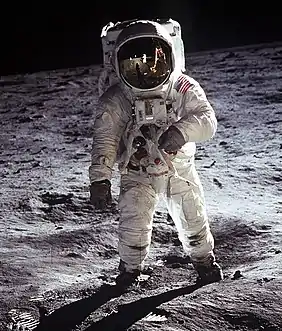
Part of what made these spacesuits so unique was the integration of Playtex fabrics and technologies into their design. The use of liquid latex in which different suit parts were dipped was integral to creating mobility for joint areas such as the elbows.[2] Liquid latex was piped into the room used for dipping these parts from the same tanks that also supplied the bra and girdle assembly lines for Playtex (until 1966).[2] There was also a cross-pollination of other materials from Playtex, as fabrics such as nylon tricot (used to create bras), and the fuzzy lining used in girdles were integrated into the suit for comfort and flexibility.[2] At this time, the spacesuits were not made as generic sizes, but had every aspect of the suit specifically sized to the person that was wearing it. This meant that the knowledge and expertise of the seamstresses was key, as they were constantly making alterations as multiple fittings would bring different problems or preferences to the fore.[2]
Work culture
One aspect of the ILC Dover work culture that made the spacesuit project so successful was a focus on collaboration, teamwork and respect between the seamstresses and engineers who were working on the suits.[2] More seamstresses like Foraker had been brought over to the project from the Playtex division (all of whom were women), and were encouraged to share their expertise and knowledge by teaching the engineers how to sew, and suggesting ways to improve the suits as they worked on them.[2] The respect had for the work that the seamstresses were doing was integral to creating a properly functioning suit, and was exhibited especially by the project head of the suit development, Leonard (Lenny) Sheperd.[2] During the final stages of the suits production, Sheperd would stay at the Dover plant with Foraker for many late nights and help move the bulky suits as she sewed them using one of the two modified singer sewing machines (dubbed 'Big Moe' and 'Sweet Sue').[2] At this time Foraker was also undertaking a supervisory role, and working eighty hour work weeks, sometimes only leaving the plant for two hours before coming back.[8] Foraker's dedication to the creation of the spacesuit meant that aside from these long work weeks, she had no days off or vacations for three years, and also ended up suffering two nervous breakdowns during this time.[8]
Lasting impacts
The softer and more flexible A7L spacesuit that was created by ILC Dover would become the template for which future spacesuit designs would be modelled after. The work that Eleanor Foraker, and this team of seamstresses did is significant in the ways in which it remained largely unacknowledged for the better part of the 20th century. This can be understood in looking at the ways in which 'women's work' in general, but specifically sewing with its links to the domestic sphere, has historically been devalued, underpaid, and obfuscated as 'real work'.[9] The incredible amount of time, skills and knowledge that these women contributed in sewing these suits helps to shed light on these realities and re-situate this work as such that is highly skilled and valuable. Among the names known and valourized for their connection to the Apollo missions, the work of the seamstresses and Foraker had remained mostly hidden until the 21st century when this started to shift. The widely acclaimed book-based movie Hidden Figures, which follows the lives of three Black women mathematicians working at NASA during the space race, exemplifies this push to acknowledge the important contributions that women have made in the past century that have remained relatively hidden. The book, Spacesuit: Fashioning Apollo, published in 2011, details the incredible amount of work that went into the making of the A7L spacesuit, and acknowledges how integral the team of seamstresses were in the suit coming together.[2] While no movie has yet been released, in 2013 Warner Bros. had had plans to adapt this book into film, hiring Richard Cordiner to write the script for it.[10] Inspired by the real events of Foraker's life, a children's book entitled The spacesuit: how a seamstress helped put a man on the moon, was published in 2019 which loosely follows her story working on the A7L spacesuit.[4]
References
- "Eleanor "Ellie" Foraker Obituary (2011) Delaware State News". Legacy.com. Retrieved 2021-11-13.
- de Monchaux, Nicholas (2011). Spacesuit : fashioning Apollo. MIT Press. pp. 209–211, 219. ISBN 978-0-262-01520-2. OCLC 776119891.
- "Airbag Test Page". mars.nasa.gov. Retrieved 2021-11-14.
- Donald, Alison. The spacesuit : how a seamstress helped put man on the moon. ISBN 978-1-6622-5560-1. OCLC 1204100314.
- "The Space Suit." Moon Machines, Science Channel Documentary, 2008.
- Brueck, Hilary. "Women made the Apollo moon landing possible — here are the crucial technologies and calculations they contributed". Business Insider. Retrieved 2021-11-14.
- Chow, Denise (2011-01-24). "Everyday Tech from Space: Out of NASA Tragedy, Better Fireproof Clothes". Space.com. Retrieved 2021-11-15.
- "Robin McKie on the fallen dream that was the moon landings". the Guardian. 2009-06-20. Retrieved 2021-11-14.
- Thompson, Emma (2021-08-17). Sew what: An ethnographic exploration of contemporary garment sewing practices in Kingston Ontario (thesis thesis).
- Jr, Mike Fleming; Jr, Mike Fleming (2013-05-22). "Warner Bros Tells Space Story, From The Bra Designers Who Made Moon Mission Possible". Deadline. Retrieved 2021-11-21.