Electride
An electride is an ionic compound in which an electron is the anion.[1] Solutions of alkali metals in ammonia are electride salts.[2] In the case of sodium, these blue solutions consist of [Na(NH3)6]+ and solvated electrons:
- Na + 6 NH3 → [Na(NH3)6]+,e−
The cation [Na(NH3)6]+ is an octahedral coordination complex.
Solid salts
Addition of a complexant like crown ether or 2,2,2-cryptand to a solution of [Na(NH3)6]+e− affords [Na (crown ether)]+e− or [Na(2,2,2-crypt)]+e−. Evaporation of these solutions yields a blue-black paramagnetic solid with the formula [Na(2,2,2-crypt)]+e−.
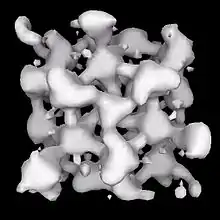
Most solid electride salts decompose above 240 K, although [Ca24Al28O64]4+(e−)4 is stable at room temperature.[3] In these salts, the electron is delocalized between the cations. Electrides are paramagnetic, and are Mott insulators. Properties of these salts have been analyzed.[4]
Reactions
Solutions of electride salts are powerful reducing agents, as demonstrated by their use in the Birch reduction. Evaporation of these blue solutions affords a mirror of Na. Such solutions slowly lose their colour as the electrons reduce ammonia:
- 2[Na(NH3)6]+e− → 2NaNH2 + 10NH3 + H2
This conversion is catalyzed by various metals.[5] An electride, [Na(NH3)6]+e−, is formed as a reaction intermediate.
High-pressure elements
Theoretical evidence supports electride behaviour in insulating high-pressure forms of potassium, sodium, and lithium. Here the isolated electron is stabilized by efficient packing, which reduces enthalpy under external pressure. The electride is identified by a maximum in the electron localization function, which distinguishes the electride from pressure-induced metallization. Electride phases are typically semiconducting or have very low conductivity,[6][7][8] usually with a complex optical response.[9] A sodium compound called disodium helide has been created under 113 gigapascals (1.12×10⁶ atm) of pressure.[10]
Layered electrides (Electrenes)
Layered electrides or electrenes are single-layer materials consisting of alternating atomically thin two-dimensional layers of electrons and ionized atoms.[11][12] The first example was Ca2N, in which the charge (+4) of two calcium ions is balanced by the charge of a nitride ion (-3) in the ion layer plus a charge (-1) in the electron layer.[11]
See also
References
- Dye, J. L. (2003). "Electrons as Anions". Science. 301 (5633): 607–608. doi:10.1126/science.1088103. PMID 12893933. S2CID 93768664.
- Holleman, A. F.; Wiberg, E. "Inorganic Chemistry" Academic Press: San Diego, 2001. ISBN 0-12-352651-5
- Buchammagari, H.; et al. (2007). "Room Temperature-Stable Electride as a Synthetic Organic Reagent: Application to Pinacol Coupling Reaction in Aqueous Media". Org. Lett. 9 (21): 4287–4289. doi:10.1021/ol701885p. PMID 17854199.
- Wagner, M. J.; Huang, R. H.; Eglin, J. L.; Dye, J. L. (1994). "An electride with a large six-electron ring". Nature. 368 (6473): 726–729. Bibcode:1994Natur.368..726W. doi:10.1038/368726a0. S2CID 4242499.CS1 maint: multiple names: authors list (link).
- Greenlee, K. W.; Henne, A. L. (1946). Sodium Amide. Inorganic Syntheses. 2. pp. 128–135. doi:10.1002/9780470132333.ch38. ISBN 9780470132333.
- Marques M.; et al. (2009). "Potassium under Pressure: A Pseudobinary Ionic Compound". Physical Review Letters. 103 (11): 115501. Bibcode:2009PhRvL.103k5501M. doi:10.1103/PhysRevLett.103.115501. PMID 19792381.
- Gatti M.; et al. (2010). "Sodium: A Charge-Transfer Insulator at High Pressures". Physical Review Letters. 104 (11): 216404. arXiv:1003.0540. Bibcode:2010PhRvL.104u6404G. doi:10.1103/PhysRevLett.104.216404. PMID 20867123. S2CID 18359072.
- Marques M.; et al. (2011). "Crystal Structures of Dense Lithium: A Metal-Semiconductor-Metal Transition" (PDF). Physical Review Letters. 106 (9): 095502. Bibcode:2011PhRvL.106i5502M. doi:10.1103/PhysRevLett.106.095502. PMID 21405633.
- Yu, Zheng; Geng, Hua Y.; Sun, Y.; Chen, Y. (2018). "Optical properties of dense lithium in electride phases by first-principles calculations". Scientific Reports. 8 (1): 3868. arXiv:1803.05234. Bibcode:2018NatSR...8.3868Y. doi:10.1038/s41598-018-22168-1. PMC 5832767. PMID 29497122.
- Wang, Hui-Tian; Boldyrev, Alexander I.; Popov, Ivan A.; Konôpková, Zuzana; Prakapenka, Vitali B.; Zhou, Xiang-Feng; Dronskowski, Richard; Deringer, Volker L.; Gatti, Carlo (May 2017). "A stable compound of helium and sodium at high pressure". Nature Chemistry. 9 (5): 440–445. arXiv:1309.3827. Bibcode:2017NatCh...9..440D. doi:10.1038/nchem.2716. ISSN 1755-4349. PMID 28430195. S2CID 20459726.
- Druffel, Daniel L.; Kuntz, Kaci L.; Woomer, Adam H.; Alcorn, Francis M.; Hu, Jun; Donley, Carrie L.; Warren, Scott C. (2016). "Experimental Demonstration of an Electride as a 2D Material". Journal of the American Chemical Society. 138 (49): 16089–16094. arXiv:1706.02774. doi:10.1021/jacs.6b10114. PMID 27960319. S2CID 19062953. Retrieved 12 October 2021.
- Druffel, Daniel L.; Woomer, Adam H.; Kuntz, Kaci L.; Pawlik, Jacob T.; Warren, Scott C. (2017). "Electrons on the surface of 2D materials: from layered electrides to 2D electrenes". Journal of Materials Chemistry C. 5 (43): 11196–11213. doi:10.1039/C7TC02488F. Retrieved 11 October 2021.
Further reading
- J. L. Dye; M. J. Wagner; G. Overney; R. H. Huang; T. F. Nagy; D. Tománek (1996). "Cavities and Channels in Electrides". J. Am. Chem. Soc. 118 (31): 7329–7336. doi:10.1021/ja960548z.
- JCTC