Electronic Registration Information Center
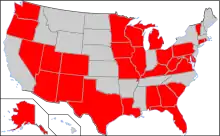
The Electric Registration Information Center (ERIC) is a USA, non-profit, organization that is operated and financed by state elections agencies and chief elections officials. States created ERIC to improve the accuracy of state voter registration rolls and boost access to voter registration for all American citizens. ERIC, with logistical and financial support from the Pew Charitable Trusts, was launched in 2012 by elections officials from seven states. Membership has grown to 30 states and the District of Columbia. The Pew Charitable Trusts, although integral to the creation of ERIC, now has no role with ERIC. Pew informed states that it would have no role with the organization after start-up and it wanted states to control and finance the organization.
Mission
At least every 60 days each ERIC state submits their voter registration data and motor vehicle licensing data to ERIC. ERIC’s technical staff matches that data against data from all the other member states and Social Security death data. ERIC uses the most sophisticated matching software available to identify voters who have moved, voters who have died, and voters with duplicate registrations within a state’s database. States may also request National Change of Address (NCOA) reports using official data from the US Postal Service and, after federal general elections, participate in a fraud check to see if voters cast ballots in more than one state. ERIC also, by matching voter data against motor vehicle licensing data, identifies individuals who are not yet registered so election officials can provide information on how to register to vote.
Structure
Each jurisdiction has a member's seat on the ERIC Board of Directors. The Board has created an executive committee and advisory committees to assist with issues related to data security and research. Key responsibilities of the Board of Directors include approving the annual budget, setting annual membership dues, and a periodic review of ERIC's Information Security Plan and policies. ERIC is governed by bylaws and a membership agreement that each state must sign before joining: https://ericstates.org/wp-content/uploads/2020/02/ERIC_Bylaws_01-2020.pdf
The seven states that created ERIC in 2012 were Colorado, Delaware, Maryland, Nevada, Utah, Virginia, and Washington. By 2019, Alabama, Alaska, Arizona, Connecticut, Florida, Georgia, Illinois, Iowa, Kentucky, Louisiana, Michigan, Minnesota, Missouri, New Mexico, Ohio, Oregon, Pennsylvania, Rhode Island, South Carolina, Vermont, West Virginia, and Wisconsin had joined the partnership, with Texas joining in March 2020[1] and Oklahoma adopting legislation to join in April, 2021.[2] In the 2020-2021 fiscal year, its budget was slightly more than $1 million.
States joining ERIC have agreed to pursue non-partisan and protective goals.[3] David Becker, former head of the elections program at Pew and the executive director of the Center for Election Innovation and Research observed, "If we didn't do that, ERIC would become another politicized tool."[3] ERIC's membership includes both traditionally "red," and "blue" jurisdictions. Private personal information, including date of birth, driver's license, and Social Security numbers, are stringently encrypted to ensure privacy. The program locates those eligible to vote no matter what their domiciles.[3] Participating states are required to mail notifications to people identified as eligible to vote but not registered. Follow-up research in some states concluded that 10 to 20 percent of those contacted had later registered to vote, a high response rate for direct mailings, Mr. Hamlin said. That rate suggests 2.6 million to 5.2 million of the 26 million people notified became voters.[3] Some state administrators said determining a person's current domicile can present problems, per the Brennan Center study.[3] Member states report that "false positives" are rare. Unopened returned mail — evidence of a wrong address — is substantially reduced. Colorado's outreach produced the highest percentage of eligible, registered voters in the country in 2016, at 90 percent, up from 82 percent in 2012. "For my money, ERIC is a big part of that," said Judd Choate, Colorado's director of elections. "ERIC has been a game-changer in elections for those of us in it." Jonas has been particularly pleased that ERIC has a small staff that tends the constantly growing database of more than 275 million records. He says, "It's not beholden to an army of experts."
History
ERIC has succeeded while another effort by states to use data matching to identify possible voter fraud Interstate Voter Registration Crosscheck Program (IVRC), or "CrossCheck, " was abandoned. That was a labor-intensive and largely ineffective enterprise that had been developed in the interests of protecting the integrity of elections by focusing on and identifying voters who cast ballots in more than one state in the same electoral period. After years of major erroneous purges of voter rolls, harmful misidentification of legitimate voters, and costly operation in return for very marginal success, it was shut down in December 2019 in part off its own weight, but also as a direct result of litigation successfully brought by the Kansas Chapter of the American Civil Liberties Union.[4]
ERIC's data matching software, on the other hand, was developed by minimalist data scientist Jeff Jonas, using his effective software in a multistate project to identify eligible voters who had fallen off the rolls via unreported changes of address, for instance, and thereby to increase voter participation and also to resolve errors in voter rolls, such as removing names of deceased voters.[3] Bringing a different perspective to the difficulties, Jonas reported finding, "As I dove into the subject, it grew on me, the complexity and relevance of the problem."[3] Between 2012 and 2018, ERIC identified 26 million persons who were eligible to cast ballots but were not registered to vote, as well as 10 million registered voters who had moved, or who appeared on more than one list.[3] As with many aspects of the electoral process, the maintenance and integrity of voter rolls are prominent issues. ERIC's role in the process is determinedly neutral. Administrators from both Democratic and Republican majority states have participated in the process of refining the product and reduced the challenge of handling data processing. Jonas modified his existing technology to accommodate the new challenges to identity resolution. "Every time you get two pieces of junk mail from the same place, that's an entity resolution problem," according to Jonas. He says they may be difficult to discern, but they're ubiquitous.[3]
In 2017, researchers at Stanford University, Harvard University, the University of Pennsylvania and the Microsoft Corporation confirmed that Crosscheck produced erroneous eligibility data, elevating the potential of disenfranchising legitimate voters. An investigation by ProPublica found that Crosscheck was also lacking sufficient protection to keep registrant information from being hacked. [5]
References
- Texas Joins Electronic Registration Information Center
- Millions of Unregistered Voters, New York Times, Steve Lohr, November 5, 2018. Retrieved December 25, 2019.
- Kansas Abandons Technology Trumpeted by Kris Kobach, Trump's Onetime Voter Fraud Czar, ProPublica, Jessica Huseman December 12, 2019. Retrieved December 27, 2019.
- Your private voter data is unsafe in national database, Mississippi Today, Adam Ganucheau, November 20, 2017. Retrieved December 27, 2019.