Elijah Abel
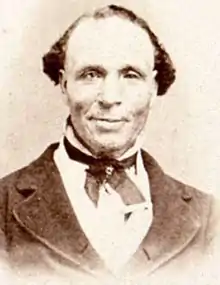
Elijah Abel, or Able or Ables[1] (July 25, 1808– December 25, 1884)[2] was one of the earliest African-American members of The Church of Jesus Christ of Latter-day Saints. He is considered by many to have been the first African-American elder and seventy in the Latter Day Saint movement.[3] Abel, though predominantly of Scotch and English descent,[4] appears by his African heritage to have been the first and one of the few black members in the early history of the church to have received the priesthood.[3][5] He later became the faith's first missionary to have descended in part through African bloodline.[3] Abel did not have his priesthood revoked when the Church began its priesthood ban for black men, but was denied a chance to receive his temple endowment by third church president John Taylor .[6] As a skilled carpenter, Abel often committed his services to the furthering of the work and to the building of LDS temples. He died in 1884, shortly after serving a mission to Cincinnati, Ohio, his last of three total missions for the church.[7][8]
| Elijah Abel | |
|---|---|
 | |
| Third Quorum of the Seventy | |
| December 20, 1836 – December 25, 1884 | |
| Called by | Joseph Smith |
| Elder | |
| January 25, 1836 – December 20, 1836 | |
| Called by | Joseph Smith |
| Personal details | |
| Born | July 25, 1808 Frederick-Town, Maryland |
| Died | December 25, 1884 (aged 76) Salt Lake City, Utah Territory |
| Resting place | Salt Lake City Cemetery 40°46′37.92″N 111°51′28.8″W |
Early life
Elijah Abel was born in Frederick-Town, Maryland on July 25, 1808, to Delilah Williams and Andrew Abel. His mother was of Scottish descent and his father of English descent; his paternal grandfather, Joseph Abel, had been a member of the English House of Commons. A grandmother of Elijah was "half white," or mulatto,[1][4][9][3] and thus Abel was considered to be "octoroon," or one-eighth African.[4]
There was initially some confusion with regards to Abel's birth-year, given that some sources put the year at 1808 and others at 1810.[10][9][11][12] However, the 1850 Census record marks 1808 as the year of Abel's birth,[13] and both Abel's patriarchal blessing and grave marker record 1808 as his birth-year.[2][14]
Some believed that Abel's mother, who died when he was 8 years old,[4] was a slave from South Carolina,[15] but the evidence for this has never been produced.[3] Others have also speculated, based on the assumption Abel was the son of a slave, that he migrated to Canada by way of the underground railroad.[11]: 2 Apart from circumstantial evidence, this claim remains entirely unsubstantiated.[3]
Conversion to the LDS faith
Abel later moved to Ohio,[3][7][16] where he was baptized and confirmed a member of The Church of Jesus Christ of Latter-Day Saints in September, 1832 in Cincinnati.[4] He was baptized by local Mormon elder and blacksmith Ezekiel Roberts, a young father of two.[9][7][16] Shortly after his baptism, Abel moved to the area of Kirtland, Ohio to join in fellowship with the main body of Latter-day Saints congregating there.[3][7][17]: 38
Priesthood ordination
Upon the Prophet Joseph Smith's January 1836 declaration that Elijah Abel was "entitled to the Priesthood and all the blessings,"[4] Abel — who had been, over the many preceding months, an active participant in the construction of the Kirtland Temple (1833–36) by which the Saints would be "endowed with power from on high"[3] — was ordained an elder of the church on 25 January (the five LDS offices in the Melchizedek Priesthood to which eligible men found worthy were ordained, in their order of ascending hierarchy, are: Elder, Seventy, High Priest, Patriarch, and Apostle). The officiator in that priesthood ordinance was Ambrose Palmer, a high priest who was also branch president in New Portage (now Barberton), Ohio, where Abel was then residing (the ordination was "licensed" at Kirtland on 31 March 1836 by the Prophet Joseph and second counselor in the First Presidency Frederick G. Williams).[1][4][11]: 2 [18]
Temple participation, patriarchal blessing & calling as a Seventy
Abel participated in the "Pentecostal season" that accompanied the completion and springtime dedication of the Kirtland Temple in 1836.[3] At the end of that year, only 11 months after his priesthood ordination, Abel was ordained a Seventy and inducted into the Third Quorum of the priesthood on December 20. He was later reconfirmed in 1841 at Nauvoo by Joseph Young and Albert P. Rockwood.[4][11]: 2 Around this time,[19] Elijah also received his patriarchal blessing from Presiding Patriarch Joseph Smith Sr. (the blessing was recorded by Warren A. Cowdery, a church scribe and newspaper editor).[3][10][17]: 38
The common practice when giving patriarchal blessings was to declare an individual to be a descendant of a specific tribe of Israel. Abel, however, was declared an "orphan" from a father who "hath never done his duty toward thee," but it was promised that he would "be made equal to thy brethren, and thy soul be white in eternity and thy robes glittering."[14][20]: 131 In this way Abel was perhaps "adopted" into the House of Israel, for the recorded blessing does not specifically declare his tribal lineage.[14] In 1836, Abel was among the first to receive the church's revealed "higher" ordinance of the "Initiatory," and was thus "washed and anointed" in the Kirtland Temple.[4]
Mission to Upper Canada
During the late 1830s, Abel labored as a missionary in New York and Upper Canada, an assignment which was part of a safe-haven and proselyting solution for black slave refugees. This solution also helped to create an effective deflection from perceived Mormon sympathies toward the abolitionist movement in the United States, a perception that agitated an already unfavorable situation for the Latter-day Saints as they sought to realize their dreams for a "Zion" community in Missouri.[7][17]: 38 [21]
In June 1838, Abel baptized 25-year-old Eunice Ross Kinney while serving in St. Lawrence County, New York, who even after Abel's death remembered him as a "powerful" minister, one who had been "ordained by Joseph the martyr."[22][8][11]: 3 Abel taught Kinney and others he baptized that "the time was drawing near for [Christ's] coming[21] but He would not come till God had a people prepared to receive Him, with all the gifts and blessings that adorned His church anciently."[21][23][24] Abel in his ministry often quoted the Apostle Peter: "Think it not strange, brethren, concerning the fiery trials[3][21] which are to try you...".[3]
Due to civil unrest and rebellion in Upper Canada, Abel's missionary travels were frequently punctuated with perilous situations and persecutions; at one point during his mission he was falsely accused of the murder of a family of six, and aggressively pursued by a mob bearing hot tar and feathers.[7] Such circumstances were certainly not unfamiliar to many Mormon missionaries of the time, nor to their leaders.[11]: 3 In retrospect, Abel's providential escape from his enemies in his travels did seem to fulfill a patriarchal promise (while also foreshadowing a dreadful civil war[21][3] that would soon strike at the heart of his own country):
Thou shalt see [the destroyer's] power in laying waste the nations, & the wicked slaying the wicked, while blood shall run down the streets like water, and thy heart shall weep over their calamities. Angels shall visit thee and thou shalt receive comfort. They shall call thee blessed and deliver thee from thine enemies. They shall break thy bands and keep thee from afflictions.[14]
Time in Nauvoo, temple building & civil marriage
Abel moved from Kirtland to Commerce (later renamed Nauvoo), Illinois in 1839, upon returning from his mission to Canada.[20] He likely settled on the property he came to own—Block 111, located northwest of the city "flats" on the banks of the Mississippi.[3] While living in Nauvoo, Abel continued to further immerse himself in church work and activity. One such duty was that of performing "baptisms for the dead" (the second of the church's "higher" ordinances to be revealed), of which Abel is known to have performed at least two: one for a friend by the name of "John F. Lancaster," and one for his mother, Delilah.[17][7][11]: 4 In this early period of the church—and before the full "temple endowment" or "celestial marriage" rites had been revealed—these baptisms on behalf of the dead were initially performed in the frigid waters of the Mississippi River, and not in temples as they would later be.
Another of Abel's duties included acting as an undertaker at the request of Joseph Smith. He was likely responsible for the fashioning of coffins and the digging of graves, and this calling may have been in response to the Malaria epidemic of 1839-40.[3][17]: 38 Abel continued to work in Nauvoo as a carpenter; he was a member of the group called the House Carpenters of the Town of Nauvoo. During Abel's time in Nauvoo he was personally acquainted with the Prophet Joseph, who he considered a dear friend.[3]
Joseph's high estimation of Abel is evident in the his dictated phrasing of Abel's priesthood license: Joseph recommends Abel as his "worthy brother in the Lord," one who is "duly authorized" to spread the gospel in a manner "equal to the authority of that Office."[25] In turn, Abel's devotion to the Prophet was manifest when—on June 6,1841—he and six other men, including Hosea Stout, quickly mobilized themselves as an expeditionary militia force to attempt the rescue of Smith after his unlawful arrest by Missouri and Illinois officers at Quincy, Illinois. By the time they reached Quincy, however, Smith had obtained a writ of habeas corpus and had been returned safely to Nauvoo.[26][27]
In 1842 Abel gathered up his belongings (leaving the deed to his Block 111 property to Nauvoo Stake President William Marks)[3] and returned to Cincinnati, Ohio, likely on assignment by Joseph Smith.[7][20] There he continued his carpentry and boarded for a time with a local painter named John Price on Eighth Street, between Sycamore and Broadway.[3]
On February 16, 1847, thirty-nine-year-old Elijah married sixteen-year-old Mary Ann Adams[28] of Nashville, Ohio,[13][7][17]: 38 who was also one-eighth African-American, or octoroon.[17][4] Abel acted as a leader of the church in Cincinnati, and was recognized as such by Joseph Smith, who pronounced to Orson Hyde and others: "Go to Cincinnati... and find an educated negro, who rides in his carriage, and you will see a man who has risen by the power of his own mind to his exalted state of respectability."[29][20]: 133
Migration and later years in Utah
In May 1853, Abel and his family migrated as part of the Appleton M. Harmon pioneer company to Utah Territory, the new headquarters of the church.[30][20] After the company's arrival in the Salt Lake Valley on October 17, Abel's family moved to Millcreek a few miles south of Salt Lake City, Abel continued to work as a carpenter as part of the LDS public works program;[3][17] Abel also assisted in the construction of the Salt Lake Temple. By 1860 the Abel family had moved to Salt Lake City's Thirteenth Ward, and lived only a short distance from the Temple Block. For a short time, a 43-year-old white schoolteacher named Alex Warrender who had crossed the overland trail as a teamster in 1858, boarded with the Abel family.[3]
Abel remained a member of the Seventy and continued to be active in the church. Along with his wife Mary Ann and their oldest son Moroni, Abel was rebaptized on March 15, 1857 as part of the Mormon Reformation.[3][17]: 39 During the mass southern migration of church members in 1858 to avoid conflict with Johnston's invading army during the Utah War, Abel stayed behind with other watchmen to ensure—should the invaders make any false move—that the emptied city be set aflame and left in ashes; the U.S. troops marched through Salt Lake City without incident.[7]
In addition to his carpentry, Abel and his wife managed the Farnham House hotel on 2nd South Street, which was advertised as a "first class" boarding house that boasted "good stabling and corrals." The hotel charged $11 per week for room and board ($9 per week for board only) and 75¢ for a single meal.[3][31] By 1860, Abel and his wife had two more children,[30] and by 1862, as the Civil War raged in the East, their growing family had relocated to the Tenth Ward in Salt Lake City.[3]
Very little is known about the personal lives of the Abel family. In 1870 they moved to Ogden, Utah for a short time before returning to Salt Lake City.[11]: 6 Of the known children born to Elijah and Mary Ann, three were born in Cincinnati—Moroni, Enoch, and Anna Rebecca[28]—and five more in Utah Territory—Delilah, Mary, Elijah Jr., Maggie, and Flora.[3][7] They also took into their home a young woman named Rola (about Moroni's age) from Ohio whom they later adopted.[7] Utah residents during this period remembered the Abel family as traveling up and down the Wasatch front (a mountain valley stretch of contiguous towns from Provo to Ogden) entertaining audiences with their "shows:"
It seems most likely that Abel played the fiddle or violin, while the family — including eight children between the ages of about one and twenty years old — acted, danced, sang, or played along with their father on other instruments. "There was a family of colored folks by the name of Able [sic]," remembered one Utah resident, "who went around from ward to ward and put on performances for the public."[3]
In 1871, Abel's son Moroni passed away, followed by Abel's wife in 1877 from pneumonia.[3] Following these tragedies, Able approached John Taylor, successor to Brigham Young, and requested his endowment, which was again denied.[7]: 250
Despite the many years of repeated temple-ordinance denials for himself and his family, Abel remained faithful and served a final mission to Ohio and Canada in 1883-84, during which he became ill. His worsening health resulted in his return to Utah in December 1884. Abel died only two weeks after his return, on Christmas Day—"in full faith of the Gospel," as read his obituary.[3][11]: 8 His body was interred at the Salt Lake City Cemetery alongside his wife, and his original grave marker is inscribed with the words: "Elijah Able — At Rest."[32]
Disputes over priesthood
Meeting in Cincinnati, 1843
On June 25, 1843, a regional conference occurred in Cincinnati in which apostles John E. Page, Orson Pratt, Heber C. Kimball, and future-apostle Lorenzo Snow presided as part of a "Traveling High Council" to organize a Mormon branch there.[3]: 77 During the conference, questions regarding Abel and his membership were addressed, including the acknowledgement of recent complaints from some of the local white populace about Abel's public preaching activity.[10][7] Apostle John E. Page stated that while "he respected a coloured Brother, wisdom forbid that we should introduce [him] before the public."[3]: 77 At the time, Cincinnati was a hot-bed of conflict between what the two general groups of escaped slaves and anti-abolitionist Irish Catholics. Pratt and Kimball supported Page's statements, and the leaders resolved to restrict Abel's activities as a member of the church.
At the conclusion of the conference, Abel was called to serve a second mission locally, but he was instructed to visit and teach only the "coloured population".[3]: 77 In their deliberations, the leaders had also referenced some of Abel's potentially threatening actions that stemmed from his time in Upper Canada. While in Canada, his activity to encourage flight from the civil uprisings there to the American "Zion" was viewed with disdain by his colleagues, as such activity may have been seen by the British government as "pro-American sympathizing," or even treason in absentia—potentially inciting or exacerbating further revolt. The missionary associates who had accused him—John Beckstead, Christopher Merkeley, John Broeffle, and some who later apostatized from the church including Zenas Gurley and James Blakeslee[7][16]—cited Abel's claims "that an elder… had as much authority" as a high priest in the church, and "that there would be stakes of Zion in all the world."[7][16] The latter statement was most alarming to them, in light of early Mormonism's millenarian worldview that espoused gathering to a "central" Zion.[21] However, despite these allegations of teaching what was perceived by some to be "false doctrine,"[33] no disciplinary action was taken against Elijah.[3][7]
Up until 1843, Abel had suffered very little discrimination from within the church. The results of the conference, however, marked a turning point for Abel and other colored, faithful adherents of the faith. For the first time, race had been used as a criterion for limiting church activities.[20]: 131 The leaders of the conference in Cincinnati made no statement that would suggest that the resolution of the meeting had been based on divine revelation, or that it constituted any sort of doctrinal mandate, but rather they deemed it an act of prudence to address the dynamic racial and politically turbulent climate of the times.[8][3]: 77
The 1849 priesthood ban
As a leader in the church in Cincinnati, and one of the three presiding area seventies at a specially convened branch conference on June 1, 1845, Abel moved for the excommunication of three women—identified as "Mrs. Carter, Mrs. Evans, and Miss Jane Roberts"—for "speaking disrespectfully against the leaders of the church," a motion which was "moved and seconded."[3] The church, despite reorganization efforts, was still unstable following the death of Joseph Smith, Jr., who had been murdered at Carthage Jail along with his brother Hyrum by a mob less than a year before. However, in the face of dissent and discord, the Cincinnati branch of 32 members "all in good standing" could claim that it was, by mid-1845, more unified than it had been "for the last three years."[7]
The few black individuals who belonged to the Latter-day Saint faith had full fellowship in the early church, which included entering into priesthood leadership positions such as Abel had. Another notable figure is Joseph T. Ball, who in 1844 in Boston had been the first man of African descent to become a branch president and to preside over an LDS congregation; Ball had been earlier called in 1841 by the Quorum of the Twelve on a mission to South America.[3]: 100
In 1849, Brigham Young—having succeeded Smith as church president—issued a church-wide ban on blacks men from being ordained to the priesthood. The policy's initial reveal by Young to the Twelve may have occurred up to two years earlier at Winter Quarters, Nebraska, possibly "between 8 and 14 April 1847".[34] Young's pronouncements in 1849 constitute the earliest known statements which officially exclude those of African descent from an ordinal endowment or a wielding of priesthood power.
This decision may have been brought about in part by the actions of William McCary, an African-American convert to the church living in Cincinnati, who believed he was a prophet and claimed on various occasions to be Jesus and Adam, father of the human race.[10][7] In 1847, as the Saints resided at Winter Quarters, McCary was excommunicated, following the discovery of various unauthorized polygamous sealings performed in his home.[3][10][7][16]
By 1847, in the unfavorable light of these and other developments, Abel's priesthood authority had begun to be challenged, despite his well-respected status within the church community.[8][3]: 99 Even after the 1849 official prohibition for all Latter-day Saint "brethren of color,"[35] Abel remained involved in the church. As one who already held the priesthood, he continued to serve as a seventy in Cincinnati from 1842 to 1853,[36] and in the autumn of 1883 served another mission to Cincinnati shortly before his death.[37]
As the church continued to migrate its members to the West, Mormons were exposed to a larger population of blacks, and anti-black political attitudes continued to increase among church members.[8][10][7] Before moving West, other influential black members of the church had included "Black Pete"[38]—a member of the "Morley Family," who in the early days of the church at Kirtland became notorious by drawing from his Protestant revivalist "enthusiasm" and "slave shout" past in trying to appear as the "revelator" he claimed to be.[3] He was ultimately disfellowshipped by Joseph Smith because of his teachings and ecstatic demonstrations, disappearing from the community soon thereafter.[10] Q. Walker Lewis, although "well respected by early Mormon leaders,"[3] also found himself under scrutiny during this period.
Denial of temple ordinances
Although Abel remained a faithful member of the church his entire life, he was not exempt from discrimination that existed in his church and state. His membership, participation, and leadership in the church both during and after his time in Illinois and Ohio was frequently questioned and challenged. After moving to Utah Territory, Abel asked Brigham Young for permission to be sealed to his wife and children, which was denied.[8][17]: 39 Abel again requested a sealing five years later to his deceased wife, son, and daughter—this time from President John Taylor, who then passed it on for the body of the Twelve to consider.[3][17]: 39 Abel's request was again refused, and he was not allowed to enter the temple to be endowed.[8][17][3]: 100
1879 meeting regarding Joseph Smith's statements
While there were no attempts to take away Abel's priesthood authority, his authority was questioned by church leaders. On May 31, 1879 a meeting was held at the residence of Provo mayor Abraham O. Smoot to discuss the conflicting versions of Joseph Smith's views on black men and the priesthood, in response to Abel's petition to be sealed to his recently deceased wife.[3]: 96 [29] President of the Quorum of the Twelve Apostles John Taylor, his secretary L. John Nuttall, mayor Smoot, apostle Brigham Young, Jr. (son of the late prophet), and Zebedee Coltrin were in attendance.[3][29] According to Nuttall, who detailed the meeting in his journal, Coltrin and Smoot made statements about all they could recollect Joseph Smith having ever said about black men and the priesthood.
Some sources state that Abel was ordained to the priesthood by Joseph Smith,[3][39] while other records indicate that he was ordained by Zebedee Coltrin.[40] He was, in fact, first ordained to the priesthood by Ambrose Palmer in January 1836, then as a Seventy by Coltrin in December of the same year.[1][4] Coltrin claimed, however, that Abel had been ordained to the Seventy in exchange for his work on the temples (at Kirtland and Nauvoo), but that Joseph Smith, after Coltrin later confronted him, and upon reflecting a moment on the matter, then realized his "error" and promptly "dropped" Abel from the quorum because of "his lineage."[17]: 39 [29] Coltrin reported that he had this conversation with Joseph Smith in 1834, yet Abel didn't receive the priesthood nor did Coltrin ordain him a Seventy until 1836 (thus making it impossible for Abel to have been "dropped" from any such capacity in 1834); nor had construction even begun on the Nauvoo Temple until 1841.[29] Joseph Smith's nephew and later-successor to the church presidency, Joseph F. Smith, contradicted Coltrin by professing: "Coltrin's memory [is] incorrect as to Brother Abel being dropped from the quorum of Seventies to which he belonged" (italics added). Smith punctuated his statement by pointing out that he had verified as being in Abel's possession two certificates (which notarized the 1836/1841 priesthood licensings referenced above) that declared Abel to be a bonafide elder of the church and a Seventy.[3][17]: 39
Even so, what the "Smoot meeting" at the end of May 1879 accomplished—beyond suddenly bringing into question Abel's long-held authority in a high-profile and likely humiliating setting—was simply a reaffirmation of the church's 1849 policy of excluding black men from receiving the priesthood. The meeting did not change the fact (as neither those meetings preceding or following it would) that Abel had long been granted by the president of the church, and retained yet still, the Melchizedek priesthood.[29]
1879 meetings with Taylor, Smith, and the Seventy
Within a week after the "Smoot meeting,"[1][4] the appointed brethren met again on June 4 to continue their discussion of the topic. Abel was present, and it may well have been for him somewhat reminiscent of a Salt Lake City Council House meeting he'd attended just two months earlier on March 25, which had consisted of 71 members from the church's 33 Seventies quorums. Abel had, on that occasion, stood and addressed the “general meeting of the Presidents and members of the Seventies," fondly reflecting upon his nearly 45-years’ experience as a priesthood-bearing Latter-day Saint. He had recounted there — as he now did for his brethren again, in the first days of June — “his appointment an[d] ordination as a Seventy, and a member of the 3rd Quorum." He recalled for them Joseph's personal words to him, "that those… called to the Melchisadec [sic] Priesthood [having] magnified that calling would be sealed up unto eternal life."[41][8][3]: 99
"The chronological proximity of the Smoot meeting and Abel's defense at the Seventies meeting," observes Jackson, "seems to indicate that the status of blacks (as it related to priesthood and temple ordinances) was then undergoing deep scrutiny at the highest levels. It makes sense that Abel would be asked to weigh in — as a long-time black Seventy."[3]
Now, in June, Abel found himself personally defending his priesthood before his brethren, outlining especially for President Taylor and Apostle Joseph F. Smith its history—which was indeed precious to him[7]—and reaffirming that the "Prophet Joseph told him he was entitled to the priesthood."[42] Armored with these statements of personal testimony, Abel was defending his right to be sealed eternally to his family in the holy temple of God.[3]: 99 Abel expressed to President Taylor his lifelong hope that his endowment of priesthood might prove one day "the welding link" (see D&C 128:18) to bond all of God's people together regardless of race.[7]
By meeting's end, John Taylor concluded at last that Joseph Smith had made "an exception" and had given Abel the priesthood despite his race, perhaps because he was an octoroon (or one-eighth black) and perhaps because he had further proved his worthiness by helping to advance and to build the early church. Taylor moved to honor Smith's decision and ruled that Abel's priesthood would be "allowed to remain."[8][3]: 99
Posthumous commentary on Abel's priesthood
Notwithstanding this seeming triumph for Abel, Church President Joseph F. Smith, in 1902, 1904, and 1908 (his memory perhaps in a state of failing),[3][8][29] declared Abel's ordination to the priesthood as "null and void by [Joseph Smith] himself because of his blackness"—suggesting based on Coltrin's antiquated testimony that the Prophet Joseph before his death had, in realizing his "mistake", repented of his initial endorsement that Abel receive the priesthood.[8][20]
These statements made just after the turn of the century, long after Abel's death, were clearly inaccurate; from the moment of Smith's 1836 sanction of his priesthood ordination at Kirtland, Abel went on to faithfully serve for nearly half a century in the Third Quorum of the Seventy until his death in 1884. Moreover, scarcely a few years had passed since Joseph F. Smith had himself been the one to ordain Abel and to set him apart to serve his final church mission.[8][17]: 24
Apostle Joseph Fielding Smith, President Smith's son who would later succeed him in the presidency, went so far as to suggest that there had been two Elijah Abels — one white and one black.[43][17]: 39
Legacy
Following Abel's death in 1884, his life and ordination to the priesthood remained a topic of conversation and debate for decades. When questions concerning black men receiving the priesthood or temple blessings arose, the story of Elijah Abel was often told.[11]: 8
All eligible men within the LDS Church were admitted to the priesthood beginning in 1978, when all former restrictions based on race were lifted with the revelation received by then-prophet and President of the Church Spencer W. Kimball. Long before this, however, Abel's son and grandson, Enoch and Elijah, had both been ordained already to the Melchizedek priesthood; Enoch was ordained an elder on November 27, 1900, and Elijah to the same office on September 29, 1935.[8][44]
In 2002, a monument was erected in Salt Lake City over Abel's gravesite by the Missouri Mormon Frontier Foundation and the Genesis Group, to memorialize Abel, his wife, and his descendants.[7][44] The monument was dedicated by LDS Church Apostle M. Russell Ballard.[45]
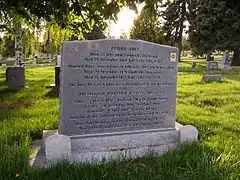
Front of Grave Marker 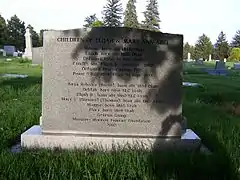
Back of Grave Marker
See also
Notes
- Smith, Joseph F. (c. 1879). "Elijah Able". The Joseph Smith Papers Project. Salt Lake City, Utah. Retrieved 15 February 2019.
- Grave Marker of Elijah Abel. (Inscribed front). File:ElijahAbelGraveFront.jpg
- Jackson, W. Kesler (2013). Elijah Abel: The Life and Times of a Black Priesthood Holder. Springville, Utah: Cedar Fort, Incorporated. ISBN 978-1462111510.
- Smith, Joseph F. (c. 1879). "Joseph F. Smith biographical transcript for Elijah Able, Joseph F. Smith Papers" (PDF). The Joseph Smith Papers Project. Salt Lake City, Utah. Retrieved 15 February 2019.
- Bowman, Matthew (2012). "Chapter 2: Little Zions: 1831-1839". The Mormon People: The Making of an American Faith. New York: Random House. p. 46. ISBN 978-0679644903.
- 125: Elijah Ables' Attempt for Temple Blessings (Part 5 of 6 Russell Stevenson), archived from the original on 2021-12-12, retrieved 2021-05-21
- Stevenson, Russell W. (2013). "A Negro Preacher: The Worlds of Elijah Ables" (PDF). Journal of Mormon History. 39 (2). Salt Lake City, Utah. pp. 165–254. Retrieved 17 February 2019.
- Reeve, W. Paul (2015). "Chapter 7: Black, White, and Mormon: 'One Drop'". Religion of a Different Color: Race and the Mormon Struggle for Whiteness. New York: Oxford University Press. pp. 194–210. ISBN 978-0199754076.
- Reasons; Patrick (15 July 1971). "They Had a Dream: Elijah Abel". The Troy Record. Troy, New York. p. 18. Retrieved 6 July 2016.
- Bringhurst, Newell G. (1984). "Chapter 4: Elijah Abel and the Changing Status of Blacks Within Mormonism". In Bush Jr., Lester E.; Mauss, Armand L. (eds.). Neither White nor Black: Mormon Scholars Confront the Race Issue in a Universal Church. Midvale, Utah: Signature Books. ISBN 9780941214223. Retrieved 18 May 2017.
- Hawkins, Chester L. (4 December 1985). Report on Elijah Abel and His Priesthood. L. Tom Perry Special Collections; Harold B. Lee Library: Unpublished. Retrieved 12 July 2016.
- Anderson, Martha (1980). Black Pioneers of the Northwest 1800-1918. p. 217.
- 1850 Census. The census record registers Mary Ann Adams Abel as being 19 years old, and her husband Elijah Abel as being 42 years old, which effectively pushes back his birthdate to 1808.
- Patriarchal Blessing of Elijah Abel, c. 1836, recorded by W. A. Cowdery with penned preamble, "[Patriarchal] Blessing of Elijah Able [sic] who was born in Frederick County, Maryland, July 25th 1808." "Joseph Smith’s Patriarchal Blessing Record" (1833-1843), 88. LDS Church Archives.
- Bush, Jr., Lester E. (1984). "Chapter 2: A Commentary on Stephen G. Taggart's 'Mormonism's Negro Policy: Social and Historical Origins'. Note 8". In Bush Jr., Lester E.; Mauss, Armand L. (eds.). Neither White nor Black: Mormon Scholars Confront the Race Issue in a Universal Church. Midvale, Utah: Signature Books. ISBN 9780941214223. Retrieved 18 February 2019.
- Stevenson, Russell W. (2014). Black Mormon: The Story of Elijah Ables (self-published). CreateSpace. ISBN 978-1500843137.
- Embry, Jessie L. (1994). "Chapter 3: Impact of the LDS 'Negro Policy'". Black Saints in a White Church: Contemporary African American Mormons. Salt Lake City, Utah: Signature Books. ISBN 978-1560850441.
- "Church History Digital Catalog | Assets". catalog.churchofjesuschrist.org. Retrieved 2019-02-20.
- Jenson, Andrew (1936). Latter-day Saint Biographical Encyclopedia. 4. Salt Lake City, Utah: The Andrew Jenson History Company. p. 697 (4 volumes: 1901-1936). It appears that the blessing was pronounced on or after 30 March 1836, when the "washing" ordinance was first introduced to the Saints and nearer the time of Abel's priesthood licensing on 31 March; or perhaps in December, at the time of his ordination as a Seventy. ISBN 978-1589580312.
- Bringhurst, Newell G. (1981). Saints, Slaves, and Blacks: The Changing Place of Black People Within Mormonism. Westport, Connecticut: Greenwood Press. p. 149. Reprint (2018) by Greg Kofford Books: Draper, Utah. ISBN 978-0313227523.
- Underwood, Grant (1999) [1993]. The Millenarian World of Early Mormonism. Urbana: University of Illinois Press. pp. 26–36, 49–51, 63–72. ISBN 978-0252068263.
- Kinney, Eunice. (5 July 1885). Letter to Wingfield Watson. L. Tom Perry Special Collections, Harold B. Lee Library, Brigham Young University. Provo, Utah. See also Eunice Kinney, "My Testimony of the Latter Day Work". (c. 1885). Microfilm typescript, MS 4226. LDS Church Archives.
- Hughes, Richard T., ed. (1988). The American Quest for the Primitive Church. Urbana: University of Illinois Press. ISBN 978-0252060298.
- Bickmore, Barry R. (2013) [1999]. Restoring the Ancient Church: Joseph Smith and Early Christianity. Redding, California: FairMormon. ISBN 978-1893036161.
- Priesthood License of Elijah Abel. (31 March 1836). Recorded by Joseph Smith, Jr. and Frederick G. Williams. Michael Marquardt Papers, box 6, folder 1. Special Collections, J. Willard Marriott Library, University of Utah. See also a scanned image of the certificate at the online document repository of The Joseph Smith Papers Project.
- Prince, Stephen L. (2017). "Chapter 7: Rising Through the Ranks". Hosea Stout: Lawman, Legislator, Mormon Defender. Logan: Utah State University Press. pp. 87–88. ISBN 978-1607326403.
- History of the Church, 4:365.
- Mary Adams' Parents. The Ohio county of residence of Mary Ann's parents (John and Anna Weston Adams) at the time of their deaths — Hamilton, located just 15 miles north of Cincinnati — is, curiously, the home county of Ezekiel Roberts, the Mormon elder who baptized Elijah Abel in 1832. Stevenson (2014) suggests, therefore, that Hamilton County may have been where Elijah was baptized. But also, as Mary's family were erstwhile residents of Hamilton (perhaps moving there, to Mount Healthy township, after Mary's birth in Nashville), it may also have been where Elijah was first introduced to Mary. Hamilton County lies 60 miles south of Miami County, where lived, according to Jackson (2013), a possible sister of Elijah, Nancy Abel Rousten.
- Givens, Terryl L.; Barlow, Philip L., eds. (2015). "Chapter 24: Mormons and Race". The Oxford Handbook of Mormonism. Oxford Handbooks. New York: Oxford University Press. ISBN 978-0199778362.
- Coleman, Ronald Gerald (1980). A History of Blacks in Utah: 1825–1910. Harold B. Lee Library; Provo, Utah: Unpublished. p. 59.
- "Elijah Abel". www.blacklds.org. Retrieved 11 July 2016.
- "Cemeteries and Burials Database: Burial Information: ABLE, ELIJAH and ABLE, MARY". Salt Lake City, Utah: Utah Division of State History. Retrieved 8 April 2018.
- The allegations against Abel had originally surfaced in a 1 June 1839 meeting convened at Quincy, Illinois — during the time when Joseph Smith was laboring with the struggling Missouri-driven Saints in establishing their new home at Commerce (Nauvoo). As such, Smith was not present at the hearing. Convened at the Quincy meeting were quorum members and presiding officers of the Seventy, as well as a young Jedediah M. Grant. Grant had been selected as the priesthood representative to convey to the body of the Seventy the complaints brought before them by Abel's missionary associates. Abel himself was in absentia. Also testifying at the hearing were John Broeffle and his cousins John & George Beckstead, Robert Burton, and Moses Smith. Abel had previously been offered refuge in the Becksteads' father's home while being pursued by a mob (Stevenson, 2013, p. 200).
- Esplin, Ronald K. (1979). "Brigham Young and Priesthood Denial to the Blacks: An Alternate View". BYU Studies Quarterly. 19 (3). Provo, Utah: Brigham Young University. pp. 394-402. Esplin's argument is not generally accepted, not only in light of Joseph Smith's 1836 priesthood sanctioning and licensing of Abel, but also given Young's conciliatory and apparently open views on the issue as evidenced in his March 1847 remarks to William McCary. Esplin does point out, however, that Young — in his remarks of 5 February 1852 to the Utah Territorial Legislature (the day after slavery had been codified into Utah law) — promised that there would be a future general bestowal of the priesthood to blacks: "That time will come when they will have the privilege of all we have the privilege of and more". Retrieved 4 March 2019.
- A formal reiteration of LDS Church policy regarding the 1849 priesthood ban was codified into law by Utah's territorial legislature on 4 February 1852, one month after Governor Brigham Young appeared before that body on 16 January to formally petition for the policy's codification. See Lester E. Bush, Jr. (1984). Chapter 3: "Mormonism’s Negro Doctrine: An Historical Overview," in Lester E. Bush, Jr. and Armand L. Mauss (eds). Neither White nor Black: Mormon Scholars Confront the Race Issue in a Universal Church. Midvale, Utah: Signature Books.
- Meeting Minutes, 25 June 1843. "Conference of Elders of the Church," Cincinnati, Ohio. LDS Church Archives.
- "Deaths," Deseret News, December 25, 1884.
- Staker, Mark L. (2009). "Chapter 1: Black Pete & Chapter 8: Black Pete and Early Mormonite Religious Enthusiasm". Hearken, O Ye People: The Historical Setting for Joseph Smith's Ohio Revelations. Draper, Utah: Greg Kofford Books. ISBN 978-1589581135.
- "Gospel Topics: Race and the Priesthood", churchofjesuschrist.org, LDS Church
- Minutes of the Seventies Journal, Hazen Aldrich, entry for 20 December 1836. LDS Church Archives, as cited by Alma Allred, "The Traditions of Their Fathers, Myth versus Reality in LDS Scriptural Writings," in Newell G. Bringhurst and Darron T. Smith, eds. (2006). Black and Mormon. Urbana: University of Illinois Press.
- "A Record of all the Quorums of Seventies in The Church of Jesus Christ of Latter-day Saints". (5 March 1879). CR3/51, box 3, folder 2. LDS Church Archives.
- "Council Meeting Minutes". (4 June 1879). Lester E. Bush papers, Special Collections, J. Williard Marriott Library, University of Utah.
- Letter of Joseph Fielding Smith to Mrs. Floren S. Preece, 18 January 1955. S. George Ellsworth Papers, Utah State University, Logan (see also Letter from Joseph Fielding Smith to Joseph H. Henderson, 10 April 1963).
- Bringhurst, Newell G.; Smith, Darron T., eds. (2006). "The 'Missouri Thesis' Revisisted: Early Mormonism, Slavery, and the Status of Black People". Black and Mormon. Urbana: University of Illinois Press. pp. 13–33, at p. 30. ISBN 978-0252029479
- Arave, Lynn (30 September 2002). "Monument in S.L. erected in honor of black pioneer". Deseret Morning News. p. B3. Retrieved 30 June 2009.
Additional references
- "Elijah Able," The Joseph Smith Papers.
- Joseph F. Smith biographical transcript for Elijah Able, as catalogued by The Joseph Smith Papers.
- "Elijah Abel and the Changing Status of Blacks Within Mormonism". (1979). Dialogue: A Journal of Mormon Thought, 12(2):22–36.
- "Deaths," Deseret News, 31 December 1884:16.
- Sessions, Gene A. (2008) [1982]. Mormon Thunder: A Documentary History of Jedediah Morgan Grant. Second Edition. Greg Kofford Books: Draper, Utah. ISBN 978-0252009440. Original publisher: Urbana: University of Illinois Press.
- Underwood, Grant. (1999) [1993]. The Millenarian World of Early Mormonism. Urbana: University of Illinois Press. ISBN 978-0252068263
Further reading
- Jackson, William Kesler (2013), Elijah Abel: The Life and Times of a Black Priesthood Holder, Springville, Utah: CFI (Cedar Fort, Inc.), ISBN 978-1-4621-1151-0, LCCN 2012044964, OCLC 808415486
- Stevenson, Russell W. (2013). "A Negro Preacher: The Worlds of Elijah Ables". Journal of Mormon History Vol. 39, No. 2, pp. 165–254.
- Stevenson, Russell (2014), Black Mormon: The Story of Elijah Ables (self-published), ISBN 978-1-5008-4313-7
External links
- Elijah Abel Black LDS site
- Mormon Central Catalogued LDS Church documentation and correspondence regarding blacks and the priesthood
Authority control  | |
|---|---|
| General | |
| National libraries | |
| Other | |