Embedded dependency
In relational database theory, an embedded dependency (ED) is a certain kind of constraint on a relational database. It is the most general type of constraint used in practice, including both tuple-generating dependencies and equality-generating dependencies. Embedded dependencies can express functional dependencies, join dependencies, multi-valued dependencies, inclusion dependencies, foreign key dependencies, and many more besides.
An algorithm known as the chase takes as input an instance that may or may not satisfy a set of EDs, and, if it terminates (which is a priori undecidable), output an instance that does satisfy the EDs.
Definition
An embedded dependency (ED) is a sentence in first-order logic of the form:

where , and is a possibly empty and is a non-empty conjunction of relational and equality atoms.[1] A relational atom has the form and an equality atom has the form where each of the , are variables or constants.



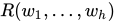


In literature there are many common restrictions on embedded dependencies, among with:[1]
- full (or universal) dependencies, which are the ones without existential quantifiers ()
- tuple-generating dependencies (TGDs)
- equality-generating dependencies (EGDs)
- single-head (or 1-head) dependencies, which have only one atom in the head
- unirelational dependencies, in which only one relation symbol occurs

When all atoms in are equalities, the ED is an EGD, and when all atoms in are relational, the ED is a TGD. Every ED is equivalent to an EGD and a TGD.
References
Further readings
- Kanellakis, Paris C. (1990). "Elements of Relational Database Theory". Handbook of Theoretical Computer Science, Volume B: Formal Models and Sematics. Amsterdam: Elsevier. pp. 1073–1156. doi:10.1016/b978-0-444-88074-1.50022-6. ISBN 978-0-444-88074-1.
- Serge Abiteboul, Richard B. Hull, Victor Vianu: Foundations of Databases. Addison-Wesley, 1995.
- Alin Deutsch, FOL Modeling of Integrity Constraints, https://www.researchgate.net/publication/228579497_FOL_Modeling_of_Integrity_Constraints_Dependencies