Embodied cognition
Embodied cognition is the theory that many features of cognition, whether human or otherwise, are shaped by aspects of the entire body of the organism. The features of cognition include high level mental constructs (such as concepts and categories) and performance on various cognitive tasks (such as reasoning or judgment). The aspects of the body include the motor system, the perceptual system, bodily interactions with the environment (situatedness), and the assumptions about the world that are built into the structure of the organism.
The embodied mind thesis challenges other theories, such as cognitivism, computationalism, and Cartesian dualism.[1][2] It is closely related to the extended mind thesis, situated cognition, and enactivism. The modern version depends on insights drawn from recent research in psychology, linguistics, cognitive science, dynamical systems, artificial intelligence, robotics, animal cognition, plant cognition and neurobiology.
Embodiment thesis
Proponents of the embodied cognition thesis emphasize the active and significant role the body plays in the shaping of cognition and in the understanding of an agent's mind and cognitive capacities. In philosophy, embodied cognition holds that an agent's cognition, rather than being the product of mere (innate) abstract representations of the world, is strongly influenced by aspects of an agent's body beyond the brain itself.[1] Thus, the embodiment thesis intends to reintroduce an agent's bodily experiences into any account of cognition. It is a rather broad thesis and encompasses both weak and strong variants of embodiment.[3][4][5][6] In their attempt to reconcile cognitive science with human experience, Varela et al.'s enactive approach to cognition defines "embodiment" as follows:[3]
- "By using the term embodied we mean to highlight two points: first that cognition depends upon the kinds of experience that come from having a body with various sensorimotor capacities, and second, that these individual sensorimotor capacities are themselves embedded in a more encompassing biological, psychological and cultural context."
- — Francisco J. Varela, Evan Thompson, Eleanor Rosch : The Embodied Mind: Cognitive Science and Human Experience pages 172–173
This double sense that Varela et al. attribute to the thesis of embodiment emphasizes the many aspects of cognition that researchers in different fields —such as philosophy, cognitive science, artificial intelligence, psychology, and neuroscience— are involved with. This general characterization of embodiment faces some difficulties: a consequence of this emphasis on the body, experience, culture, context, and the cognitive mechanisms of an agent in the world is that often distinct views and approaches to embodied cognition overlap. Indeed, for example, the theses of extended cognition and situated cognition are usually intertwined and not always carefully separated. Similarly, since each of these aspects of the embodiment thesis is endorsed to different degrees, embodied cognition should be better seen as a research program rather than an unified well-defined theory.[5]
Some authors explain the embodiment thesis by arguing that cognition depends on an agent's body and its interactions with a determined environment. Accordingly, cognition in real biological systems is not an end in itself but is constrained by the system's goals and capacities. However, they argue, such constraints do not mean cognition is set by adaptive behavior (or autopoiesis) alone, but rather that cognition requires "some kind of information processing... the transformation or communication of incoming information". The acquiring of such information involves the agent's "exploration and modification of the environment".[7]
- "It would be a mistake, however, to suppose that cognition consists simply of building maximally accurate representations of input information...the gaining of knowledge is a stepping stone to achieving the more immediate goal of guiding behavior in response to the system's changing surroundings."
- — Marcin Miłkowski: Explaining the Computational Mind, p. 4
Another approach to understand embodied cognition comes from a narrower characterization of the embodiment thesis. The following narrower view on embodiment not only avoids any compromises to external sources other than the body, but also allows differentiating between embodied cognition, extended cognition, and situated cognition. Thus, we can specify the embodiment thesis as follows:[1]
- Embodiment thesis: Many features of cognition are embodied in that they are deeply dependent upon characteristics of the physical body of an agent, such that the agent's beyond-the-brain body plays a significant causal role, or a physically constitutive role, in that agent's cognitive processing.
- —RA Wilson and L Foglia, Embodied Cognition in the Stanford Encyclopedia of Philosophy
This thesis points out the core idea that an agent's body plays a significant role in shaping different features of cognition such as perception, attention, memory, reasoning among others. Accordingly, these features of cognition depend on the kind of body an agent has. Furthermore, the thesis omits direct mention of some aspects of the "more encompassing biological, psychological and cultural context" included by Varela et al. and, therefore, makes possible to separate embodied cognition, extended cognition, and situated cognition.
The Extended mind thesis, in contrast to the Embodiment thesis, limits cognitive processing neither to the brain nor even to the body, but extends it outward into the agent's world.[1][8] Situated cognition emphasizes that this extension is not just a matter of including resources outside the head, but stresses the role of probing and modifying interaction with the agent's world.[9]
Philosophical background
In his Universal Natural History and Theory of Heaven (1755),[10] philosopher Immanuel Kant advocated a view of the mind–body problem with parallels to the embodied view.[11] Some difficulties with this interpretation of Kant include (i) the view that Kant holds the empirical, and specific knowledge of the body, which cannot support a priori transcendental claims,[12] and (ii) the view that Kant holds that transcendental philosophy, although charged with the responsibility of explaining how we can have empirical knowledge, is not itself empirical.[13]
José Ortega y Gasset, George Santayana, Miguel de Unamuno, Maurice Merleau-Ponty and others in the broadly existential tradition have proposed philosophies of mind influencing the development of the modern 'embodiment' thesis.[14]
The embodiment movement in artificial intelligence has fueled the embodiment argument in philosophy and a revised view of ethology:[15]
- "Species-typical activity patterns must be thought of as emergent phenomena in three different senses of the word. They have emerged...through natural selection, ....by a process of maturation and/or learning, ...and from interactions between the creature's low-level activities and its species-typical environment."
- —Horst Hendriks-Jansen Catching Ourselves in the Act, p. 10
These developments have also given emotions a new status in philosophy of mind as an indispensable constituent, rather than a non-essential addition to rational intellectual thought. In philosophy of mind, the idea that cognition is embodied is sympathetic with other views of cognition such as situated cognition or externalism. This is a radical move towards a total re-localization of mental processes out of the neural domain.[16]
History
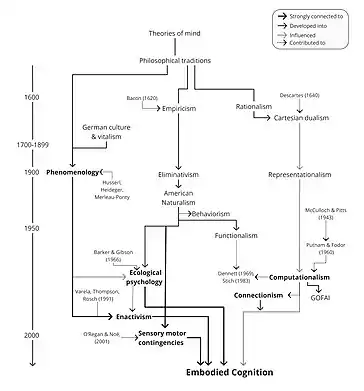
The theory of embodied cognition, along with the multiple aspects it comprises, can be regarded as the imminent result of an intellectual skepticism towards the flourishment of the disembodied theory of mind put forth by René Descartes in the 17th century. According to Cartesian dualism, the mind is entirely distinct from the body, and can be successfully explained and understood without reference to the body or to its processes.[17]
Research has been done to identify the set of ideas that would establish what could be considered as the early stages of embodied cognition around inquiries regarding the mind-body-soul relation and vitalism in the German tradition from 1740 to 1920.[18] However, embodied cognition, as it is conceived nowadays, has a relatively short history.[19] We can trace back the intellectual underpinnings of embodied cognition to the influence of philosophy, and more specifically, the phenomenological tradition, psychology, and connectionism in the 20th century.
Phenomenologists such as Edmund Husserl (1850 – 1938), Martin Heidegger (1889 – 1976), and Maurice Merleau-Ponty (1908 – 1962) were a great source of inspiration for what would later be known as the embodiment thesis. They stood up against the mechanistic and disembodied approach to the explanation of the mind by emphasizing the fact that there are aspects of our human experiences (consciousness, cognition) that cannot simply be explained by a model of the mind as computation of inner symbols. From a phenomenological standpoint, such aspects remain unaccountable if we deny the fact—as dualism does—that they "are deeply rooted in the physical nuts-and-bolts of the interacting agent".[20] Maurice Merleau-Ponty in his "Phenomenology of Perception" (French: Phénoménologie de la perception), for example, rejects the cartesian idea that our primary mode of being in the world is "thinking" (English: I think, therefore I am, Latin: cogito ergo sum) and proposes corporeity (French: corporéité), that is, the body itself as the primary site for knowing the world, and perception as the medium and the pre-reflective foundation of experience.
"The body is the vehicle of being in the world, and having a body is, for a living creature, to be intervolved in a definite environment, to identify oneself with certain projects and be continually committed to them." [21]
So stated, the body is the primary condition for experience, it "is my point of view upon the world" which opens up multiple possibilities for being, it "is a knot of living significations".[21]
The appreciation of the phenomenological mindset allows us to not overlook the influence that phenomenology's speculative but systematic reflection on the mind-body-world relation had in the growth and development of the core ideas which embodied cognition comprises. From a phenomenological perspective "all cognition is embodied, interactive, and embedded in dynamically changing environments".[22] These constitute the set of beliefs which proponents of embodied cognition such as Francisco Varela, Eleonor Rosch, and Evan Thompson will revise later on and seek to reintroduce in the scientific study of cognition under the name of enaction.[23] Enactivism reclaims the importance of considering the biodynamics of the living organism to understand cognition by gathering ideas from fields such as biology, psychoanalysis, Buddhism, and phenomenology. According to this enactive approach, organisms obtain knowledge or develop their cognitive capacities through perception–action interactions with a determined environment.
On the bases of empirical grounds, and in opposition to those philosophical traditions that denied the importance of the body to understand cognition, research on embodiment have demonstrated the relationship between cognition and bodily process. Thus, understanding cognition requires to consider and investigate the sensory and motor mechanism that enables it. George Lakoff, for example, holds that reasoning and language, arise from the nature of our bodily experiences and, thus, even our own metaphors have bodily references.[24]
Since the 1950s, encouraged by progress in informatics, researchers began to create digital models of the processes by which sensory input is selected by the brain, stored in the memory, connected to existing knowledge and used for elaboration.[25] These traditional computationalist views of cognition that were typical in the 1950s–1980s are now considered implausible because there is no continuity with the cognitive skills that would have been demanded of the ancestors of the human species.[26] Some researchers argues that this algorithmic focus on mental activities ignores the fact that human beings engage with evolutionary pressures using their entire bodies.[27][28] According to Wilson and Margaret (2008) the embodied cognition perspective is fundamentally an evolutionary one, viewing cognition as a set of abilities that built upon, and still reflects, the structure of our physical bodies and how our brains evolved to manage those bodies.[26] The theory of evolution emphasises that thanks to their bipedal gait, early humans did not need their 'forepaws' for locomotion, facilitating them to manipulate the environment with the aids of tools. Some researcher goes further, positing that the multiple opportunities provided by our hands shape our concepts of the mind.[28] One example is that we often conceive cognitive processes in manual terms, such as 'grasping an idea'.
J.J. Gibson (1904 – 1979 ) developed his theory on ecological psychology that entirely contradicted the computationalist idea of understanding the mind as information processing which by that time had permeated psychology—both in theory and practice. Gibson particularly disagreed with the way his contemporaries understood the nature of perception. While computationalism considers perceptual objects as an unreliable sources of information upon which the mind must do some sort of inference, Gibson considers perceptual processes as the product of the relation between a moving agent and its relationship with a determined environment.[29]
Connectionism also put forth a critique to the computationalist commitments yet granting the possibility of some sort of non-symbolic computational processes to take place.[30] According to the connectionist thesis, cognition as a biological phenomenon can be explained and understood through the interaction and dynamics of artificial neural networks (ANNs).[31][32] However, given the traces of abstraction that remain in the inputs and outputs through which connectionist neural networks carry its computations, connectionism is said to be not so far from computationalism and unable to cope with both the challenge of dealing with the details involved during perceiving and acting and explaining higher level cognition.[33][34] Likewise, although connectionism's take on cognition is biologically inspired by the behavior and interaction of single neurons, its connections to the embodiment thesis in general, and to perception–action interactions in particular, are not clearly outlined or straightforward.
More recently, O'Regan, J. K. and Noë, A. provide empirical evidence against the computationalist mindset arguing that although cortical maps exist in the brain and their patterns of activation give rise to perceptual experiences, this does not fully explain their subjective character. Namely, it is unclear how internal representations generate conscious perception. Given this ambiguity, O'Regan, J. K. and Nöe, A. put forth what will be known as "sensorimotor contingencies" (SMCs) in an attempt to understand the changing character of sensations as we act in the world. According to the SMC theory,
"the experience of seen occurs when the organism master what we call the governing laws of sensor motor contingency" [35]
Ever since the late 20th century and recognizing the significant role the body plays for cognition, the embodied cognition theory has gained (an ever increasing) popularity, it has been the subject of multiple articles in different research areas, and the mainstream approach to what Shapiro and Spaulding call the "embodied make-over".[22] A consequence of this widespread acceptance of the embodiment thesis is the emergence of 4E features of cognition (embodied, embedded, enacted, and extended cognition). Under 4E, cognition is no longer thought of as being instantiated in or by a single organism but rather:
"It assumes that cognition is shaped and structured by dynamic interactions between the brain, body, and both the physical and social environments".[36]
The scope of embodied cognition
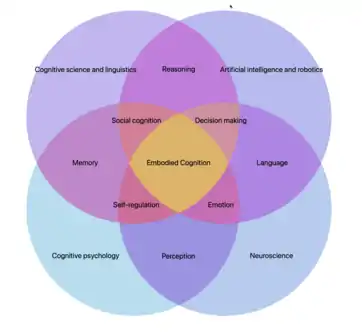
Embodied cognition argues that several factors both internal and external (such as the body and the environment) play a role in the development of an agent's cognitive capacities, just as mental constructs (such as thoughts and desires) are said to influence an agent's bodily actions. For this reason, embodied cognition is considered as a wide-ranging research program, rather than a well-defined and unified theory.[22] A scientific approach to embodied cognition reaches, inspires, and brings together ideas from several research areas, each with its own take on embodiment yet in a joint effort to (methodically) investigate embodied cognition.
Research on embodied cognition comprises a variety of fields within the sciences such as linguistics, neuroscience, (cognitive) psychology, philosophy, artificial intelligence and robotics, etc. For this reason, recent developments on embodied cognition can be regarded as the embodied make-over of cognitive science offering new ways to look at the nature, structure, and mechanisms of cognition.[37] Furthermore, embodying cognition requires the different features of cognition such as perception, language, memory, learning, reasoning, emotion, self-regulation, and its social aspects to be revisited and investigated through lens of embodiment in order to ground its theoretical and methodological underpinnings.[38]
In the field of linguistics, George Lakoff (a cognitive scientist and linguist) and his collaborators (including Mark Johnson, Mark Turner, and Rafael E. Núñez) have written a series of books promoting and expanding the embodiment thesis based on developments within the field of cognitive science, such as conceptual metaphor, image schema, and prototypes.[39] Simultaneously, Irina Trofimova experimentally confirmed the phenomenon of "projection through capacities" as a prototype of the embodiment theory which states that people just register those aspects of objects or situations with which they themselves are able to deal.[40] Researchers also provide evidence suggesting that people use their understanding of familiar physical objects, actions and situations (such as containers, spaces, trajectories) to understand other domains (such as mathematics, relationships or death). Lakoff argues that all cognition is based on knowledge that comes from the body and that other domains are mapped onto our embodied knowledge using a combination of conceptual metaphor, image schema and prototypes.
Through a collection of thousands of examples of conceptual metaphors across several domains, Lakoff and Johnson (1980)[41] showed that humans use metaphor ubiquitously, that these metaphors operate at a conceptual level (i.e., they map one conceptual domain onto another), that a single metaphor lies behind an unlimited number of individual expressions and that the same metaphor is used conventionally throughout a culture. Lakoff and his collaborators have collected thousands of examples of conceptual metaphors in many domains.[42][43] For instance, people will typically use language about journeys to discuss the history and status of a love affair, a metaphor the authors call "love is a journey" and which is used in expressions such as "we arrived at a crossroads," "we parted ways", "we hit the rocks" (as in a sea journey), "she's in the driver's seat", or simply, "we're together". According to the authors, these metaphors involving the concept of love are tied to the physical embodied experience of traveling and the emotions associated with a journey. Another example by Lakoff and Turner involving language and embodiment is that creatures like us that stand upright and move forward think of things that are "in front of" themselves as located in the line of vision or in terms of the direction they are moving. In contrast, creatures that are long and flat and moves backward might have a very different concept of "in front of", or perhaps none at all. To this respect, proponents of the embodied cognition claim that the experience of "up-ness", depends on the particular kind of body an individual have, and how that body interacts with its surroundings.[44]
Lakoff and Nuñez (2000) claim that we understand abstract concepts by thinking of simple physical situations (which they call "image schema"). We can then use our sensorimotor and perceptual skills to better understand the abstract concept. The authors argue that this shows how abstract reasoning requires us to use knowledge and skills that are an aspects of the body —the kind of ordinary spatial reasoning that using a body requires. So understood, image schema are a form of conceptual metaphor. For instance, to understand the mathematical concept of imaginary numbers, we picture the rotation of an arrow across a mental picture (the complex plane). In doing this, we are using our visual cortex and our skills in reasoning about space in order to understand a completely abstract concept.[45]
Prototypes are "typical" members of a category, e.g. a robin is a prototypical bird, but a penguin is not. The role of prototypes in human cognition was first identified and studied by Eleanor Rosch in the 1970s.[46] She was able to show that prototypical objects are more easily categorized than non-prototypical objects, and that people answered questions about a category as a whole by reasoning about a prototype. She also identified basic level categories:[47] categories that have prototypes that are easily visualized (such as a chair) and are associated with basic physical motions (such as "sitting"). Prototypes of basic level categories are used to reason about more general categories. Thus, prototype theory has been used to explain human performance on many different cognitive tasks and in a large variety of domains. According to Lakoff, prototype theory shows that the categories that people use are based on our experience of having a body and have no resemblance to logical classes or types, therefore, showing that traditional objectivist accounts of truth cannot be correct.[48]
Neuroscientists Gerald Edelman, António Damásio and others have outlined the connection between the body, individual structures in the brain and aspects of the mind such as consciousness, emotion, self-awareness and will.[49] Biology has also inspired Gregory Bateson, Humberto Maturana, Francisco Varela, Eleanor Rosch and Evan Thompson to develop a closely related version of the idea, which they call enactivism.[50] The motor theory of speech perception proposed by Alvin Liberman and colleagues at the Haskins Laboratories argues that the identification of words is embodied in perception of the bodily movements by which spoken words are made.[51][52][53][54][55] In related work at Haskins, Paul Mermelstein, Philip Rubin, Louis Goldstein, and colleagues developed articulatory synthesis tools for computationally modeling the physiology and aeroacoustics of the vocal tract, demonstrating how cognition and perception of speech can be shaped by biological constraints. This was extended into the audio-visual domain by the "talking heads" approach of Eric Vatikiotis-Bateson, Rubin, and other colleagues.
The concept of embodiment theory has been inspired through research in cognitive neuroscience, such as the proposals of Gerald Edelman concerning how mathematical and computational models such as neuronal group selection and neural degeneracy result in emergent categorization. From a neuroscientific perspective, the embodied cognition theory examines the interaction of sensorimotor, cognitive and affective neurological systems. The embodied mind thesis is compatible with some views of cognition promoted in neuropsychology, such as the theories of consciousness of Vilayanur S. Ramachandran, Gerald Edelman, and Antonio Damasio.
Historically, the view of cognition inherited by most of contemporary cognitive neuroscience is internalist in nature. An agent's behaviour along with his capacity to maintain (an accurate) representation of the environment around him are the product of "powerful brains that can maintain the world models and devise plans".[56] From this perspective, cognizing is something that an isolated brain does. In contrast, accepting the role the body plays during cognitive processes allows us to account for a more encompassing view of cognition. Successful behaviour in real-world scenarios demands the integration of several sensorimotor and cognitive (as well as affective) capacities of an agent. Thus, it is in the relationship between an agent and his environment, rather than in the brain alone, where cognition emerges.
By examining brain activity with neuroimaging techniques, researchers found indications supporting the embodiment thesis. In an Electroencephalography (EEG) study, researchers showed, in line with the embodied cognition, sensorimotor contingency and common coding theses, that sensory and motor processes in the brain are not sequentially separated but are strongly coupled.[57] Considering the interaction of the sensorimotor and cognitive system, Rohrer (2005) stresses how crucial sensorimotor cortices are for semantic comprehension of body-action terms and sentences.[58] A functional magnetic resonance imaging (fMRI) study by Hauk et al. (2004) showed that passively read action words, such as lick, pick or kick, led to a somatotopic neuronal activity in or adjacent to brain regions associated with actual movement of the respective body parts.[59] Using transcranial magnetic stimulation (TMS), Buccino et al. (2005) revealed that the activity of the motor system is coupled to auditory action-related sentences. When the participants listened to hand- or foot-related sentences, the motor evoked potentials (MEPs) recorded from the hand and foot muscles were reduced.[60] These two exemplary studies indicate a relationship between cognitively understanding words referring to sensorimotor concepts and activation of sensorimotor cortices. Neuroimaging techniques therefore serve to show interactions of the sensory and motor system.
Next to neuroimaging studies, behavioural studies point towards the embodied cognition theory. Abstract higher cognitive concepts such as the "importance" of an object or an issue also seem to stand in relation to the sensorimotor system. People estimate objects to be heavier when they are told that they are important / hold important information in contrast to unimportant information.[61] From another perspective, more importance is assigned to decision-making procedures when people are, at the same time, holding heavier clipboards.[62] In the sense of embodied cognition, the authors Jostmann et al. (2009) [62] theorise that physical effort invested in objects leads to more cognitive effort when dealing with abstract concepts.
The modeling work of cognitive neuroscientists such as Francisco Varela and Walter Freeman seeks to explain embodied and situated cognition in terms of dynamical systems theory and neurophenomenology, but rejects the idea that the brain uses representations to do so (a position also espoused by Gerhard Werner).
All in all, multiple methods such as neuroimaging techniques, behavioural experiments and dynamical models can be employed to support and further investigate from a neuroscientific perspective the embodied cognition thesis.
In the field of Robotics researchers such as Rodney Brooks, Hans Moravec and Rolf Pfeifer have argued that true artificial intelligence can only be achieved by machines that have sensory and motor skills and are connected to the world through a body.[63] The insights of these robotics researchers have in turn inspired philosophers like Andy Clark and Horst Hendriks-Jansen.[64] Traditional artificial intelligence involves a computational approach. In artificial intelligence, an algorithm analyzes a set of data and then applies these new learnings to a situation.[65] The artificial intelligence algorithm can, however, have a number of limitations, particularly when it is interacting with the real world. Additionally, algorithms have difficulty controlling complex movements and situations involving common sense or shared human experiences. Sensory and perceptual abilities have become the hardest problems to solve.[66] A body is essential for cognition and therefore for intelligent behavior, since the interaction between the body and the environment is fundamental for the development of cognitive abilities.[67] This type of knowledge is grounded in our physical embodiment; the relationship that humans have with their bodies. It is the concept of "the idea that the mind is not only connected to the body but that the body influences the mind". Embodied artificial intelligence and robotics is a method of applying this principle to artificial systems.[68]
Limits of symbolic AI: The experience of AI research provides another line of evidence supporting the embodied mind thesis. In the early history of AI successes in programming high-level reasoning tasks such as chess-playing led to an unfounded optimism that all AI problems would be relatively quickly solved. These programs simulated intelligence using logic and high-level abstract symbols (an approach called Good old-fashioned AI). This "disembodied" approach ran into serious difficulties in the 1970s and 80s, as researchers discovered that abstract, disembodied reasoning was highly inefficient and could not achieve human-levels of competence on many simple tasks.[69] Funding agencies (such as DARPA) withdrew funding because the field of AI had failed to achieve its stated objectives, leading to difficult period now known as the "AI winter". Many AI researchers began to doubt that high level symbolic reasoning could ever perform well enough to solve simple problems.
Rodney Brooks argued in the mid-80s that these symbolic approaches were failing because researchers did not appreciate the importance of sensorimotor skills to intelligence in general, and applied these principals to robotics (an approach he called "Nouvelle AI"). Another successful new direction was neural networks—programs based on the actual structures within human bodies that gave rise to intelligence and learning. In the 90s, statistical AI achieved high levels of success in industry without using any symbolic reasoning, but instead using probabilistic techniques to make "guesses" and improve them incrementally. This process is similar to the way human beings are able to make fast, intuitive choices without stopping to reason symbolically.
Moravec's paradox is the discovery by researchers in the field of artificial intelligence and robotics that, contrary to traditional assumptions, high-level reasoning requires very little computation however low-level sensorimotor skills requires an enormous computational resources. It observes that tasks that humans find difficult are simpler for AI to learn, such as playing chess, calculating advanced statistics, algebra, and other high-level tasks, but it is much more difficult to teach them to do things that are easy for humans, such as recognizing faces and voices or paying attention to things that we humans find interesting or relevant such as grasping objects or moving smoothly. This became a concept to understand AI. The principle was articulated by Hans Moravec (whence the name) and others in the 1980s.
As Moravec writes:
Encoded in the large, highly evolved sensory and motor portions of the human brain is a billion years of experience about the nature of the world and how to survive in it. The deliberate process we call reasoning is, I believe, the thinnest veneer of human thought, effective only because it is supported by this much older and much powerful, though usually unconscious, sensorimotor knowledge. We are all prodigious Olympians in perceptual and motor areas, so good that we make the difficult look easy. Abstract thought, though, is a new trick, perhaps less than 100 thousand years old. We have not yet mastered it. It is not all that intrinsically difficult; it just seems so when we do it.[70]
Embodied approaches to artificial intelligence
Solving problems of perception and locomotion directly
Many artificial intelligence researchers have argued that a machine may need a human-like body to think and speak as well as a human being. As early as 1950, Alan Turing wrote:
It can also be maintained that it is best to provide the machine with the best sense organs that money can buy, and then teach it to understand and speak English. That process could follow the normal teaching of a child. Things would be pointed out and named, etc. (Turing, 1950).[71]
Embodiment theory was brought into artificial intelligence most notably by Rodney Brooks who showed in the 1980s that robots could be more effective if they 'thought' (planned or processed) and perceived as little as possible. The robot's intelligence is geared towards only handling the minimal amount of information necessary to make its behavior be appropriate and/or as desired by its creator.
Others have argued for including the architecture of the human brain, and embodiment: otherwise we cannot accurately replicate language acquisition, comprehension, production, or non-linguistic actions.[72] They suggest that while robots are unlike humans, they could benefit from strengthened associative connections in their optimization. Also robots could improve through reactivity and sensitivity to environmental stimuli, human-machine interaction, multisensory integration and linguistic input.[72]
The embodied approach to AI has been given several names by different schools of researchers, including: Nouvelle AI (Brooks' term), Situated AI, Behavior based AI and Embodied cognitive science.
Embodied AI research
Working with real-world physical systems is referred to as embodiment in AI. For example, a crucial aspect of embodiment requires this physical system such as robots. Researchers working on embodied AI are moving away from an algorithm-driven approach.[73] Instead, they try to figure out how biological systems work first, then construct basic rules of intelligent behavior, and finally apply that knowledge to create artificial systems like robots or intelligent devices.[74] The robots employ artificial intelligence to interact with the physical world and learn from it. They are equipped with sensors that can import data from the outside world, as well as AI systems that can analyze and "learn" from this data.[75]
If researchers wanted to train a robot to pick up a wrench, they could use the algorithmic method to program the robots with the actions required in order to perform the end goal for examples to open hand, move hand over wrench, or even closing hands. An embodied AI approach on the other hand might strategize to train the robot to predict a set of potential actions by having it make random attempts and learning from each failure until it achieves its goal. Autonomous vehicles may be the most interesting use of embodied AI. Developing onboard technologies that allow autonomous vehicles to learn about their surroundings while they drive, in particular. The idea is for these vehicles to learn to drive in the same way that humans do: by detecting their surroundings and making judgments based on what they see.[76] While this type of highly-functional embodied AI is still a long way off, many researchers are working in this area.
Future of Embodied AI
While the traditional techniques and approaches to AI have resulted in a slew of smart algorithms that are now widely utilized, the embodied approach appears to be more constrained. A deeper understanding of embodied intelligence will lead to several applications in the field of so-called embedded systems, which are systems that interact with the real environment autonomously, not just by perceiving but also by altering it without the need for human intervention. These systems aren't robots in the traditional sense (for example they are different from humanoid robots), but they share similar characteristics in terms of intelligent, autonomous interaction with the current environment.[77]
Perception
It is widely acknowledged that when an internal representation of the outside world is activated somewhere in the brain, it leads to a perceptual experience. Embodied cognition challenges this claim by stating that although cortical maps do exist, they themselves cannot explain our subjective experience of perception.[78] For example, they cannot sufficiently explain the apparent stability of the visual world despite eye movements, the filling-in of the blind spot, the "change blindness", and other such visual illusions that unveil the (seemingly) imperfections of the visual system.[78] From an embodied cognition perspective, perception is not a passive reception of (incomplete) sensory inputs for which the brain must compensate to provide us with a coherent picture. The brain interprets the outside world based on an individual's intentions, memories, and emotions, as well as the environment and the specific situation the individual is in. Furthermore, perception does not simply consists in receiving inputs (or visual stimuli) from the external world to output actions in response to them. Perception is an active process conducted by a perceiving agent (a perceiver),[79] it entails an engaged perceiver, and thus perception is influenced by the agent's experiences and intentions, his bodily states, and the interaction between the agent's body and the environment around it.
One example of such active interaction between perception and the body is the case that distance perception can be influenced by bodily states. The way we view the outside world can differ depending on the physical resources that individuals have such as fitness, age or glucose levels. For instance, in one study, people with chronic pain who are less capable of moving around perceived given distances as further than healthy people did.[80] Another study shows that intended actions can affect processing in visual search, with more orientation errors for pointing than for grasping.[81] Because orientation is important when grasping an object, the plan to grasp an object is thought to improve orientation accuracy.[81] This shows how actions, the body's interaction with the environment, can contribute to visual processing of task relevant information.
Perception also influences the perspective individuals take on a particular situation and the type of judgments they make. For instance, researchers have shown that people will significantly more likely take the perspective of another person (e.g., a person in a picture) instead of their own when making judgements about objects in a photograph.[82] This means that the presence of people (as compared to only objects) in a visual scene affects the perspective a viewer takes when making judgements on, for example, relations between objects in the scene. Interestingly, researchers claim that these results suggest a "disembodied" cognition given the fact that people take the perspective of others instead of their own and make judgements accordingly.[82]
Language
Embodied cognition views on language claim that when we comprehend words, sensorimotor areas are involved in interacting with the objects and entities the words refer to.[83] In past years, behavioral and neural evidence has shown that the process of language comprehension activates a motor simulation[84] and involves motor systems.[85][86][87] Some researchers investigated mirror neurons to illustrate the link between the mirror neuron systems and language.[88] A study (Fogassi, & Ferrari, 2007) suggested that some aspects of language, such as part of semantics and phonology, can be embodied in the sensorimotor system represented by mirror neurons.[88]
Language has a multi-component structure. One of these structures is language comprehension. Glenberg & Kaschak's (2002) research on embodied cognition shows that language comprehension involves the motor system.[89][90][91] In addition, various studies explain that understanding linguistic explanations of actions is based on a simulation of the action described. These action simulations also include evaluation of the motor system.[91] Olmstead et al. (2009)conducted a study in which university students have evaluated language comprehension and motor system with a pendulum swinging task while performing the "sentence judgment task.". They found significant changes in functions containing performable sentences.[90]
Another study used the mirror neurons perspective to illustrate the relationship between the motor system and various language components. Because mirror neurons are one of the essential parts of the motor system, Fogassi and Ferrari (2007) compared monkeys and humans in an anatomical framework; specifically, they have made the comparison in Broca areas.[88] In a study concerning the role of mirror neurons during learning via language usage, Rizzolatti and Craighero, noted that activations occurred in the Broca area even when participants watched other people's conversations without hearing the sounds.[92] An fMRI study examining the relationship of mirror neurons in humans with linguistic materials has shown that there are activations in the premotor cortex and Broca's area when both reading or listening to sentences associated with actions.[93] According to this findings, researchers claim that there is a connection between the motor system and language. Furthermore, they argue that motor systems and mirror neuron mechanisms can process certain aspects of language.[88]
The current literature mainly focused on language and embodied cognition on a motor system, precisely mirror neuron explanations. With that, we see that this relationship extends the cognition capabilities with a variety of language components. For instance, Atkinson (2010) examined how embodied cognition and second language acquisition can extend cognitive ability.[94] The nature of language acquisition extends cognitive capability itself due to the fact of having multiple components. Furthermore, all those components have embodied representation. Therefore, we can say that embodied cognition provides a ground concept for language.[95] There is an increasing interest in investigating the relationship between embodied cognition and language in the current research.
Memory
The body has an essential role in shaping the mind. So, the mind must be understood in the context of its relationship with a physical body that interacts in the world. These interactions can also be cognitive activities that we find in everyday life, such as driving, chatting, imagining the placement of items in a room. However, these cognitive activities are limited by memory capacity.[96] The relationships between memory and embodied cognition have been demonstrated in studies in different fields and through a variety of tasks. In general, studies on embodied cognition and memory investigate how manipulations on the body cause changes in memory performance, or vice versa, manipulations through memory tasks subsequently lead to bodily changes.[97] In one study, Glenberg drew attention to the relationship between memory and action in his embodied cognition approach. In particular, he defines memory as integrated patterns of action that are limited by the body. Embodied cognition sees action preparation as a fundamental function of cognition. Memory plays a role in tasks that do not occur in the present but involve remembering actions and information from the past and imagining events that may or may not happen in the future. Also, he states that there is a reciprocal relationship between memory, action and perception. That is, manipulations that can take place in the body or movement can lead to various changes in memory.[97][98]
In another study, Dijkstara and et al. investigated the influence of body position on ease of recall in an autobiographical memory study to examine the effect of embodied cognition on memory performance. In the study, participants were asked to take positions compatible or incompatible with their original body position of the remembered event during a recall event, and participants given compatible body positions compared to incompatible body positions showed faster responses in recalling memories during the experiment. Thus, researchers conclude that body position facilitates access to autobiographical memories.[97][99] In another research that emphasized the relationship between memory and body, Wilson explains that memory systems depend on the body's experiences with the world. This is particularly evident in episodic memory due to the fact that episodic memories in the episodic memory system are defined by their content and are remembered as experienced by the one who does the remembering.[96] Another study focused on the recalling of personal memories and embodied memory, Culbertson, evaluated embodied memory through the recalling of personal traumas and violent memories and reported that people who have experienced trauma or violence re-feel their experiences in their narratives throughout their lives. In addition, he emphasizes that memories that threaten the life of a person by having a direct effect on the body, such as injury and physical violence, create similar reactions again in the body whilst remembering the event. Similarly, Culbertson stated that he felt smells, sounds, and movements in some of the remembered memories from his childhood trauma memories. Then he proceeded to evaluate those memories and the corresponding physical and physiological phenomena associated with them through his own childhood memories. At the end, Culbertson pointed out that the set of memories to be recalled and brought back to memory are embodied.[100]
Wilson introduced new perspectives on the neural structure and memory processes underlying embodied cognition, episodic memory, recall, and recognition. As experiences are received, neural states are reenacted in systems of action, perception, and introspection. Perception includes sensory modalities, motor modalities include movement, and introspection includes emotional, mental, and motivational states. All of these modalities altogether constitute different aspects that shape our experiences. Therefore, cognitive processes applied to memory support the action that is appropriate for a particular situation, not by remembering what the situation is, but by remembering the relationship of the action to that situation.[96] For example, Bietti argues that remembering and identifying the party one attended the previous day is related to the body because the sensory-motor aspects of the event that is being recalled (i.e., the party), along with the details of what happened, are being reconstructed.[97][101]
Learning
Embodied cognition can give us an explanation about the process through which infants attain spatial knowledge and understanding.[102] Most infants learn to walk in the first 18 months of life, which draw on ample new opportunities for exploring things around them. For example, they may learn the affordance of "transportability" when they start exploring and carrying objects from place to place.[103] Thereafter, new phases in exploration may occur, and through these phases, children can discover other, even more elaborate affordances.[102] According to Eleanor Gibson's theory, exploration itself takes an essential place in cognitive development. For example, infants explore whatever is in their vicinity by seeing, mouthing, or touching it before learning to reach to objects nearby. Then, infants learn to crawl, which enables them to seek out objects beyond reaching distance, but also to learn about basic spatial relations between themselves, objects and others including basic understanding of depth and distance.[102] Hence, through exploration, infants get to know the nature of the physical and social world around them. Achievement of motor skills seem to play a central rule as to visual spatial cognition.[102]
Another example of the embodied learning and social cognition in infants is shown in the works of Woodward and colleagues. In one experiment, 3-month old infants who are not skilled in reaching, were trained to reach for objects with velcro covered mittens instead. Afterwards, the assessments and comparison with the control group showed that the experimental group was more likely to view others' action as goal directed. Further research has shown that mere observational experience on the part of the infants does not produce these results.[104]
Aspects of embodiment are also relevant for language learning and acquisition. For instance, the action based language theory (ABL) proposes that the brain exploits the same mechanisms used in motor control for language learning. When adults call attention to an object and an infant follows the lead and attends to said object, canonical neurons are activated and affordances of an object become available to the infant. Simultaneously, hearing the articulation of the name of the object leads to the activation of speech mirror mechanisms in infants. This chain of events allows for Hebbian learning of the meaning of verbal labels by linking together both the speech controller and action controller which get activated in the scenario described above.[105]
The role of gestures in learning is another example of the importance of embodiment for cognition. In a study using the Tower of Hanoi (TOH) puzzle, participants were divided into two groups. In the first part of the experiment, the smallest disks used in TOH were the lightest and could be moved using just one hand. For the second part, this was reversed for one group (switch group) so that the smallest disks were the heaviest and participants needed both hands to move them. The disks remained the same for the other group ( no-switch group). After the experiment ended, participants were asked to explain their solution while researchers monitored their use of gestures when describing their solution. The results showed that using gestures affected the performance of the switch group in the second part of the experiment. The more they used one handed gestures to depict their solution in the first part of the experiment, the worse they performed in the second part of it.[106]
One study investigated the role of gestures in second language learning. The results showed that learning second language vocabulary with self performed gestures increases learning outcomes. The benefits of learning with gestures continued even after 2 months and 6 months post learning. This study also investigated the neural correlates of learning a second language with gestures. Left premotor areas and superior temporal sulcus ( a region that is responsible for visual processing of biological motion) were activated during learning with gestures. These findings are indicative of the strong role of embodied cognition in language learning.[107]
Another study using fMRI showed that children who learned to solve mathematical problems using a speech and gesture strategy were more likely to have activation in motor regions of the brain. Importantly, the activation of motor regions occurred during scans in which children were not using gestures to solve the problems. This indicates that learning with the help of gestures, creates a neural trace of the motor system that goes beyond the learning phase and activates when children engage with problems they learned to solve with gestures.[108]
Embodied cognition is linked to both reading and writing. It has been shown that physical and perceptual engagements which are congruent with the content of the reading material can boost reading comprehension. It has also been suggested that the benefits accrued from handwriting as compared to typing in letter recognition and written communication are the result of the more embodied nature of this mode of writing.[109]
These findings have been translated into an overhaul of educational and teaching practices in favour of embodied learning and teaching methods. For example, Energy Theatre is a method of teaching about energy dynamics based on the theory of embodied interaction. In this method, participants each play the role of a unit of energy and together they enact the transformation and transfer of energy in specific scenarios.[110]
The Human Orrery is another embodied method of education in which students learn about the solar system through enactment. In this method, the position of the planets are marked by disks and the participants enact the role of the planets by moving on their orbits.[111]

For mathematical education, Abrahamson classifies the embodied design for educational purposes into two genres of perception-based and action-based designs. In perception-based designs, the target is a/b concepts such as likelihood, slope, and proportional equivalence in geometrical similitude. The first step in this design is asking students to use their naive worldview to judge a set of material presented to them by their teacher which affirms their naive worldview. In the next step, teachers provide students with appropriate media and attempt to guide them to build models by following the formal procedure. In action-based designs, learners are presented with sensorimotor problems. Abrahamson and colleagues developed a platform called "Mathematical Imagery Trainer" to explore this design. In one particular version of MIT which was designed to teach proportion to learners, they were to move two cursors with both of their hands to turn a screen green. The screen would only turn green when the height of right and left hands from the base had a particular ratio. Once the learners discover the strategy to solve this problem, first the grid and then numerals are added to the screen so that the learners shift from qualitative to a quantitative understanding of the concept at hand.[112]
Overall, embodied cognition has served as a new framework for exploring the learning process and developing new educational practices. The older methods of education are slowly being replaced or complemented by the new approaches inspired by embodied cognition theory.[113]
Reasoning
Bodily action and (sensory) motor experiences are linked to various aspects of reasoning. For instance, a series of experiments demonstrated the interrelation between motor experience and high-level reasoning. In one of these studies it was illustrated that although most individuals recruit visual processes when presented with spatial problems such as mental rotation tasks[114] motor experts favor motor processes to perform the same tasks, with higher overall performance.[115] A related study showed that motor experts use similar processes for the mental rotation of body parts and polygons, whereas non-experts treated these stimuli differently.[116] These results were not due to underlying confounds, as demonstrated by a training study which showed mental rotation improvements after a one-year motor training, compared with controls.[117] Similar patterns were also found in working memory tasks, with the ability to remember movements being greatly disrupted by a secondary verbal task in controls and by a motor task in motor experts, suggesting the involvement of different processes to store movements depending on motor experience, namely verbal for controls and motor for experts.[118]
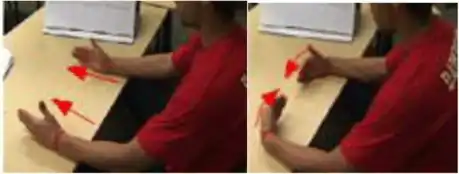
The role of motor experience in reasoning has been also investigated concerning gestures. The Gesture as Simulated Action framework (GSA), provides the necessary background to understand how gestures are manifestations of this connection. According to GSA, gestures are the result of the mental simulation of actions or perceptual states. Consequently, the use of gestures in expressing ideas shows that embodied processes are involved in producing these ideas. More significantly, the use of gestures heightens focus and increases activation on motor and perceptual information. Thus, gestures have a casual role in reasoning as using them leads to an increase in the flow of motor and perceptual information in the reasoning process. However, this does not necessarily translate into more effective reasoning as such information is sometimes not relevant to the problem at hand.[119] The effects of gestures on reasoning are not limited to speakers. The gestures of speakers impact the reasoning of listeners as well. For example, listeners could produce similar simulations to speakers by attending to the gestures of the speakers.[119]
More evidence on the role of gestures in reasoning comes from the study of mathematical and geometric reasoning. Gestures and particularly dynamic depictive gestures (i.e. gestures that are used to represent and show the transformation of objects ) are linked to better performance in snap judgment (intuition), insight, and mathematical reasoning for proof. It has also been shown that the use of dynamic depictive gestures is associated with better mathematical reasoning. Moreover, directing learners to use such gestures, facilitate justification and proof activities.[120]
Emotion

Embodied cognition theories have provided rigorous accounts of emotion and the processing of information about emotion.[121][122] In this respect, experiencing and re-experiencing an emotion involve overlapping mental processes. When re-experiencing an emotion, through the interconnections of the neurons that were active during the original experience, a partial multimodal reenactment of the experience is produced.[123][124] One of the reasons why only parts of the original neural populations are reactivated is that attention is selectively focused on certain aspects of the experience that are most salient and important for the individual.
Re-experience of emotion is produced in the originally implicated sensory-motor systems as if the individual were there in the very situation, the very emotional state, or with the very object of thought.[125] For example, the embodiment of anger might involve muscle tension used to strike, the enervation of certain facial muscles to frown, etc. Such simulation is backed by specialized mirror neuron or a "mirror neuron system", which maps the correspondences between the observed and performed actions.[126] However, there is no consensus about the exact location of the mirror neurons, whether these neurons constitute a system, and whether there actually are mirror neurons.
Theories of embodiment propose that the processing of emotional states and the concepts we use to refer to them are partly based on one's own perceptual, motor, and somatosensory systems.[127] For instance, Niedenthal's (2007) research shows, through manipulations of facial expressions and posture under controlled laboratory settings, how the embodiment of a person's emotion casually affects the way emotional information is processed.[126][128] Similarly, Well & Petty showed that nodding the head while listening to persuasive messages led to more positive attitudes toward the message than when shaking the head.[129] Duclos et al. led participants to adopt various bodily positions indirectly associated with different feelings such as fear, anger, and sadness and found that these corporeal postures modulated the experienced affect.[130]
Given the significant role emotions (e.g., fear and hope) play in an individual's life, research has been done linking embodiment, motivation and behaviour to investigate the intrinsic tendencies to act towards or away from a given stimuli.[131][132] The approach and avoidance conflict (AAC) or approach and avoidance task (AAT) describes a natural behavioural bias to approach pleasant stimuli and avoid unpleasant ones (congruent response) faster than approaching unpleasant stimuli and avoiding pleasant ones (incongruent responses). According to Elliot (2006),
"The approach-avoidance distinction is fundamental and basic to motivation, so much that it may be used as a conceptual lens through which to view the structure and function of self-regulation" [133]
The AAT has been investigated in different scenarios and with different types of stimuli such as words and images. A study focusing on the AAT on embodied cognition, for example, examined people's response to positive and negative words presented on the center of a screen by moving them away or towards the center. The study concludes that participants moved the given positive words towards the center of the screen while moving the negative words away from the center of the screen. In conformity with the AAT, participants showed an approach effect for positive words and avoidance effects for negative words.[134] In a recent study on emotional or affective priming, the AAT was used to demonstrate the interaction between emotions and visual exploration. Pictures of news pages were presented on the computer screen and eye movements were measured. Researchers found out that the participants' harmonious bodily interaction during the emotional preparation process shows that their interest in the image's content displayed on the computer screen increased. These findings demonstrate the effect of emotional priming in the approach and avoidance behavior.[135] Furthermore, a recent study on the behavior of approach and avoidance suggests that there is an embodied component that is crucial to it. [136] To investigate the role of gestures in AAT, participants were asked to react to positive and negative stimuli by either pressing a (far or near) button on a response pad; or by pushing forward or pulling backward a joystick. Researchers reported a significant response time advantage for the congruent responses when performed with the joystick and none when performed with the response pad. The fact that participants are faster at responding to the stimuli with the joystick seems to suggest the role of a crucial embodied component. In contrast to the response pad, the joystick couples more naturally with the body (hand) for the performance of the action and facilitates the gesture of approaching or avoiding positive or negative stimuli.
Evolutionary psychologists view emotion as an important self-regulatory aspect of embodied cognition, and emotion as a motivator towards goal-relevant action.[137] Emotion helps drive adaptive behavior. The evolutionary perspective cites language, both spoken and written, as types of embodied cognition.[137] Pacing and non-verbal communication reflect embodied cognition in spoken language. Technical aspects of written language, such as italics, all caps, and emoticons promote an inner voice and thereby a sense of feeling rather than thinking about a written message.[137] Furtheremore, some researchers argues that at least some abstract words are semantically grounded in emotion knowledge and, therefore, "embodied". Whereas the meanings of the words "eye" and "grasp" can be explained to a degree, by pointing to objects and actions, those of "beauty" and "freedom" can not. Abstract terms show a strong tendency to be semantically linked to knowledge about emotions.[138][139] In addition, abstract words strongly activate anterior cingulate cortex, a site known to be relevant for emotion processing. Motor system activation for emotion-expressing body parts was indeed found when adults processed abstract emotion words,[140] indicating that, for one important class of abstract concepts, semantic grounding in emotion-expressing action can partly explain the meaning–symbol link.[141]
Self-regulation
The basic idea underlying findings on embodied cognition is that cognition is composed of experiences that are multimodal and spread throughout the body, not in a way that amodal semantic nodes are stored purely in the mind. In line with this idea of embodied cognition, the body itself can also be involved in self-regulation.[142]
Self-regulation can be defined as the capacity of organisms to successfully implement goal-consistent responses despite distracting or countervailing influences.[143] Most people undergo a dilemma when they encounter immediate pains to gain long-term benefits.[144][145] When facing this dilemma, the body can help augment willpower by evoking nonconscious willpower-strengthening goals that boost people's ongoing conscious attempts to facilitate their pursuit of long-term goals.[142]
In a study, the effect of muscle-firming on donating money to Haiti was investigated. The participants either held the pen to fill out the donation sheet in their fingers ("control conditions") or in their hand ("muscle-firming" condition). Significantly more participants of the "muscle-firming" group donated money than of the control group. One can therefore deduce that firming one's muscle can help to get over their physical aversion to viewing the devastation in Haiti and spend money.[142] Similarly, physical or environmental cues signal the energetic costs of action and, subsequently, influence willingness to engage in additional volitional action.[146] According to a set of studies by Shalev (2014),[147] exposure to physical or conceptual thirst or dryness-related cues reduces perceived energy and in turn, decreases self-regulation These studies suggest that embodied cognition can play a role in self-regulation.
Some suggest that the embodied mind serves self-regulatory processes by combining movement and cognition to reach a goal. Thus, the embodied mind has a facilitative effect. To navigate the social world, one must approach helpful resources such as friends and avoid dangers like foes. Facial expression can be a signal for evaluation whether a person is desirable or dangerous. While the emotional signal might be ambiguous, embodied cognition can aid in clarifying others' emotions.[148] In a study by Niedenthal, Brauer, Halberstadt, & Innes-Ker (2001),[149] participants were able to identify expression shifts faster when they mimicked them in contrast to participants holding a pen in their mouths that froze their facial muscles, therefore, unable to mimic facial expressions. Other goal-relevant actions may be encouraged by embodied cognition, as evidenced by the automated approach and avoidance of certain environmental cues. Embodied cognition is also influenced by the situation. If one moves in a way previously associated with danger, the body may require a greater level of information processing than if the body moves in a way associated with a benign situation. The studies above may suggest that embodied cognition could serve a functional purpose by assisting in self-regulatory processes.
Social cognition

In social psychology and, and more specifically in social cognition, research focuses on how people interact and influence one another. In the context of embodiment, research in social cognition investigates how the presence of people and the interactions with them affects thoughts, feelings and behaviour.[151] More precisely, social cognition in accordance with the embodiment thesis proposes that thoughts, feelings and behaviour are grounded in sensory experiences and bodily states.[152]
In the field of phenomenology, Merleau-Ponty's intercorporéité means that when meeting a person, one initially experiences the other person via his/her bodily expressions, which has an impact before cognitive reflections.[153] This phenomenon is investigated in social psychology and is known as nonverbal synchrony.[154] Synchrony during social interaction arises spontaneously and is often independent of conscious information processing.[155]
In a dyadic social interaction study by Tschacher et al. (2014), same-sex participants interacted verbally in cooperative, competitive and 'fun task' conditions. The focus of this study was to investigate the connection between the participants' affectivity and nonverbal synchrony. Results showed that positive emotions were associated with positive synchrony while negative emotions were associated negatively. Furthermore, the findings point towards a causal relation between synchrony and emotions with synchrony leading to affect rather than vice versa.[154] In a similar study, same-sex participant pairs were instructed to alternate asking certain questions and to progressively self-disclose. Results show that people spontaneously move together in space and synchronize their movement which enhances the quality of interaction (embodied rapport). Self-disclosure and behavioural synchrony correlate with positive emotions towards another person.[150]
These two exemplary studies both revealed that nonverbal, behavioural synchrony of bodily movements influence the psychological experience of the interaction between two people. These findings support the embodiment thesis idea of bodily experiences influencing people's psychological and emotional states.
Sensorimotor contingencies
As a part of the theory of embodied cognition, the concept of sensorimotor contingencies (SMCs) claims that the quality of perception is determined by the knowledge of how sensory information changes when one acts in the world. As an example, to look underneath an object, one has to bend down, shift one's head and change the gaze direction.[156] Every stimulus modality / sensory modality such as light, sound pressure, etc. follow specific rules, i.e. sensorimotor contingencies,[157] that govern those changes of sensory information. Consequentially, since those rules differ between modalities, also the qualitative experience of them differ. An instance of a SMC distinct for the visual percept is the expansion of the flow pattern on the retina when the body moves forward and the analogue contraction when the body moves backwards.[157] Auditory SMCs are affected by head rotations which change the temporal asynchrony of a received signal between the right and the left ear. This movement mainly affects the amplitude but not the frequency of the sensory input.[157] These examples highlight differences between SMCs of different modalities.
Support for this theory of sensorimotor contingencies is brought forward by studies on sensory substitution, sensory augmentation and by the field of robotics. Research on sensory substitution and sensory substitution devices examine the replacement of one modality by another (e.g. visual information replaced by tactile information [158]). Sensorimotor contingencies of one modality are therefore transmitted via another modality. Sensory augmentation aims for the perception of a new sense via already existing perceptual channels. In the case of sensory augmentation, new sensorimotor contingencies are formed. In the field of robotics, one can investigate how visual SMCs are learned on a neural level with the help of a robotic arm and dynamic neural fields.[159]
Challenges
Research on embodied cognition is extremely broad, covering a wide range of concepts. Methods to study how our cognition is embodied vary from experiment to experiment based on the operational definition used by researchers. There is much evidence for this embodiment, although interpretation of results and their significance may be disputed. Researchers continue to search for the best way to study and interpret the theory of embodied cognition.[160]
Research with preverbal infants
Daum at al. suggested that pre-verbal infants may be considered an ideal channel for studying embodied cognition, especially embodied social cognition.[161] since they utilise symbols less than adults do.[161] Some (Longo, 2009) criticised this notion since it may be impossible to know which stage of a preverbal infant is supposed to be the "ideal model" for embodied social cognition, as infant cognition changes dramatically throughout the preverbal period. A 9-month old has reached a different developmental stage than a 2-month old.[162]
Another major issue is whether or not a particular ability reflects an embodied mode of processing. Some claim that looking-time could likely be a better measure of embodied cognition than reaching because infants have not developed certain fine motor skills yet. Infants may first develop a passive mode of embodied cognition before they develop the active mode involving fine motor movements. Longo (2009) pointed out that it is problematic in that there is no apparent reason to suppose that the abilities revealed through looking-time paradigm reflect embodied processing.[162] For the distinction between embodied and symbolic modes of processing to be useful in generating testable experimental hypotheses, it must be clear what sort of evidence could, at least in principle, allow a researcher to determine whether or not any particular ability is embodied.[162]
Replication crisis and misinterpretation
It has been shown that some of the famous findings in embodied cognition have failed to reproduce the same results as the originals. Take the "power poses" studies for example, the claim that physically expanding your body can increase one's confidence has failed to replicate in several studies.[163] A study[164] that showed sensations of weight activate concepts of importance, which in turn may affect morality-related variables has also failed to be recreated.[165] And, some researchers also could not replicate the previous findings claiming that holding a warm cup creates a sense of interpersonal warmth.[166] These findings are all related to the idea that bodily experiences influence cognitive process that is typically thought of as solely a mental activity.
The fact that they failed to replicate the same results does not prove the body does not affect cognition at all. Still, there are numbers of findings within the topic of embodied cognition that are scientifically sound. However, some[167] say many of the failed embodiment findings rely on priming. And many cases of facilitative movements of the body due to priming may be incorrectly labeled as evidence of embodied cognition. The pencil-in-teeth study[168] may be the examples of priming. The researchers believed that the quicker responses to positive sentences by participants engaging their smiling muscles represented embodied cognition. However, opponents argue that the effects of this exercise were primed or facilitated by the engagement of certain facial muscles. Priming (pencil in teeth, lips) may causally induce certain perceptual-motor activity that, in turn, causally induces certain cognitive processes, without the perceptual-motor activity constituting cognitive processing.[169]
Six views of embodied cognition
The following "Six Views of Embodied Cognition" are taken from Margaret Wilson:[170][171]
- "Cognition is situated. Cognitive activity takes place in the context of a real-world environment, and inherently involves perception and action." One example of this is moving around a room while, at the same time, trying to decide where the furniture should go.
- "Cognition is time-pressured. We are 'mind on the hoof' (Clark, 1997), and cognition must be understood in terms of how it functions under the pressure of real-time interaction with the environment." When you're under pressure to make a decision, the choice that is made emerges from the confluence of pressures that you're under. In the absence of pressure, a decision may be made differently.
- "We off-load cognitive work onto the environment. Because of limits on our information-processing abilities (e.g., limits on attention and working memory), we exploit the environment to reduce the cognitive workload. We make the environment hold or even manipulate information for us, and we harvest that information only on a need-to-know basis." This is seen when people have calendars, agendas, PDAs, or anything to help them with everyday functions. We write things down so we can use the information when we need it, instead of taking the time to memorize or encode it into our minds.
- "The environment is part of the cognitive system. The information flow between mind and world is so dense and continuous that, for scientists studying the nature of cognitive activity, the mind alone is not a meaningful unit of analysis." This statement means that the production of cognitive activity does not come from the mind alone, but rather is a mixture of the mind and the environmental situation that we are in. These interactions become part of our cognitive systems. Our thinking, decision-making, and future are all impacted by our environmental situations.
- "Cognition is for action. The function of the mind is to guide action and things such as perception and memory must be understood in terms of their contribution to situation-appropriate behavior." This claim has to do with the purpose of perception and cognition. For example, visual information is processed to extract identity, location, and affordances (ways that we might interact with objects). A prominent anatomical distinction is drawn between the "what" (ventral) and "where" (dorsal) pathways in visual processing. However, the commonly labeled "where" pathway is also the "how" pathway, at least partially dedicated to action.
- "Off-line cognition is body-based. Even when decoupled from the environment, the activity of the mind is grounded in mechanisms that evolved for interaction with the environment – that is, mechanisms of sensory processing and motor control." This is shown with infants or toddlers best. Children utilize skills and abilities they were born with, such as sucking, grasping, and listening, to learn more about the environment. The skills are broken down into five main categories that combine sensory with motor skills, sensorimotor functions. The five main skills are:
- Mental Imagery: Is visualizing something that is not currently present in your environment. For example, imagining a future activity, or recalling how many windows are on the first floor of a house you once lived in (even though you did not count them explicitly while living there).
- Working Memory: Short-term memory
- Episodic Memory: Long-term memory of specific events.
- Implicit Memory: means by which we learn certain skills until they become automatic for us. An example of this would be an adult brushing his/her teeth, or an expert race car driver putting the car in drive.
- Reasoning and Problem-Solving: Having a mental model of something will increase problem-solving approaches.
Criticism of the six claims
Margaret Wilson adds: "Some authors go so far as to complain that the phrase 'situated cognition' implies, falsely, that there also exists cognition that is not situated (Greeno & Moore, 1993, p. 50)."[172] Of her six claims, she notes in her abstract, "the first three and the fifth claim appear to be at least partially true, and their usefulness is best evaluated in terms of the range of their applicability. The fourth claim, I argue, is deeply problematic. The sixth claim has received the least attention, but it may in fact be the best documented and most powerful of the six claims."[173]
See also
- Action-specific perception
- Active inference
- Blue Brain Project
- Cognitive biology
- Cognitive linguistics
- Cognitive neuropsychology
- Cognitive neuroscience
- Cognitive science
- Conceptual blending
- Conceptual metaphor
- Ecological psychology
- Embodied bilingual language
- Embodied cognitive science
- Embodied embedded cognition
- Embodied music cognition
- Embodied phenomenology
- Enactivism
- Extended cognition
- Extended mind thesis
- Externalism
- Feeling
- Image schema
- Metaphors We Live By
- Moravec's paradox
- Motor cognition
- Neuroconstructivism
- Neuropsychology
- Neurophenomenology
- Philosophy of mind
- Plant cognition
- Where Mathematics Comes From
- Women, Fire, and Dangerous Things
References
- Wilson RA, Foglia L (July 25, 2011). "Embodied Cognition". In Zalta EN (ed.). The Stanford Encyclopedia of Philosophy (Fall 2011 Edition).
- Varela, Thompson & Rosch 1991
- Varela FJ, Thompson E, Rosch E (1991). The embodied mind: Cognitive science and human experience (Paperback 1992 ed.). MIT Press. ISBN 978-0262720212.
- "Embodied Cognition and Radical Embodied Cognition", Radical Embodied Cognitive Science, The MIT Press, 2009, doi:10.7551/mitpress/8367.003.0005, ISBN 978-0-262-25867-8
- Shapiro LA (2019). Embodied cognition. ISBN 978-1-138-74698-5. OCLC 1100588211.
- Wilson AD, Golonka S (2013). "Embodied Cognition is Not What you Think it is". Frontiers in Psychology. 4: 58. doi:10.3389/fpsyg.2013.00058. PMC 3569617. PMID 23408669.
- Milkowski M (2013). Explaining the Computational Mind. MIT Press. p. 4. ISBN 9780262018869.
- David Chalmers (ed.). "The Extended Mind". Philosophy of the mind. philpapers: philosophical research on line. Retrieved 20 February 2015. See also: Clark A, Chalmers DJ (2010). "Chapter 2: The extended mind". In Richard Menary (ed.). The extended mind. MIT Press. pp. 27 ff. ISBN 9780262014038.
- Clark A (2008). Supersizing the Mind : Embodiment, Action, and Cognitive Extension: Embodiment, Action, and Cognitive Extension. Cambridge University Press. p. 107. ISBN 9780199715534.
no genuinely cognitive system will turn out to consist entirely of the kind of external resources that fans of extended cognition typically invoke
- Immanuel Kant, Universal Natural History and Theory of the Heavens, p.367; translated by Stephen Palmquist in Kant's Critical Religion (Aldershot: Ashgate, 2000), p.320.
- Carpenter A (2008). "Kant on the embodied cognition". فلسفه. 36 (1): 59–68.
- Varela FJ, Thompson E, Rosch E (13 November 1992). "Chapter 4: The I of the storm". The Embodied Mind: Cognitive Science and Human Experience (Paperback 1992 ed.). p. 70. ISBN 978-0262720212.
- Svare H (2006). "Chapter 7: The body and the transcendental". Body and Practice in Kant. Springer Science & Business Media. pp. 213 ff. ISBN 9781402041198.
- Cowart M (2004). "Embodied Cognition". The Internet Encyclopedia of Philosophy. ISSN 2161-0002. Retrieved 27 February 2012.
- Hendriks-Jansen H (1996). Catching Ourselves in the Act: Situated Activity, Interactive Emergence, Evolution, and Human Thought. MIT Press. ISBN 9780262082464.
- Di Paolo E (29 October 2009). "Shallow and Deep Embodiment". University of Sussex. Retrieved 27 Feb 2012.
- "Meditations on First Philosophy". Descartes: Meditations on First Philosophy. Cambridge Texts in the History of Philosophy. Cambridge University Press. 1996-04-18. pp. 1–11. doi:10.1017/cbo9780511805028.006. ISBN 978-0-521-55818-1.
- McCarthy JA (2016-01-12). The Early History of Embodied Cognition 1740-1920. BRILL. doi:10.1163/9789004309036. ISBN 978-90-04-30902-9.
- McNerney S. "A Brief Guide to Embodied Cognition: Why You Are Not Your Brain". Scientific American Blog Network. Retrieved 2021-07-22.
- Gomila T, Calvo P (2008). "Directions for an Embodied Cognitive Science". Handbook of Cognitive Science. Elsevier. pp. 1–25. doi:10.1016/b978-0-08-046616-3.00001-3. ISBN 978-0-08-046616-3.
- Merleau-Ponty M (1962). Phenomenology of perception. London: Routledge & K. Paul. ISBN 978-0-7100-3613-1.
- Shapiro L (2021). "Embodied Cognition". In Zalta EN, Spaulding S (eds.). The Stanford Encyclopedia of Philosophy (Fall 2021 ed.). Metaphysics Research Lab, Stanford University. Retrieved 2021-07-22.
- Varela F, Thompson E, Rosch EJ (2017). The Embodied Mind: Cognitive Science and Human Experience. The MIT Press. doi:10.7551/mitpress/9780262529365.001.0001. ISBN 978-0-262-33549-2.
- Lawler JM, Lakoff G, Johnson M (1983). "Metaphors We Live by". Language. 59 (1): 201. doi:10.2307/414069. JSTOR 414069.
- Stern, Elsbeth (August 2015). "Embodied cognition: A grasp on human thinking". Nature. 524 (7564): 158–159. doi:10.1038/524158a. ISSN 1476-4687.
- Wilson, Margaret (2008), "How Did We Get from There to Here? An Evolutionary Perspective on Embodied Cognition", Handbook of Cognitive Science, Elsevier, pp. 373–393, doi:10.1016/B978-0-08-046616-3.00019-0, retrieved 2021-12-08
- "Intelligence in the Flesh | Yale University Press". yalebooks.yale.edu. Retrieved 2021-12-08.
- McGinn, Colin (2015-08-07). Prehension: The Hand and the Emergence of Humanity. Cambridge, MA, USA: MIT Press. ISBN 978-0-262-02932-2.
- Gibson JJ (1950). The perception of the visual world. Boston: Houghton Mifflin. OCLC 560396.
- Hatfield G (1991). "Representation and Rule-Instantiation in Connectionist Systems". In Horgan T, Tienson J (eds.). Connectionism and the Philosophy of Mind. Studies in Cognitive Systems. 9. Dordrecht: Springer Netherlands. pp. 90–112. doi:10.1007/978-94-011-3524-5_5. ISBN 978-94-010-5559-8.
- Buckner C, Garson J (1997). "Connectionism". The Stanford Encyclopedia of Philosophy.
- Flusberg SJ, Thibodeau PH, Sternberg DA, Glick JJ (2010). "A connectionist approach to embodied conceptual metaphor". Frontiers in Psychology. 1: 197. doi:10.3389/fpsyg.2010.00197. PMC 3153806. PMID 21833256.
- Calvo P, Symons J, eds. (2014). The architecture of cognition : rethinking Fodor and Pylyshyn's systematicity challenge. Cambridge, MA. ISBN 978-0-262-32246-1. OCLC 877987820.
- Fodor JA (1987). Psychosemantics : the problem of meaning in the philosophy of mind. British Psychological Society. Cambridge, Mass.: MIT Press. ISBN 0-585-33288-6. OCLC 45844220.
- O'Regan JK, Noë A (October 2001). "A sensorimotor account of vision and visual consciousness". The Behavioral and Brain Sciences. 24 (5): 939–973. doi:10.1017/S0140525X01000115. PMID 12239892.
- Newen A, de Bruin L, Gallagher S (2018-08-23). The Oxford Handbook of 4E Cognition. Oxford University Press. ISBN 978-0-19-105436-5.
- Chemero, Anthony (2009). Radical embodied cognitive science. Cambridge, Mass.: MIT Press. ISBN 978-0-262-25867-8. OCLC 459795594.
- Clark, Andy (1999). "An embodied cognitive science?". Trends in Cognitive Sciences. 3 (9): 345–351. doi:10.1016/S1364-6613(99)01361-3. ISSN 1364-6613. PMID 10461197.
- Lakoff & Johnson (1980); Lakoff (1987); Lakoff & Turner (1989); Lakoff & Johnson (1999); Lakoff & Nunez 2000
- Trofimova, Irina (1999). "An Investigation of How People of Different Age, Sex, and Temperament Estimate the World". Psychological Reports. 85 (2): 533–552. doi:10.2466/pr0.1999.85.2.533. ISSN 0033-2941.
- Lakoff & Johnson 1980.
- Lakoff & Johnson 2003.
- Lakoff & Turner 1989.
- Lakoff G, Johnson M (2003). Metaphors We Live By. University of Chicago Press. doi:10.7208/chicago/9780226470993.001.0001. ISBN 978-0-226-46801-3.
- Lakoff G, Núñez RE (2000). Where Mathematics Comes From. Basic Books. ISBN 0-465-03770-4.
- Rosch E (1973). "Natural categories". Cognitive Psychology. 4 (3): 328–350. doi:10.1016/0010-0285(73)90017-0.
- Rosch E (1978). "Principles of Categorization". In Rosch E, Lloyd BB (eds.). Cognition and Categorization'. Lawrence Erlbaum Associates. pp. 7–48.
- Lakoff G. Women, Fire, and Dangerous Things: What Categories Reveal About the Mind. University of Chicago Press. ISBN 0-226-46804-6.
- Edelman 2004, Damasio 1999
- Maturana & Varela 1987, Varela, Thompson & Rosch 1991
- Liberman AM, Cooper FS, Shankweiler DP, Studdert-Kennedy M (November 1967). "Perception of the speech code". Psychological Review. 74 (6): 431–461. doi:10.1037/h0020279. PMID 4170865.
- Liberman AM, Mattingly IG (October 1985). "The motor theory of speech perception revised". Cognition. 21 (1): 1–36. CiteSeerX 10.1.1.330.220. doi:10.1016/0010-0277(85)90021-6. PMID 4075760. S2CID 112932.
- Liberman AM, Mattingly IG (January 1989). "A specialization for speech perception". Science. 243 (4890): 489–494. Bibcode:1989Sci...243..489L. doi:10.1126/science.2643163. PMID 2643163. S2CID 16274933.
- Liberman AM, Whalen DH (May 2000). "On the relation of speech to language". Trends in Cognitive Sciences. 4 (5): 187–196. doi:10.1016/S1364-6613(00)01471-6. PMID 10782105. S2CID 12252728.
- Galantucci B, Fowler CA, Turvey MT (June 2006). "The motor theory of speech perception reviewed". Psychonomic Bulletin & Review. 13 (3): 361–377. doi:10.3758/bf03193857. PMC 2746041. PMID 17048719.
- Haselager P, van Dijk J, van Rooij I (2008), "A Lazy Brain? Embodied Embedded Cognition and Cognitive Neuroscience", Handbook of Cognitive Science, Elsevier, pp. 273–290, doi:10.1016/b978-0-08-046616-3.00014-1, ISBN 978-0-08-046616-3
- Melnik A, Hairston WD, Ferris DP, König P (June 2017). "EEG correlates of sensorimotor processing: independent components involved in sensory and motor processing". Scientific Reports. 7 (1): 4461. Bibcode:2017NatSR...7.4461M. doi:10.1038/s41598-017-04757-8. PMC 5493645. PMID 28667328.
- Rohrer T (2005). "Image schemata in the brain". From Perception to Meaning: Image Schemas in Cognitive Linguistics. Cognitive Linguistics Research. 29: 165–196. doi:10.1515/9783110197532.2.165. ISBN 978-3-11-018311-5.
- Hauk O, Johnsrude I, Pulvermüller F (January 2004). "Somatotopic representation of action words in human motor and premotor cortex". Neuron. 41 (2): 301–307. doi:10.1016/S0896-6273(03)00838-9. PMID 14741110. S2CID 7423629.
- Buccino G, Riggio L, Melli G, Binkofski F, Gallese V, Rizzolatti G (August 2005). "Listening to action-related sentences modulates the activity of the motor system: a combined TMS and behavioral study". Brain Research. Cognitive Brain Research. 24 (3): 355–363. doi:10.1016/j.cogbrainres.2005.02.020. PMID 16099349.
- Schneider IK, Parzuchowski M, Wojciszke B, Schwarz N, Koole SL (2015). "Weighty data: importance information influences estimated weight of digital information storage devices". Frontiers in Psychology. 5: 1536. doi:10.3389/fpsyg.2014.01536. PMC 4287016. PMID 25620942.
- Jostmann NB, Lakens D, Schubert TW (September 2009). "Weight as an embodiment of importance". Psychological Science. 20 (9): 1169–1174. doi:10.1111/j.1467-9280.2009.02426.x. PMID 19686292. S2CID 21117487.
- Moravec 1988, Brooks 1990, Pfeiffer 2001
- Clark 1997, Hendriks-Jansen 1996
- Russell S, Norvig P (April 1995). "A modern, agent-oriented approach to introductory artificial intelligence". ACM SIGART Bulletin. 6 (2): 24–26. doi:10.1145/201977.201989. ISSN 0163-5719. S2CID 16172669.
- Pfeifer R (2001). "Embodied Artificial Intelligence 10 Years Back, 10 Years Forward". Informatics. Lecture Notes in Computer Science. 2000. Berlin, Heidelberg: Springer Berlin Heidelberg. pp. 294–310. doi:10.1007/3-540-44577-3_21. ISBN 978-3-540-41635-7.
- Fumiya I, ed. (January 2008). 50 Years of Artificial Intelligence : Essays Dedicated to the 50th Anniversary of Artificial Intelligence. Springer. ISBN 978-3-540-77295-8. OCLC 466121242.
- Mudrik L (2009-08-18). "Review of Aamodt & Wang (2008): Welcome to your brain: Why you lose your car keys but never forget how to drive and other puzzles of everyday life". Pragmatics and Cognition. 17 (2): 441–449. doi:10.1075/pc.17.2.11mud. ISSN 0929-0907.
- See History of AI § The problems
- Moravec 1988, pp. 15–16.
- Turing 1950.
- Paradowski, Michał B. 2012. Developing embodied multisensory dialogue agents. In: Rzepka, Rafał, Michał Ptaszyński & Paweł Dybala (Eds.) Linguistic and Cognitive Approaches to Dialogue Agents. Birmingham: The Society for the Study of Artificial Intelligence and Simulation of Behaviour, 6–14.
- Iida F, Pfeifer R, Steels L, Kuniyoshi Y (2004). Embodied Artificial Intelligence : International Seminar, Dagstuhl Castle, Germany, July 7-11, 2003. Revised Papers. Springer-Verlag Berlin Heidelberg. ISBN 978-3-540-27833-7. OCLC 769771206.
- Anderson ML (September 2003). "Embodied Cognition: A field guide". Artificial Intelligence. 149 (1): 91–130. doi:10.1016/s0004-3702(03)00054-7. ISSN 0004-3702.
- Chrisley R (September 2003). "Embodied artificial intelligence". Artificial Intelligence. 149 (1): 131–150. doi:10.1016/s0004-3702(03)00055-9. ISSN 0004-3702.
- Holland O (2004), "The Future of Embodied Artificial Intelligence: Machine Consciousness?", Embodied Artificial Intelligence, Lecture Notes in Computer Science, Berlin, Heidelberg: Springer Berlin Heidelberg, 3139, pp. 37–53, doi:10.1007/978-3-540-27833-7_3, ISBN 978-3-540-22484-6
- Pfeifer R, Iida F (2004), "Embodied Artificial Intelligence: Trends and Challenges", Embodied Artificial Intelligence, Lecture Notes in Computer Science, Berlin, Heidelberg: Springer Berlin Heidelberg, 3139, pp. 1–26, doi:10.1007/978-3-540-27833-7_1, ISBN 978-3-540-22484-6
- O'Regan JK, Noë A (October 2001). "A sensorimotor account of vision and visual consciousness". The Behavioral and Brain Sciences. 24 (5): 939–973, discussion 973–1031. doi:10.1017/s0140525x01000115. PMID 12239892.
- O'Regan JK (September 1992). "Solving the "real" mysteries of visual perception: the world as an outside memory". Canadian Journal of Psychology. 46 (3): 461–488. doi:10.1037/h0084327. PMID 1486554.
- Witt JK, Linkenauger SA, Bakdash JZ, Augustyn JS, Cook A, Proffitt DR (January 2009). "The long road of pain: chronic pain increases perceived distance". Experimental Brain Research. 192 (1): 145–148. doi:10.1007/s00221-008-1594-3. PMC 3193944. PMID 18949471.
- Bekkering H, Neggers SF (July 2002). "Visual search is modulated by action intentions". Psychological Science. 13 (4): 370–374. doi:10.1111/j.0956-7976.2002.00466.x. PMID 12137141. S2CID 11584027.
- Tversky B, Hard BM (January 2009). "Embodied and disembodied cognition: spatial perspective-taking". Cognition. 110 (1): 124–129. doi:10.1016/j.cognition.2008.10.008. PMID 19056081. S2CID 15229389.
- Jirak D, Menz MM, Buccino G, Borghi AM, Binkofski F (September 2010). "Grasping language--a short story on embodiment". Consciousness and Cognition. 19 (3): 711–720. doi:10.1016/j.concog.2010.06.020. PMID 20739194. S2CID 14827435.
- Gallese V (2008). "Mirror neurons and the social nature of language: the neural exploitation hypothesis". Social Neuroscience. 3 (3–4): 317–333. doi:10.1080/17470910701563608. PMID 18979384. S2CID 6329445.
- Barsalou LW (2008-01-01). "Grounded cognition". Annual Review of Psychology. 59 (1): 617–645. doi:10.1146/annurev.psych.59.103006.093639. PMID 17705682.
- "APA PsycNet". psycnet.apa.org. Retrieved 2021-10-26.
- Pulvermüller F (July 2005). "Brain mechanisms linking language and action". Nature Reviews. Neuroscience. 6 (7): 576–582. doi:10.1038/nrn1706. PMID 15959465. S2CID 205500274.
- Fogassi L, Ferrari PF (2007-06-01). "Mirror Neurons and the Evolution of Embodied Language". Current Directions in Psychological Science. 16 (3): 136–141. doi:10.1111/j.1467-8721.2007.00491.x. ISSN 0963-7214. S2CID 1283759.
- Glenberg AM, Kaschak MP (September 2002). "Grounding language in action". Psychonomic Bulletin & Review. 9 (3): 558–65. doi:10.3758/bf03196313. PMID 12412897. S2CID 1274984.
- Fischer MH, Zwaan RA (June 2008). "Embodied language: a review of the role of the motor system in language comprehension". Quarterly Journal of Experimental Psychology. 61 (6): 825–50. doi:10.1080/17470210701623605. PMID 18470815. S2CID 14948542.
- Olmstead AJ, Viswanathan N, Aicher KA, Fowler CA (December 2009). "Sentence comprehension affects the dynamics of bimanual coordination: implications for embodied cognition". Quarterly Journal of Experimental Psychology. 62 (12): 2409–17. doi:10.1080/17470210902846765. PMID 19396732. S2CID 25131897.
- Rizzolatti G, Craighero L (2004). "The mirror-neuron system". Annu. Rev. Neurosci. 27: 169–192. doi:10.1146/annurev.neuro.27.070203.144230. PMID 15217330.
- Tettamanti M, Buccino G, Saccuman MC, Gallese V, Danna M, Scifo P, Fazio F, Rizzolatti G, Cappa SF, Perani D (February 2005). "Listening to action-related sentences activates frontoparietal motor circuits". Journal of Cognitive Neuroscience. 17 (2): 273–81. doi:10.1162/0898929053124965. PMID 15811239. S2CID 18300171.
- Atkinson D (2010). "Extended, embodied cognition and second language acquisition". Applied Linguistics. 31 (5): 599–6222. doi:10.1093/applin/amq009.
- Dove G (2014). "Thinking in words: language as an embodied medium of thought". Topics in Cognitive Science. 6 (3): 371–389. doi:10.1111/tops.12102. PMID 24943737.
- Wilson M (December 2002). "Six views of embodied cognition". Psychonomic Bulletin & Review. 9 (4): 625–636. doi:10.3758/BF03196322. PMID 12613670. S2CID 267562.
- Dijkstra K, Zwaan RA (2014). "Memory and action". Routledge Handbook of Embodied Cognition. pp. 314–323.
- Glenberg AM (March 1997). "What memory is for". The Behavioral and Brain Sciences. 20 (1): 1–19. doi:10.1017/S0140525X97000010. PMID 10096994.
- Dijkstra K, Kaschak MP, Zwaan RA (January 2007). "Body posture facilitates retrieval of autobiographical memories". Cognition. 102 (1): 139–149. doi:10.1016/j.cognition.2005.12.009. PMID 16472550. S2CID 23251779.
- Culbertson R (1995). "Embodied memory, transcendence, and telling: Recounting trauma, re-establishing the self". New Literary History. 26 (1): 169–195. doi:10.1353/nlh.1995.0007. S2CID 143144859.
- Bietti LM (2012). "Towards a cognitive pragmatics of collective remembering". Pragmatics & Cognition. 20 (1): 32–61. doi:10.1075/pc.20.1.02bie.
- How Children Learn to Discover Their Environment: An Embodied Dynamic Systems Perspective on the Development of Spatial Cognition. Academic Press. 2017-01-01. pp. 309–360. doi:10.1016/B978-0-12-801638-1.00009-4. ISBN 978-0-12-801638-1.
- Gibson EJ (January 1988). "Exploratory Behavior in the Development of Perceiving, Acting, and the Acquiring of Knowledge". Annual Review of Psychology. 39 (1): 1–42. doi:10.1146/annurev.ps.39.020188.000245. ISSN 0066-4308.
- Kontra C, Goldin-Meadow S, Beilock SL (October 2012). "Embodied learning across the life span". Topics in Cognitive Science. 4 (4): 731–739. doi:10.1111/j.1756-8765.2012.01221.x. PMC 3634974. PMID 22961943.
- Glenberg AM, Gallese V (July 2012). "Action-based language: a theory of language acquisition, comprehension, and production". Cortex; A Journal Devoted to the Study of the Nervous System and Behavior. 48 (7): 905–922. doi:10.1016/j.cortex.2011.04.010. PMID 21601842. S2CID 206984079.
- Beilock SL, Goldin-Meadow S (November 2010). "Gesture changes thought by grounding it in action". Psychological Science. 21 (11): 1605–1610. doi:10.1177/0956797610385353. PMC 2978768. PMID 20889932.
- Mayer KM, Yildiz IB, Macedonia M, von Kriegstein K (February 2015). "Visual and motor cortices differentially support the translation of foreign language words". Current Biology. 25 (4): 530–535. doi:10.1016/j.cub.2014.11.068. PMID 25660537. S2CID 19013216.
- Wakefield EM, Congdon EL, Novack MA, Goldin-Meadow S, James KH (October 2019). "Learning math by hand: The neural effects of gesture-based instruction in 8-year-old children". Attention, Perception & Psychophysics. 81 (7): 2343–2353. doi:10.3758/s13414-019-01755-y. PMID 31111452. S2CID 160013471.
- Fugate JM, Macrine SL, Cipriano C (2019-10-02). "The role of embodied cognition for transforming learning". International Journal of School & Educational Psychology. 7 (4): 274–288. doi:10.1080/21683603.2018.1443856. ISSN 2168-3603. S2CID 150176182.
- Scherr RE, Close HG, Close EW, Flood VJ, McKagan SB, Robertson AD, et al. (2013-07-12). "Negotiating energy dynamics through embodied action in a materially structured environmen". Physical Review Special Topics - Physics Education Research. 9 (2): 020105. Bibcode:2013PRPER...9b0105S. doi:10.1103/PhysRevSTPER.9.020105. ISSN 1554-9178.
- Rollinde E (2019-02-01). "Learning Science Through Enacted Astronomy". International Journal of Science and Mathematics Education. 17 (2): 237–252. Bibcode:2019IJSME..17..237R. doi:10.1007/s10763-017-9865-8. ISSN 1573-1774. S2CID 148863234.
- Abrahamson D, Nathan MJ, Williams-Pierce C, Walkington C, Ottmar ER, Soto H, Alibali MW (2020). "The Future of Embodied Design for Mathematics Teaching and Learning". Frontiers in Education. 5: 147. doi:10.3389/feduc.2020.00147. ISSN 2504-284X.
- Shapiro L, Stolz SA (2019-03-01). "Embodied cognition and its significance for education". Theory and Research in Education. 17 (1): 19–39. doi:10.1177/1477878518822149. ISSN 1477-8785. S2CID 150186367.
- Hyun JS, Luck SJ (February 2007). "Visual working memory as the substrate for mental rotation". Psychonomic Bulletin & Review. 14 (1): 154–158. doi:10.3758/bf03194043. PMID 17546746.
- Moreau D (2012). "The role of motor processes in three-dimensional mental rotation: Shaping cognitive processing via sensorimotor experience". Learning and Individual Differences. 22 (3): 354–359. doi:10.1016/j.lindif.2012.02.003.
- Moreau D (February 2013). "Constraining movement alters the recruitment of motor processes in mental rotation". Experimental Brain Research. 224 (3): 447–454. doi:10.1007/s00221-012-3324-0. PMID 23138523. S2CID 18336850.
- Moreau D, Clerc J, Mansy-Dannay A, Guerrien A (2012). "Enhancing spatial ability through sport practice: Evidence for an effect of motor training on mental rotation performance". Journal of Individual Differences. 33 (2): 83–88. doi:10.1027/1614-0001/a000075. S2CID 145191639.
- Moreau D (March 2013). "Motor expertise modulates movement processing in working memory". Acta Psychologica. 142 (3): 356–361. doi:10.1016/j.actpsy.2013.01.011. PMID 23422289.
- Alibali MW, Boncoddo R, Hostetter AB (2014). "Gesture in reasoning: an embodied perspective". The Routledge Handbook of Embodied Cognition. Routledge. doi:10.4324/9781315775845-25/gesture-reasoning-embodied-perspective-martha-alibali-rebecca-boncoddo-autumn-hostetter (inactive 2021-11-08). ISBN 978-1-315-77584-5. Retrieved 2021-10-28.CS1 maint: DOI inactive as of November 2021 (link)
- "APA PsycNet". psycnet.apa.org. Retrieved 2021-10-28.
- Feldman-Barrett L, Niedenthal PM, Winkielman P (2005). Emotion : Conscious and Unconscious. Guilford Press.
- Damasio AR (1994). Descartes' Error: Emotion, Reason, and the Human Brain. Putnam.
- Damasio AR (November 1989). "Time-locked multiregional retroactivation: a systems-level proposal for the neural substrates of recall and recognition". Cognition. 33 (1–2): 25–62. doi:10.1016/0010-0277(89)90005-x. PMID 2691184. S2CID 34115898.
- Barsalou LW, Niedenthal PM, Barbey AK, Ruppert JA (2003-01-01). "Social Embodiment". Psychology of Learning and Motivation Volume 43. Psychology of Learning and Motivation. 43. Academic Press. pp. 43–92. doi:10.1016/S0079-7421(03)01011-9. ISBN 9780125433433. ISSN 0079-7421.
- Gallese V (July 2003). "The roots of empathy: the shared manifold hypothesis and the neural basis of intersubjectivity". Psychopathology. 36 (4): 171–180. doi:10.1159/000072786. PMID 14504450. S2CID 9422028.
- Niedenthal PM (May 2007). "Embodying emotion". Science. 316 (5827): 1002–1005. Bibcode:2007Sci...316.1002N. doi:10.1126/science.1136930. PMID 17510358. S2CID 14537829.
- Carr EW, Kever A, Winkielman P (2018-09-13). "Embodiment of emotion and its situated nature". In Newen A, De Bruin L, Gallagher S (eds.). The Oxford Handbook of 4E Cognition. pp. 528–552. doi:10.1093/oxfordhb/9780198735410.013.30. ISBN 978-0-19-873541-0.
- Winkielman P, Niedenthal PM, Oberman L (2008). "The Embodied Emotional Mind". In Semin GR, Smith ER (eds.). Embodied Grounding. pp. 263–288. doi:10.1017/CBO9780511805837.012. ISBN 9780511805837.
- Wells GL, Petty RE (1980-09-01). "The Effects of Over Head Movements on Persuasion: Compatibility and Incompatibility of Responses". Basic and Applied Social Psychology. 1 (3): 219–230. doi:10.1207/s15324834basp0103_2. ISSN 0197-3533.
- Duclos SE, Laird ID, Schneider E, Sexter M, Stern L, Van Lighten O (1989). "Emotion-specific effects of facial expressions and postures on emotional experience". Journal of Personality and Social Psychology. 57: 100–108. doi:10.1037/0022-3514.57.1.100.
- Elliot, Andrew J.; Church, Marcy A. (1997). "A hierarchical model of approach and avoidance achievement motivation". Journal of Personality and Social Psychology. 72 (1): 218–232. doi:10.1037/0022-3514.72.1.218. ISSN 1939-1315.
- Corr, Philip J. (2013). "Approach and Avoidance Behaviour: Multiple Systems and their Interactions". Emotion Review. 5 (3): 285–290. doi:10.1177/1754073913477507. ISSN 1754-0739.
- Elliot, Andrew J. (2006). "The Hierarchical Model of Approach-Avoidance Motivation". Motivation and Emotion. 30 (2): 111–116. doi:10.1007/s11031-006-9028-7. ISSN 1573-6644.
- van Dantzig S, Zeelenberg R, Pecher D (2009). "Unconstraining theories of embodied cognition". Journal of Experimental Social Psychology. 45 (2): 345–351. doi:10.1016/j.jesp.2008.11.001.
- "repOSitorium: Let Me Make You Happy, and I'll Tell You How You Look Around: Using an Approach-Avoidance Task as an Embodied Emotion Prime in a Free-Viewing Task". repositorium.ub.uni-osnabrueck.de. Retrieved 2021-09-15.
- Solzbacher, Johannes; Czeszumski, Artur; Walter, Sven; König, Peter (2021). "Evidence for the Embodiment of the automatic approach bias". psyarxiv.com.
- Kaschak MP, Maner JK, Miller S, Coyle JM (2009). "Embodied social cognition: Bodies, emotions, and blackberries". European Journal of Social Psychology. 39 (7): 1255–1256. doi:10.1002/ejsp.692. ISSN 0046-2772.
- Meteyard L, Cuadrado SR, Bahrami B, Vigliocco G (July 2012). "Coming of age: a review of embodiment and the neuroscience of semantics". Cortex; A Journal Devoted to the Study of the Nervous System and Behavior. Language and the Motor System. 48 (7): 788–804. doi:10.1016/j.cortex.2010.11.002. PMID 21163473. S2CID 12584984.
- Kousta ST, Vigliocco G, Vinson DP, Andrews M, Del Campo E (February 2011). "The representation of abstract words: why emotion matters". Journal of Experimental Psychology. General. 140 (1): 14–34. doi:10.1037/a0021446. PMID 21171803.
- Moseley R, Carota F, Hauk O, Mohr B, Pulvermüller F (July 2012). "A role for the motor system in binding abstract emotional meaning". Cerebral Cortex. 22 (7): 1634–1647. doi:10.1093/cercor/bhr238. PMC 3377965. PMID 21914634.
- Pulvermüller F (September 2013). "How neurons make meaning: brain mechanisms for embodied and abstract-symbolic semantics". Trends in Cognitive Sciences. 17 (9): 458–470. doi:10.1016/j.tics.2013.06.004. PMID 23932069. S2CID 16899118.
- Hung IW, Labroo AA (2011-04-01). "From Firm Muscles to Firm Willpower: Understanding the Role of Embodied Cognition in Self-Regulation". Journal of Consumer Research. 37 (6): 1046–1064. doi:10.1086/657240. ISSN 0093-5301.
- Baumeister RF, Vohs KD, Tice DM (2007-12-01). "The Strength Model of Self-Control". Current Directions in Psychological Science. 16 (6): 351–355. doi:10.1111/j.1467-8721.2007.00534.x. ISSN 0963-7214. S2CID 7414142.
- Fishbach A, Friedman RS, Kruglanski AW (February 2003). "Leading us not unto temptation: momentary allurements elicit overriding goal activation". Journal of Personality and Social Psychology. 84 (2): 296–309. doi:10.1037/0022-3514.84.2.296. PMID 12585805.
- Fishbach A, Labroo AA (August 2007). "Be better or be merry: how mood affects self-control". Journal of Personality and Social Psychology. 93 (2): 158–173. doi:10.1037/0022-3514.93.2.158. PMID 17645393.
- Baumeister RF, Bratslavsky E, Muraven M, Tice DM (May 1998). "Ego depletion: is the active self a limited resource?". Journal of Personality and Social Psychology. 74 (5): 1252–1265. doi:10.1037/0022-3514.74.5.1252. PMID 9599441.
- Shalev S (2017-11-18). "Solitary Confinement As a Prison Health Issue". SSRN 3073610.
- Balcetis E, Cole S (2009). "Body in Mind: The Role of Embodied Cognition in Self-Regulation". Social and Personality Psychology Compass. 3 (5): 759–774. doi:10.1111/j.1751-9004.2009.00197.x.
- Niedenthal PM, Brauer M, Halberstadt JB, Innes-Ker ÅH (2001-11-01). "When did her smile drop? Facial mimicry and the influences of emotional state on the detection of change in emotional expression". Cognition and Emotion. 15 (6): 853–864. doi:10.1080/02699930143000194. ISSN 0269-9931. S2CID 15974618.
- Vacharkulksemsuk T, Fredrickson BL (January 2012). "Strangers in sync: Achieving embodied rapport through shared movements". Journal of Experimental Social Psychology. 48 (1): 399–402. doi:10.1016/j.jesp.2011.07.015. PMC 3290409. PMID 22389521.
- Ross L, Lepper M, Ward A (2010). "History of social psychology: Insights, challenges, and contributions to theory and application". In Fiske ST, Gilbert DT, Lindzey G (eds.). Handbook of social psychology. 1 (5th ed.). Hoboken. pp. 3–50.
- Meier BP, Schnall S, Schwarz N, Bargh JA (October 2012). "Embodiment in social psychology". Topics in Cognitive Science. 4 (4): 705–716. doi:10.1111/j.1756-8765.2012.01212.x. hdl:2027.42/94239. PMID 22777820.
- Lorelle P (2015). "L'intercorporéité au-delà du <<je peux>>: Husserl, Merleau-Ponty et Levinas". Alter: Revue de phénoménologie. 23: 245–260.
- Tschacher W, Rees GM, Ramseyer F (2014). "Nonverbal synchrony and affect in dyadic interactions". Frontiers in Psychology. 5 (1323): 1323. doi:10.3389/fpsyg.2014.01323. PMC 4241744. PMID 25505435.
- Tschacher W, Giersch A, Friston K (July 2017). "Embodiment and Schizophrenia: A Review of Implications and Applications". Schizophrenia Bulletin. 43 (4): 745–753. doi:10.1093/schbul/sbw220. PMC 5472128. PMID 28338892.
- Slater M (December 2009). "Place illusion and plausibility can lead to realistic behaviour in immersive virtual environments". Philosophical Transactions of the Royal Society of London. Series B, Biological Sciences. 364 (1535): 3549–3557. doi:10.1098/rstb.2009.0138. PMC 2781884. PMID 19884149.
- O'Regan JK, Noë A (October 2001). "A sensorimotor account of vision and visual consciousness". The Behavioral and Brain Sciences. 24 (5): 939–1031. doi:10.1017/S0140525X01000115. PMID 12239892.
- Bach-y-Rita P, Collins CC, Saunders FA, White B, Scadden L (March 1969). "Vision substitution by tactile image projection". Nature. 221 (5184): 963–964. Bibcode:1969Natur.221..963B. doi:10.1038/221963a0. PMID 5818337. S2CID 4179427.
- Houbre Q, Angleraud A, Pieters R (2021). "Balancing Exploration and Exploitation: A Neurally Inspired Mechanism to Learn Sensorimotor Contingencies". Human-Friendly Robotics 2020: 13th International Workshop. Springer International Publishing: 59–73.
- Raab M, Araújo D (2019). "Embodied Cognition With and Without Mental Representations: The Case of Embodied Choices in Sports". Frontiers in Psychology. 10: 1825. doi:10.3389/fpsyg.2019.01825. PMC 6693419. PMID 31440188. S2CID 199465498.
- Daum MM, Sommerville J, Prinz W (2009). "Disentangling embodied and symbolic modes of social understanding". European Journal of Social Psychology. 39 (7): 1214–1216. doi:10.1002/ejsp.686. ISSN 0046-2772.
- Longo MR (2009). "What's embodied and how can we tell?". European Journal of Social Psychology. 39 (7): 1207–1209. doi:10.1002/ejsp.684. S2CID 26888277.
- "Eleven new studies suggest 'power poses' don't work". MSUToday | Michigan State University. Retrieved 2021-12-06.
- Kouchaki M, Gino F, Jami A (February 2014). "The burden of guilt: heavy backpacks, light snacks, and enhanced morality". Journal of Experimental Psychology. General. 143 (1): 414–424. doi:10.1037/a0031769. PMID 23398182.
- Rabelo AL, Keller VN, Pilati R, Wicherts JM (2015-08-04). "No Effect of Weight on Judgments of Importance in the Moral Domain and Evidence of Publication Bias from a Meta-Analysis". PloS One. 10 (8): e0134808. doi:10.1371/journal.pone.0134808. PMC 4524628. PMID 26241042.
- Chabris CF, Heck PR, Mandart J, Benjamin DJ, Simons DJ (2018-12-10). "No Evidence that Experiencing Physical Warmth Promotes Interpersonal Warmth: Two Failures to Replicate Williams and Bargh (2008)". doi:10.31234/osf.io/mvn9b. Cite journal requires
|journal=(help) - Goldhill O. "The replication crisis is killing psychologists' theory of how the body influences the mind". Quartz. Retrieved 2021-12-06.
- Strack F, Martin LL, Stepper S (1988). "Inhibiting and facilitating conditions of the human smile: A nonobtrusive test of the facial feedback hypothesis". Journal of Personality and Social Psychology. 54 (5): 768–777. doi:10.1037/0022-3514.54.5.768. ISSN 1939-1315.
- Adams F (2010-12-01). "Embodied cognition". Phenomenology and the Cognitive Sciences. 9 (4): 619–628. doi:10.1007/s11097-010-9175-x. ISSN 1572-8676.
- "Margaret Wilson -". people.ucsc.edu. Retrieved 23 March 2018.
- Wilson M (December 2002). "Six views of embodied cognition". Psychonomic Bulletin & Review. 9 (4): 625–636. doi:10.3758/BF03196322. PMID 12613670. S2CID 267562.
- Wilson (2002: 627).
- Wilson (2002: 625).
Further reading
- Brook RA (1999). Cambrian Intelligence: The Early History of the New AI. Cambridge MA: The MIT Press. ISBN 0-262-52263-2.
- Clark A (1997). Being There: Putting Brain, Body and World Together Again. Cambridge MA: The MIT Press. ISBN 0-262-53156-9.
- Damásio A (1999). The Feeling of What Happens: Body and Emotion in the Making of Consciousness. New York: Houghton Mifflin Harcourt. ISBN 0-15-601075-5.
- Edelman G (2004). Wider than the Sky: The Phenomenal Gift of Consciousness. Yale University Press. ISBN 0-300-10229-1.
- Gallagher S (2005). How the Body Shapes the Mind. Oxford: Oxford University Press. ISBN 0-19-920416-0.
- Hyun JS, Luck SJ (February 2007). "Visual working memory as the substrate for mental rotation". Psychonomic Bulletin & Review. 14 (1): 154–158. doi:10.3758/bf03194043. PMID 17546746.
- Lakoff G, Johnson M (1980). Metaphors We Live By. University of Chicago Press. ISBN 0-226-46801-1.
- Lakoff G (1987). Women, Fire, and Dangerous Things: What Categories Reveal About the Mind. University of Chicago Press. ISBN 0-226-46804-6.
- Lakoff G, Turner M (1989). More Than Cool Reason: A Field Guide to Poetic Metaphor. University of Chicago Press. ISBN 0-226-46812-7.
- Lakoff G, Johnson M (1999). Philosophy In The Flesh: the Embodied Mind and its Challenge to Western Thought. Basic Books. ISBN 0-465-05674-1.
- Lakoff G, Núñez RE (2001). Where Mathematics Comes From: How the Embodied Mind Brings Mathematics into Being. New York: Basic Books. ISBN 0-465-03771-2.
- Maturana M, Varela F (1987). The Tree of Knowledge: The Biological Roots of Human Understanding. Boston: Shambhala. ISBN 0-87773-373-2.
- Pfeifer R (2001). Understanding Intelligence. Cambridge MA: The MIT Press. ISBN 0-262-16181-8.
- Pfeifer R, Bongard J (2006). How the Body Shapes the Way We Think: A New View of Intelligence. Cambridge MA: The MIT Press. ISBN 978-0-262-16239-5.
- Greeno JG, Moore JL (1993). "Situativity and symbols: Response to Vera and Simon". Cognitive Science. 17: 49–59. doi:10.1207/s15516709cog1701_3. S2CID 2258750.
- Wilson M (March 2001). "The case for sensorimotor coding in working memory". Psychonomic Bulletin & Review. 8 (1): 44–57. doi:10.3758/BF03196138. PMID 11340866. S2CID 8984921.
External links
- , a special issue of Janus Head: Journal of Interdisciplinary Studies in Literature, Continental Philosophy, Phenomenological Psychology and the Arts. Guest edited by Shaun Gallagher.
- Embodiment and Experientialism from the Handbook of Cognitive Linguistics (pdf)
- Embodied Cognition: A Field Guide (pdf) – from an Artificial Intelligence perspective
- Where the Action Is by Paul Dourish- for applications to human-computer interaction.
- Pragmatism, Ideology, and Embodiment: William James and the Philosophical Foundations of Embodiment by Tim Rohrer
- Society for the Scientific Study of Embodiment
- Embodied Cognition – Internet Encyclopedia of Philosophy
- 2001 Summary of how the embodiment hypothesis of cognitive linguistics has begun to interact with theories of embodiment in fields ranging from cognitive anthropology to cognitive neuroscience
- Goddard College's Embodiment Studies Web Resources
- Embodiment Resources – for those researching into embodiment, particularly as it relates to phenomenology, sociology and cognitive neuroscience.
- EUCog – European Network for the Advancement of Artificial Cognitive Systems, Interaction and Robotics Many references here to up to date research on embodiment and enaction


| Metaphysicians |
|
|---|---|
| Theories |
|
| Concepts |
|
| Related topics | |
| |
