Piano Concerto No. 5 (Beethoven)
The Piano Concerto No. 5 in E♭ major, Op. 73, known as the Emperor Concerto in English-speaking countries,[1] is a concerto composed by Ludwig van Beethoven for piano and orchestra. Beethoven composed the concerto in 1809 under salary in Vienna, and he dedicated it to Archduke Rudolf, who was his patron, friend, and pupil. Its public premiere was on 28 November 1811 in Leipzig, with Friedrich Schneider as the soloist and Johann Philipp Christian Schulz conducting the Gewandhaus Orchestra. Beethoven, usually the soloist, could not perform due to declining hearing.
| Piano Concerto in E-flat major | |
|---|---|
| No. 5 (Emperor) | |
| by Ludwig van Beethoven | |
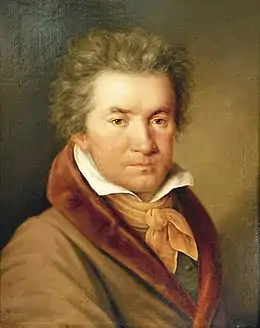 Beethoven in 1815; portrait by Joseph Willibrord Mähler | |
| Catalogue | Op. 73 |
| Composed | 1809 |
| Dedication | Archduke Rudolf |
| Performed | 28 November 1811: Gewandhaus, Leipzig |
| Movements |
|
| Scoring |
|
The work's military aspects and symbolism characterize its heroic style. Beethoven took novel approaches with the piece, such as beginning the solo entrance without orchestral introduction, lengthening the concerto, and creating a new relationship between piano and orchestra. The first of its three movements, Allegro, is in sonata form and is longer than any opening movement of Beethoven's earlier piano concertos. The second movement, Adagio un poco mosso, is a nocturne that directly builds into the third movement. The last movement, Rondo: Allegro ma non troppo, is in seven-part rondo form. The concerto is approximately forty minutes.
The origin of the epithet Emperor is uncertain; it may have been coined by Johann Baptist Cramer, the English publisher of the concerto. The concerto has no association with any emperor, and according to Donald Tovey and Betsy Schwarm, Beethoven would have disliked it due to his disapproval of Napoleon's conquest. As part of his repertoire, Franz Liszt frequently performed the concerto throughout his life.
Background
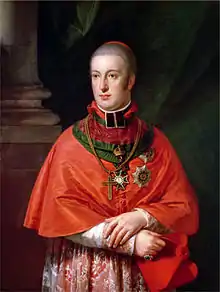
Beethoven's return to Vienna from Heiligenstadt in 1802 marked a change in musical style and is now often designated as the start of his middle or "heroic" period characterized by many original works composed on a grand scale.[2] In the autumn of 1808, after being rejected for a position at the Royal Theatre, Beethoven received an offer from Napoleon's brother Jérôme Bonaparte, then king of Westphalia, for a well-paid position as Kapellmeister at the court in Cassel. To persuade him to stay in Vienna, Archduke Rudolf, Prince Kinsky, and Prince Lobkowitz pledged to pay him a pension of 4000 florins a year.[3] Archduke Rudolf paid his share of the salary on the agreed date.[4] Kinsky, immediately called to military duty, did not contribute and died in November 1812 after falling from his horse.[5][6] When the Austrian currency destabilized in 1811, Lobkowitz went bankrupt. To benefit from the agreement, Beethoven had to obtain recourse from the law, which in 1815 brought him some payment.[7]
Beethoven felt the Napoleonic Wars reaching Vienna in early 1809 and completed writing the piano concerto in April while Vienna was under siege by Napoleon's armies.[5][8] He wrote to his publisher in July 1809 that there was "nothing but drums, cannons, men, misery of all sorts" around him.[8][1] To save his hearing, he fled to his brother's cellar and covered his ears with pillows.[9] The work's heroic style reflects the war-ridden era in its military topics and heroic tone.[10] Beethoven often composed in E-flat for noble music, and audiences in his time would recognize E-flat's significance.[8] Beethoven experimented with new techniques, such as the piano entrance beginning earlier than typical and with a cadenza.[11]
The concerto's public premiere was on 28 November 1811 in Leipzig, with Friedrich Schneider as the soloist.[1] Beethoven's hearing loss did not prevent him from composing music, but it made playing at concerts increasingly difficult.[12] The concerto debuted in Vienna on 12 February 1812, with Carl Czerny, Beethoven's pupil, as the soloist.[13] The English premiere was on 24 June 1829, with Felix Mendelssohn as the soloist.[14]
The origins of the concerto's epithet, Emperor, are obscure. An unlikely and unauthenticated story says that at the first Vienna performance, a French officer said, "C'est l'Empereur!"[1] Johann Baptist Cramer may have coined it, but there is no consensus on its origin.[15][16] According to Donald Tovey and Betsy Schwarm, Beethoven would have disliked the epithet due to his disapproval of Napoleon's conquest.[1] Beethoven had previously reconsidered the dedication of his third symphony; initially dedicated to Napoleon, Beethoven changed it after Napoleon assumed the title of emperor in 1804.[15] According to Yan Shen, musicologists agree that the concerto has no connection to an emperor.[17] Archduke Rudolf of Austria was Beethoven's aristocratic patron, and in 1803 or 1804, Rudolf began studying piano and composition with Beethoven. They became friends, and their meetings continued until 1824.[18] Beethoven dedicated many pieces to him, including this concerto.[8][1]
Music
Overview
The concerto is divided into the following three movements:[1]
- Allegro in E♭ major, (4
4) - Adagio un poco mosso[lower-alpha 1] in B major, (4
4) - Rondo: Allegro ma non troppo in E♭ major, (6
8)
The concerto is scored for two flutes, two oboes, two clarinets in B♭ (clarinet I playing in A in movement 2), two bassoons, two horns, two trumpets, timpani in E♭ and B♭, and strings. In the second movement, the 2nd flute, 2nd clarinet, trumpets, and timpani are tacet.[20]
Beethoven began innovating the piano concerto genre with his third piano concerto and continued through his fifth piano concerto.[21] While Wolfgang Amadeus Mozart's piano concertos consisted of the piano and orchestra working in tandem, in Beethoven's last two piano concertos, the pianist was the "hero," the dominant and directional soloist.[22][23] Also, in Mozart's concertos, the soloist was a virtuoso and more important than the composer; in Beethoven's, the pianist is a vector for the composer.[24][25]
Beethoven created the tradition of linking movements in concertos, especially the middle and the last. Subsequent composers connected and transitioned through all movements in an attempt to create unity in a piece.[13]
I. Allegro
The first movement is longer than any that Beethoven had previously composed in the piano concerto genre.[11][26] Beethoven adhered to the traditional sonata form but significantly redefined the interaction between piano and orchestra.[27] The opening cadenza precedes orchestral exposition, solo exposition, development, recapitulation, written cadenza, and a coda.[28]
Beethoven explicitly forbids the soloist from performing their own cadenza, a shift from previous piano concertos. Stephan Lindeman and William Kinderman have speculated that Beethoven wanted to control all aspects of the piece since he could not personally perform it or create a better flow without a virtuosic interruption.[29][30] Following this piece, composers wrote cadenzas instead of leaving them to the performer.[27]
Introduction and exposition
The concerto opens with the orchestra offering three sonorous chords. The solo piano responds to each chord with flourishes of arpeggios, trills, and scales.[31] This opening was new in classical concertos, and the flourishes almost became thematic.[11]
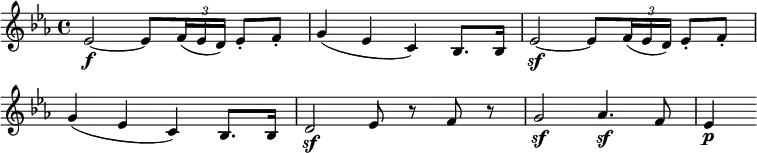
The propulsive first theme follows, and the expository material repeats with variations, virtuoso figurations, and modified harmonies. The second theme, a march, appears first in B minor form in the strings, then thematically shifts to C-flat major by the horns.[32][8] Throughout the movement, Beethoven transforms these themes into a range of keys, moods, and figurations.[32]
Following the opening, the movement follows Beethoven's three-theme sonata structure for a concerto. The orchestral exposition is a two-theme sonata exposition. The second exposition with the piano introduces a triumphant, virtuosic third theme that belongs solely to the solo instrument, a trademark of Beethoven's concertos. The coda elaborates upon the open-ended first theme, building intensity before finishing into a final climactic arrival at the tonic E♭ major.
II. Adagio un poco mosso

The second movement in B major forms a quiet nocturne for the solo piano, muted strings, and wind instruments that converse with the solo piano. The movement briefly changes to D major, a very remote key from the concerto's E♭ major. The third movement begins without interruption when a lone bassoon note B drops a semitone to B♭, the dominant of the tonic key E♭. The end of the second movement builds directly into the third.
Beethoven uses B major as a “surprise” key for abrupt distant key relationships. This resolves to B♭ in the transition to the last movement.[33]
III. Rondo: Allegro ma non troppo

The final movement of the concerto is a seven-part rondo form (ABACABA). The solo piano introduces the main theme before the orchestra affirms the soloist's statement. The rondo's B-section begins with piano scales before the orchestra again responds. The C-section is much longer, presenting the theme from the A-section in three different keys before the piano performs a passage of arpeggios. Rather than finishing with a strong entrance from the orchestra, the trill ending the cadenza dies away until the introductory theme reappears, played first by the piano and then the orchestra. In the last section, the theme undergoes variation before the concerto ends with a short cadenza and robust orchestral response.
Reception
Contemporary reception was positive, with reviews praising its originality and beauty. One review said:
In the exuberance of his genius, he almost never thinks of the ne quid nimium;[lower-alpha 2] he pursues his theme with tireless haste, not infrequently makes digressions which seem baroque, and thus, through exertion, he himself exhausts the eager attention of the weaker musical amateur, who cannot follow his train of thought.[34]
— Robin Wallace, The Critical Reception of Beethoven's Compositions by His German Contemporaries, Op. 73 to Op. 85 (2018)
Criticism fell on the concerto's length, saying that its duration took away from its beauty.[35]
According to Betsy Schwarm, the piece was a favorite of Franz Liszt.[36] Liszt frequently performed the concerto throughout his life, including at the unveiling of the Beethoven Monument in 1845, at an 1841 performance reviewed by Richard Wagner, and at an 1877 all-Beethoven concert with Ferruccio Busoni in attendance.[37][38][39] At the 1877 concert, Liszt played with nine fingers because of an injury to his left hand. Eleven-year-old Busoni was "bitterly disappointed" at his performance; he was the only one who noticed.[40]
The musicologist Alfred Einstein described the concerto as "the apotheosis of the military concept." He believed it was the sister work of Eroica because it evokes imagery of an emperor such as Napoleon.[41] As of 2021, it was the most performed piano concerto at Carnegie Hall, with 215 performances.[42]
Recordings
Notable recordings
On 2 October 1912, Frank La Forge recorded the adagio movement with a studio orchestra for the Victor Talking Machine Company; the recording was issued as Victor 55030-A.[43] In 1922, Frederic Lamond made the first complete recording with the Royal Albert Hall Orchestra under Eugene Goossens.[44] In 1945, Walter Gieseking made a stereophonic tape recording for German radio with the Grosses Funkorcheser under Artur Rother. It is one of the earliest stereo recordings and one of about 500 such recordings made during the war, of which five survived. During the quiet passages, anti-aircraft weapons can be heard.[45][46] As part of complete recordings of Beethoven's piano concertos, Piano Concerto No. 5 was recorded by Wilhelm Backhaus in 1927,[47] Artur Schnabel in the early 1930's,[48] Leon Fleisher in 1959-1961,[49] Daniel Barenboim in 1967[50] and 2012,[51] Vladimir Ashkenazy three times,[52][53][54] and Maurizio Pollini twice.[55][56]
Other commercial recordings
- March 1927: Ignaz Friedman with the New Queen's Hall Orchestra under Henry Wood; this recording no longer exists.[57]
- 12 May 1940: Josef Hofmann with the Chicago Symphony Orchestra, conducted by Hans Lange.[58]
- Arthur Rubinstein recorded it three times for RCA Victor, with Josef Krips, Erich Leinsdorf, and Daniel Barenboim.[59][60]
- 1952: Vladimir Horowitz in live performance at Carnegie Hall with RCA Victor Symphony Orchestra under Fritz Reiner.[61][62]
- Wilhelm Kempff recorded it with Paul van Kempen in 1953 and with Ferdinand Leitner in 1961.[63][64]
- Rudolf Serkin recorded it four times: with the New York Philharmonic under Bruno Walter in 1941; with the Philadelphia Orchestra under Eugene Ormandy in 1953; with the New York Philharmonic under Leonard Bernstein in 1962; and with the Boston Symphony Orchestra under Seiji Ozawa in 1981.[65]
- Claudio Arrau recorded it four times: with Alceo Galliera in 1958,[66] Bernard Haitink in 1964,[67] and twice with Sir Colin Davis, first with the Royal Concertgebouw Orchestra and later with the Staatskapelle Dresden.[68][69]
- Glenn Gould recorded this concerto with Leopold Stokowski (the only recording the two ever made together) using somewhat non-traditional phrasings and tempi, as was typical of Gould's interpretations.[70] Gould also recorded it with Karel Ančerl.[71][72]
- Alfred Brendel recorded all of Beethoven's piano concertos at least three times over his career.[73]
- 1971: Friedrich Gulda recorded all of Beethoven's piano concertos with the Vienna Philharmonic under Horst Stein.[74]
- Alicia de Larrocha recorded it first in 1978 with the Los Angeles Philharmonic under Zubin Mehta and then all of Beethoven's piano concertos with Riccardo Chailly and the Berlin Radio Symphony Orchestra in 1983–1984.[75][76]
- 1986: Murray Perahia recorded all five of Beethoven's piano concertos with the Royal Concertgebouw Orchestra under Bernard Haitink.[77]
- 1989: Krystian Zimerman in live performance with the Vienna Philharmonic under Leonard Bernstein, shortly before his death. The performance was filmed and released on DVD.[78]
- 2005: Richard Goode recorded all of Beethoven's piano concertos with the Budapest Festival Orchestra under Iván Fischer.[79][80]
- December 2006: Hélène Grimaud in live performance with the Staatskapelle Dresden under Vladimir Jurowski.[81]
- 2010: Paul Lewis recorded all five of Beethoven's piano concertos with the BBC Symphony Orchestra under conductor Jiří Bělohlávek.[82]
- 2012: Norwegian Leif Ove Andsnes recorded all five of Beethoven's piano concertos in the album "the Beethoven Journey", with the Mahler Chamber Orchestra.[83][84]
References
Notes
- The original autograph (page 74r) has Adagio un poco moto ("Adagio with a little motion"), not mosso.[19]
- Latin, "nothing in excess"
Citations
- Steinberg 1998, p. 71.
- Tyson 1969, p. 138–141.
- Thayer 1967a, p. 457.
- Cooper 2008, p. 195.
- Cooper 1996, p. 48.
- Cooper 2008, p. 48.
- Solomon 1998, p. 194.
- Varineau, John P. "Program Notes" (PDF). Richmond Symphony Orchestra. Retrieved 18 August 2021.
- Steinberg 1998, p. 73.
- Shen 2015, pp. 2–7.
- Steinberg 1998, p. 74.
- Kerman, Tyson & Burnham 2001, § 5.
- Lindeman 1999, p. 17.
- Wilfrid Blunt, On Wings of Song (1974), p. 100
- Schwarm, Betsy. "Emperor Concerto". Encyclopædia Britannica. Retrieved 30 September 2021.
- Stevenson, Joseph. "Johann Baptist Cramer Biography, Songs, & Albums". AllMusic. Retrieved 28 October 2021.
- Shen 2015, p. 2.
- Lockwood 2005, pp. 300–301.
- Beethoven, Ludwig van. "Konzerte; pf, orch; Es-Dur; op.73, 1809". Digitalisierte Sammlungen der Staatsbibliothek zu Berlin. Retrieved 3 September 2021.
- Beethoven 1999, p. 1.
- Eisen n.d.
- Keefe 2005, p. 89.
- Eisen n.d. "Whereas in Mozart's concertos soloist and ensemble work in tandem, in Beethoven's the soloist is clearly the hero.
- "About Beethoven's Piano Concerto No. 5 in E-flat major "Emperor", Op. 73". Redlands Symphony. Retrieved 4 September 2021.
- Eisen n.d. "... they increasingly cast the composer, not the performer, as the works' hero.
- Steinberg, Michael. "San Francisco Symphony - Beethoven: Piano Concerto No. 5". San Francisco Symphony. Retrieved 10 October 2021.
- Lindeman 1999, p. 20.
- Lindeman 1999, p. 18.
- Lindeman 1999, pp. 19–20.
- U of Nebraska Press 2000, p. 88.
- "San Francisco Symphony – Beethoven: Concerto No. 5 in E-flat major for Piano and Orchestra, Opus 73, Emperor". 11 August 2014. Archived from the original on 11 August 2014. Retrieved 19 August 2021.
- "Piano Concerto No. 5 in E-flat Major, "Emperor"". www.bsomusic.org. Retrieved 19 August 2021.
- Bribitzer-Stull 2006, p. 241.
- Wallace 2018, p. 12.
- Wallace 2018, p. 14.
- Schwarm 2011, p. 118.
- Comini 2008, p. 333.
- "Liszt in Paris: Enduring Encounters". The Morgan Library & Museum. 19 August 2013. Retrieved 2 October 2021.
- Walker 1987, p. 423.
- Comini 2008, p. 347.
- Einstein 1958, p. 248.
- "The Five Most-Often Performed Piano Concertos at Carnegie Hall". www.carnegiehall.org. Retrieved 21 September 2021.
- "Adagio from 5th concerto, op. 73". loc.gov. Library of Congress. Retrieved 25 September 2021.
- "Frederic Lamond – Beethoven Recordings, Vol. 1". Gramophone. Retrieved 25 September 2021.
- "Gieseking Experimental stereo Beethoven Emperor, plus Concerto No. 4 (1944/51) – PASC390". Pristine Classical. Retrieved 25 September 2021.
- "Sound Design and Recorded Music" (PDF). broadwaypress.com. pp. 58–59. Retrieved 25 September 2021.
- "Beethoven Piano Concertos 4 & 5". Gramophone. Retrieved 25 September 2021.
- Schnabel, Artur (1993). "Artur Schnabel plays the Beethoven piano concertos". searchworks.stanford.edu. Pearl: distributed by Pavilion Records. Retrieved 25 September 2021.
- "Leon Fleisher". loc.gov. Retrieved 25 September 2021.
- "Piano concertos 1–5: Choral fantasia". searchworks.stanford.edu. EMI Classics. 2006. Retrieved 26 September 2021.
- Tsioulcas, Anastasia (28 August 2012). "Barenboim's Beethoven: A Soloist And Conductor In Complete Agreement". NPR.org. Retrieved 26 September 2021.
- "Beethoven ‒ Vladimir Ashkenazy, Chicago Symphony Orchestra, Sir Georg Solti – The Piano Concertos (CD)". Discogs. Retrieved 26 September 2021.
- "Beethoven: Piano Concertos/Ashkenazy/Cleveland - Classics Today". classicstoday.com. Retrieved 26 September 2021.
- "Vladimir Ashkenazy- Bio, Albums, Pictures – Naxos Classical Music". www.naxos.com. Retrieved 26 September 2021.
- "Classical picks: Pollini and Abbado, pianist Drew Petersen, and Piffaro". inquirer.com. Retrieved 26 September 2021.
- "Maurizio Pollini – Bio, Albums, Pictures – Naxos Classical Music". www.naxos.com. Retrieved 26 September 2021.
- "Great Pianists Friedman" (PDF). chandos.net. Retrieved 25 September 2021.
- "The Complete Contents of the CSO's Boxed Set". Chicago Tribune. 7 April 1991. Retrieved 26 September 2021.
- "Arthur Rubinstein Plays Great Piano Concertos". www.classicalarchives.com. Retrieved 26 September 2021.
- Rubinstein Collection, Vol. 36 – Piano Concerto No. 5 in E-flat major ("Emperor"), Op. 73 at AllMusic
- Audio on YouTube, Vladimir Horowitz, 1952
- Horowitz, Vladimir (1990). "Horowitz plays Tchaikovsky, Beethoven". searchworks.stanford.edu. RCA Victor Gold Seal. Retrieved 25 September 2021.
- "Beethoven – Wilhelm Kempff, Berlin Philharmonic Orchestra, Paul van Kempen – The 5 Piano Concertos (1978, Vinyl)". discogs.com. Retrieved 26 September 2021.
- "Wilhelm Kempff: The Concerto Recordings". Presto Music. Retrieved 26 September 2021.
- Freed, Richard (17 May 1981). "Rudolf Serkin's New 'Emperor'". The Washington Post. Retrieved 25 September 2021.
- "Beethoven: Piano Concertos Nos. 1–5". Presto Music. Retrieved 26 September 2021.
- "Beethoven, Claudio Arrau, Concertgebouw Orchestra, Amsterdam, Bernard Haitink – Piano Concerto No. 5: 'Emperor' (Vinyl)". Discogs. Retrieved 26 September 2021.
- "Claudio Arrau/Ludwig van Beethoven – Works". pianistdiscography.com. Retrieved 26 September 2021.
- Arrau, Claudio (1986). "Piano Concerto No. 5 in E-flat, Op. 73 'Emperor'". searchworks.stanford.edu. Philips. Retrieved 26 September 2021.
- "Glenn Gould plays Beethoven: The 5 Piano Concertos". Presto Music. Retrieved 26 September 2021.
- McLellan, Joseph (16 March 1983). "Glenn Gould, Naturally". The Washington Post. Retrieved 26 September 2021.
- Libbey, Ted (14 September 1997). "The Gould Variations". The Washington Post. Retrieved 26 September 2021.
- "Alfred Brendel Piano Piano Concerto No.5". discogs.com. Retrieved 26 September 2021.
- "Beethoven – Friedrich Gulda, Horst Stein, Vienna Philharmonic Orchestra – The Five Piano Concertos (1971, Vinyl)". discogs.com. Retrieved 26 September 2021.
- "Beethoven, Alicia De Larrocha, Zubin Mehta, The Los Angeles Philharmonic – Piano Concerto No. 5, 'Emperor' (1979, Vinyl)". Discogs. Retrieved 26 September 2021.
- "Beethoven: Piano Concertos Nos. 1–5 & Choral Fantasia". Presto Music. Retrieved 26 September 2021.
- "Beethoven – Murray Perahia, Royal Concertgebouw Orchestra, Bernard Haitink – The Five Piano Concertos (CD)". discogs.com. Retrieved 26 September 2021.
- Burton, Humphrey (13 November 2007). "Beethoven: The Piano Concertos". amazon. Deutsche Grammophon. Retrieved 25 September 2021.
- McCarthy, James (12 July 2012). "Beethoven's Complete Piano Concertos". Gramophone. Retrieved 9 March 2021.
- Weininger, David (13 March 2009). "Getting back to Beethoven". Boston.com. Retrieved 26 September 2021.
- "Beethoven: Piano Concerto No. 5 & Piano Sonata No. 28 in A, Op. 101". Presto Music. Retrieved 26 September 2021.
- Tommasini, Anthony (24 September 2010). "Mixing Urgency and Relaxation". The New York Times. Retrieved 26 September 2021.
- Tommasini, Anthony (26 February 2015). "Beethoven From Andsnes and the Mahler Chamber Orchestra". The New York Times. Retrieved 26 September 2021.
- "The Beethoven Journey: The Complete Piano Concertos". spotify. 2012. Retrieved 26 September 2021.
Book sources
- Beethoven, Ludwig van (1 January 1999). Piano concerto no. 5 in E-flat major, op. 73: "Emperor". Courier Corporation. ISBN 978-0-486-40636-7. Retrieved 18 August 2021.
- Comini, Alessandra (2008). The Changing Image of Beethoven: A Study in Mythmaking. Sunstone Press. ISBN 978-0-86534-661-1. Retrieved 2 October 2021.
- Cooper, Barry, ed. (1996). The Beethoven Compendium: A Guide to Beethoven's Life and Music (revised ed.). London: Thames and Hudson. ISBN 978-0-50-027871-0.
- Cooper, Barry (2008). Beethoven. Oxford: Oxford University Press. ISBN 978-0-19-531331-4.
- Einstein, Alfred (1958). Essays on Music. London: Faber and Faber. OCLC 713913183.
- Forum, Beethoven (1 March 2000). Beethoven Forum. U of Nebraska Press. ISBN 978-0-8032-6195-2. Retrieved 12 October 2021.
- Keefe, Simon P. (27 October 2005). The Cambridge Companion to the Concerto. Cambridge University Press. ISBN 978-0-521-83483-4. Retrieved 9 October 2021.
- Lindeman, Stephan D. (1999). Structural Novelty and Tradition in the Early Romantic Piano Concerto. Stuyvesant, New York: Pendragon Press. ISBN 1576470008.
- Lockwood, Lewis (2005). Beethoven: The Music and the Life. New York: W.W. Norton. ISBN 978-0-393-32638-3.
- Schwarm, Betsy (2011). Classical Music Insights: Understanding and Enjoying Great Music. Trafford Pub. ISBN 978-1-4269-9667-2. Retrieved 2 October 2021.
- Solomon, Maynard (November 1998). Beethoven (2nd revised ed.). New York: Schirmer Trade Books. ISBN 978-0-8256-7268-2.
- Steinberg, Michael (1998). The Concerto: A Listener's Guide. Oxford University Press. p. 71. ISBN 978-0-19-510330-4. Retrieved 18 August 2021.
- Thayer, Alexander Wheelock (1967a). Forbes, Elliot (ed.). Thayer's Life of Beethoven. 1. Princeton: Princeton University Press. ISBN 978-0-691-02717-3.
- Walker, Alan (1987). Franz Liszt: The Virtuoso Years, 1811-1847. Cornell University Press. ISBN 978-0-8014-9421-5. Retrieved 2 October 2021.
- Wallace, Robin (2018). The Critical Reception of Beethoven's Compositions by His German Contemporaries, Op. 73 to Op. 85 (PDF). Center for Beethoven Research Boston University. ISBN 978-0-692-12921-0. Retrieved 1 October 2021.
Other sources
- Bribitzer-Stull, Matthew (2006). "The Cadenza as Parenthesis: An Analytic Approach". Journal of Music Theory. 50 (2): 211–251. doi:10.1215/00222909-2008-016.
- Eisen, Cliff (n.d.). "Ludwig van Beethoven – The five piano concertos". beethoven.org.pl. Retrieved 4 September 2021.
- Kerman, Joseph; Tyson, Alan; Burnham, Scott G. (2001). "Ludwig van Beethoven". Oxford Music Online. doi:10.1093/gmo/9781561592630.article.40026.
- Shen, Yan (May 2015). "Narrative Analysis of Beethoven's Piano Concerto No. 5" (PDF). uh-ir.tdl.org. Retrieved 19 August 2021.
- Tyson, Alan (February 1969). "Beethoven's Heroic Phase". The Musical Times. 110 (1512): 139–141. doi:10.2307/952790. JSTOR 952790.
External links
 |
Wikimedia Commons has media related to Piano Concerto No. 5 (Beethoven). |
- Piano Concerto No. 5: Scores at the International Music Score Library Project
- Gutmann, Peter (2017). "Beethoven: Piano Concerto # 5 in E-flat major, Op. 73 ('Emperor')". Classical Notes.
- Original autograph, 1809, Berlin State Library
- Beethoven's Fifth Piano Concerto Analysis and description of Beethoven's Fifth Emperor Piano Concerto
- BBC Discovering Music – analysis (RealAudio, 29 minutes)
Authority control  | |
|---|---|
| General | |
| National libraries | |
| Other | |