Tacitus (emperor)
Marcus Claudius Tacitus (/ˈtæsɪtəs/; died June 276) was Roman emperor from 275 to 276. During his short reign he campaigned against the Goths and the Heruli, for which he received the title Gothicus Maximus.
| Tacitus | |||||
|---|---|---|---|---|---|
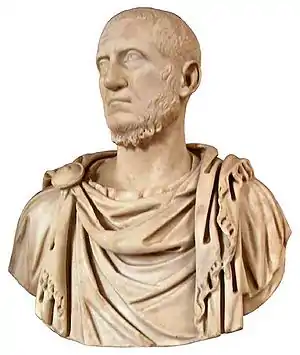 | |||||
| Roman emperor | |||||
| Reign | 25 September 275 – June 276 | ||||
| Predecessor | Aurelian | ||||
| Successor | Florian | ||||
| Died | June 276 (aged 76) Antoniana Colonia Tyana, Cappadocia | ||||
| |||||
Early life
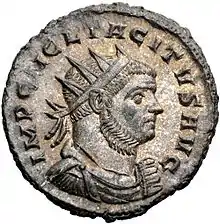
His early life is largely unknown. His faction circulated copies of the historian Publius Cornelius Tacitus' work, which was barely read at the time, perhaps contributing to the partial survival of the historian's work. An origin story which made Tacitus the heir of an old Umbrian family and one of the wealthiest men of the empire with a total wealth of 280 million sestertii circulated after his coronation. Modern historiography rejects his claimed descent from the historian as a fabrication.[2][3] More likely is an Illyrian military origin which made him a representative of the army in imperial politics.[4]
In the course of his long life he discharged the duties of various civil offices, holding the consulship twice, once under Valerian and again in 273, earning universal respect.[5]
Emperor
After the assassination of Aurelian, the army, apparently in remorse at the effects of the previous centuries' military license, which had brought about the death of the well-liked emperor, relinquished the right of choosing his successor to the Senate.[6] After a few weeks, the throne was offered to the aged Princeps Senatus, Tacitus.
Tacitus, after ascertaining the sincerity of the Senate's regard for him, accepted their nomination on 25 September 275,[7] and the choice was cordially ratified by the army.[1] This was the last time the Senate elected a Roman Emperor. In older historiography, it was generally accepted that Aurelian's wife, Ulpia Severina, ruled in her own right before the election of Tacitus which could indicate an interregnum which lasted as long as six months.[8][9] Contemporary bibliography considers that no interregnum may have existed between Aurelian's death and the coronation of the new Emperor. Tacitus had been living in Campania before his election, and returned only reluctantly to the assembly of the Senate in Rome, where he was elected. He immediately asked the Senators to deify Aurelian, before arresting and executing Aurelian's murderers.[10] In primary sources, he was described as very old at that time, but in reality he was possibly in his fifties.[4]
Amongst the highest concerns of the new reign was the restoration of the ancient Senatorial powers. He granted substantial prerogatives to the Senate, securing to them by law the appointment of the emperor, of the consuls, and the provincial governors, as well as supreme right of appeal from every court in the empire in its judicial function, and the direction of certain branches of the revenue in its long-abeyant administrative capacity.[11] Probus respected these changes, but after the reforms of Diocletian in the succeeding decades not a vestige would be left of them.
Fighting barbarians
Next he moved against the barbarian mercenaries that had been gathered by Aurelian to supplement Roman forces for his Eastern campaign. These mercenaries had plundered several towns in the Eastern Roman provinces after Aurelian had been murdered and the campaign cancelled.[12] His half-brother, the Praetorian Prefect Florian, and Tacitus himself won a victory against these tribes, among which were the Heruli, gaining the emperor the title Gothicus Maximus.[10]
Death
On his way back to the west to deal with a Frankish and Alamannic invasion of Gaul, according to Aurelius Victor, Eutropius and the Historia Augusta, Tacitus died of fever at Tyana in Cappadocia in June 276.[13][14] It was reported that he began acting strangely, declaring that he would alter the names of the months to honor himself, before succumbing to a fever. In a contrary account, Zosimus claims he was assassinated, after appointing one of his relatives to an important command in Syria.[15]
References
- Jones, pg. 873
- McMahon, Note 3 and accompanying text
- Leadbetter 2010, p. 86.
- Hagi 2016, p. 336
- Edward Gibbon, The Decline and Fall of the Roman Empire, (The Modern Library, 1932), ch. XII., p. 276
- Gibbon, pp. 274-278
- Historia Augusta, Vita Taciti, 3.2.
- Watson, Alaric (1999). Aurelian and the Third Century. London: Routledge. ISBN 0-415-07248-4.
- Körner, Christian (December 23, 2008). "Aurelian (A.D. 270–275)". De Imperatoribus Romanis: An Online Encyclopedia of Roman Rulers and Their Families. Retrieved January 6, 2011.
- Southern, pg. 127
- Gibbon, p. 279
- Gibbon, p. 280
- Aurelius Victor, 36:1
- Historia Augusta, Vita Taciti, 13:5
- Zosimus, I:63:2
Sources
Primary sources
- Historia Augusta, Vita Taciti, English version of Historia Augusta
- Eutropius, Breviarium ab urbe condita, ix. 16, English version of Breviarium ab Urbe Condita
- Aurelius Victor, "Epitome de Caesaribus", English version of Epitome de Caesaribus
- Zosimus, "Historia Nova", Historia Nova
- Joannes Zonaras, Compendium of History extract: Zonaras: Alexander Severus to Diocletian: 222–284
Secondary sources
- McMahon, Robin, "Tacitus (275–276 A.D)", De Imperatoribus Romanis
- Jones, A.H.M.; J.R. Martindale & J. Morris (1971). The Prosopography of the Later Roman Empire Volume 1: A.D. 260–395. Cambridge University Press. ISBN 0-521-07233-6.
- Leadbetter, Bill (2010). Galerius and the Will of Diocletian. London: Routledge. ISBN 978-0-415-40488-4.
- Hagi, David, ed. (2016 (2001)). Coinage and History of the Roman Empire. Routledge. ISBN 1135971250. Check date values in:
|date=(help) - Southern, Pat. The Roman Empire from Severus to Constantine, Routledge, 2001
- Gibbon. Edward Decline & Fall of the Roman Empire (1888)
- Chisholm, Hugh, ed. (1911). . Encyclopædia Britannica (11th ed.). Cambridge University Press.
Further reading
 |
Wikimedia Commons has media related to Marcus Claudius Tacitus. |
- Constantine P. Cavafy, The Complete Poems, Harcourt, Brace & World (1961), p. 201
- Alan Dugan, Poems 2, Yale University Press (1963), p. 33
Authority control  | |
|---|---|
| General | |
| National libraries | |
| Other | |