Encarnación Cabré
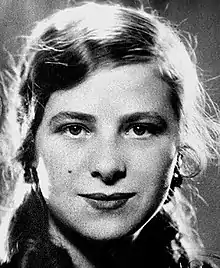
Encarnación Cabré Herreros (21 March 1911 – 18 March 2005) was a Spanish archaeologist.
Encarnación Cabré | |
|---|---|
 | |
| Born | Encarnación Cabré Herreros March 21, 1911 Madrid, Spain |
| Died | March 18, 2005 (aged 93) Madrid, Spain |
| Alma mater | Complutense University of Madrid |
Cabré developed her interests in archaeology at a young age, and accompanied her father Juan Cabré, a prominent Spanish archaeologist, on expeditions to peninsular Spain. In the 1930s, she was a prolific academic in archaeological excavation, documenting her activities in various journal publications and presenting them at international conferences. After the Spanish Civil War, the Francoist dictatorship forbade her from teaching, and she mostly retired. She returned to the field in 1975, where she worked until the end of her life.
Cabré is considered to be the first woman in Spain to become a professional archaeologist.[1][2][3] A 2018 initiative by the Spanish parliament recognised her as part of a "group of skilled young women who opened the university to many others and demonstrated that women can successfully enter traditionally masculine disciplines."[2]
Biography
Early life
Encarnación Cabré Herreros was born on 21 March 1911 in Madrid, Spain, to a middle-class family[1] with "deep Catholic roots."[2] Her father, Juan Cabré, was a prominent Spanish archaeologist. The first six years of her life were spent in the house of her maternal grandparents in Santa María de Huerta. Her father could not own a house due to the intense nature of his work.[4]
In 1917, her family moved to Madrid, so that her father could conduct his research on Iberian culture at the Center for Historical Studies. In Madrid, she was enrolled into the Colegio de Monjas del Sagrado Corazón, a school of the Sacred Heart, for her primary education. She entered the Instituto Cardenal Cisneros in 1921, where she studied for her baccalaureate until 1928. Later in 1921, she had her first experience with archaeological excavations when she visited Cantabria, where her father was completing an inspection of archaeological sites.[4]
Early academic career
.jpg.webp)
Cabré began to work as her father's main collaborator with much of his fieldwork in 1927, when she was seventeen years old.[5] She accompanied him on excavations in peninsular Spain through her university education and until the Spanish Civil War, later becoming a co-author on the report of their results. She attended the Complutense University of Madrid from 1928 to 1932, where she obtained a degree in history.[1][6][5] In September 1929, she attended the IV International Congress of Classical Archaeology in Barcelona, where she presented the only study conducted by a Spanish woman. She also attended the XV International Congress of Prehistoric Archaeology and Anthropology in Portugal in 1930. The same year, her portrait was included in publications by the Portuguese and French press which discussed the modernity of Spanish women.[1][7]
Cabré taught as a professor at the University of Madrid and the Instituto-Escuela in Germany and Morocco, as well as on a Mediterranean study cruise hosted by the University of Madrid in 1933.[1][6] However, the Francoist dictatorship forbade her from continuing her tenure at the University of Madrid.[2] She became the only woman to have begun work on a doctoral thesis in the first three decades of the 20th century[8] which she began after receiving a scholarship from the Junta para Ampliación de Estudios (an institution that managed the Center for Historical Studies). She used the scholarship to attend prehistory and ethnography courses at universities in Berlin and Hamburg in 1934 and 1935.[1] There, she studied under German academics Leo Frobenius, Albert Kiekebusch, and Walter Matthes.[9] From 1934 to 1936, she travelled to France, Germany, Austria, Czechoslovakia, Italy, and Switzerland as a part of a pedagogical initiative launched by Spanish government.[1]
Postwar career
Through the peak of the civil war, from 1937 to 1939, Cabré finished her doctoral studies while working at the Center for Historical Studies under Manuel Gómez-Moreno Martínez.[10] Her thesis focused on Iron Age weaponry in the Iberian Peninsula. After the war, in 1939, she was forced to retired from the field of archaeology due to family obligations, after marrying Francisco Morán. She only intermittently published works, primarily in collaboration with her father. After her father died in 1947, she returned to the field, mainly to publish his work in various academic journals and conference proceedings from 1949 to 1959.[1][9]
She began to publish again in 1975, mainly in collaboration with her son Juan Morán Cabré, and continued doing so until the end of her life. She died on 18 March 2005 in Madrid. Upon her death, she bequeathed her father's and her own archives to the Autonomous University of Madrid.[1][11]
Legacy
In the first three decades of the 20th century, women were incompletely incorporated into professional archaeology and scarcely took part in excavations. According to archaeologist María Luisa Oliveros Rives, women in this time period were viewed as "a disruptive and undesirable element" on excavations. Margarita Díaz-Andreu, an archaeologist at the University of Barcelona, asserts that Cabré became an exception to this predominant view. Because Cabré's father carried out most of the archaeological fieldwork in Spain during this time period, she was exposed to the field of archaeology and collaborated with her father on much of his fieldwork.[6]
In 2018, Unidas Podemos registered a proposal to the Government of Spain and the Directorate-General for Fine Arts to rename a garden at Madrid's National Archaeological Museum after Cabré. The garden would be renamed as the Jardín de Encarnación Cabré in recognition of her role in the "group of young women who opened the university to many others and demonstrated that women can successfully enter traditionally masculine disciplines."[2][3] The proposal was unanimously approved by the Committee of Culture in the Congress of Deputies on 27 February 2019.[2]
Notes
- Real Academia de la Historia.
- Riaño 2019.
- La Vanguardia 2018.
- Baquedano Beltrán 1993.
- Alonso & Fullola i Pericot 2006, pp. 365–366.
- Díaz-Andreu 1998, p. 132.
- International Union of Prehistoric and Protohistoric Sciences 2009, p. 280.
- Díaz-Andreu 1998, p. 133.
- Díaz-Andreu, Mora Rodríguez & Cortadella Morral 2009, p. 162.
- Díaz-Andreu 1998, p. 130.
- Díaz-Andreu 1998, p. 134.
References
- Alonso, Francisco Gracia; Fullola i Pericot, Josep Maria (2006). El sueño de una generación: el crucero universitario por el Mediterráneo de 1933 (PDF) (in Spanish). Edicions Universitat Barcelona. ISBN 978-84-8338-483-1.
- Baquedano Beltrán, Isabel (1993). "Encarnación Cabré Herreros, la primera mujer en la Arqueología española". Revista de Arqueología (in Spanish). 146: 54–59.
- "Encarnación Cabré Herreros". Diccionario biográfico español (in Spanish). Real Academia de la Historia.
- Díaz-Andreu, Margarita; Mora Rodríguez, Gloria; Cortadella Morral, Jordi, eds. (2009). Diccionario histórico de la arqueología en España : (siglos XV-XX). Marcial Pons, Ediciones de Historia. ISBN 9788496467453.
- Díaz-Andreu, Margarita (1998). "Spanish Women in a Changing World". In Díaz-Andreu, Margarita; Sørensen, Marie Louise Stig (eds.). Excavating Women: A history of women in European archaeology. Routledge. ISBN 9780415157605.
- International Union of Prehistoric and Protohistoric Sciences (2009). Kaeser, Marc-Antoine; Babeș, Mircea (eds.). Archaeologists without boundaries : towards a history of International Archaeological Congresses (1866-2006). Archaeopress. ISBN 9781407306223.
- "Podemos pide que el jardín de Museo Arqueológico se llame Encarnación Cabré". La Vanguardia (in Spanish). EFE. 17 September 2018.
- Riaño, Peio H. (3 March 2019). "Un jardín para recordar a 'Miss Congress', Encarnación Cabré". El País (in Spanish).
Authority control  | |
|---|---|
| General | |
| National libraries | |
| Other | |