Endsieg
Endsieg ([ˈɛntziːk]) is German for "ultimate victory". It is generally used to denote a victory at the end of a war or conflict.[1]
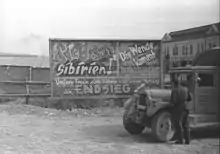
Adolf Hitler used Endsieg in his book Mein Kampf ("My Struggle") in 1925 when he asked the rhetorical question if fate wanted the Jewish people to achieve final victory.
In the 1930s and 1940s, the word was widely used in the propaganda of Nazi Germany. Endsieg was part of the Nazi doctrine: Despite temporary losses, the Third Reich would ultimately prevail, and any breakdown in allegiance to Nazi ideology was not to be tolerated. This conjuration of final victory became more desperate in 1943 when Allied successes forced Germany onto the defensive. It was propagated that the Endsieg was inevitable because of the superiority of the Aryan race. Joseph Goebbels still spoke about Endsieg as late as March 1945.[2]
References
- Duden Online, s.v. "Endsieg": "am Ende eines Krieges, Kampfes stehender Sieg".
- ARD: http://kriegsende.ard.de/pages_std_lib/0,3275,OID1146474,00.html. Retrieved on 29 April 2006 Archived 1 February 2009 at the Wayback Machine