Entorrhizomycetes
Entorrhizomycetes is the sole class in the phylum Entorrhizomycota within the Fungi subkingdom Dikarya along with Basidiomycota and Ascomycota. It contains three genera and is a small group of teliosporic root parasites that form galls on plants in the Juncaceae (rush) and Cyperaceae (sedge) families. Prior to 2015 this phylum was placed under the subdivision Ustilaginomycotina. A 2015 study[1] did a "comprehensive five-gene analyses" of Entorrhiza and concluded that the former class Entorrhizomycetes is possibly either a close sister group to the rest of Dikarya or Basidiomycota.
| Entorrhizomycetes | |
|---|---|
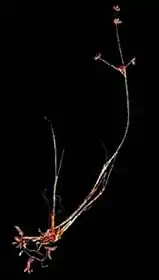 | |
| Galls on the roots of Juncus articulatus induced by Entorrhiza casparyana | |
| Scientific classification | |
| Kingdom: | |
| Subkingdom: | |
| Division: | Bauer (2015) [1] |
| Class: | Entorrhizomycetes |
| Type genus | |
| Entorrhiza C.A.Weber (1884) | |
| Genera | |
| |
| Synonyms | |
|
Entorrhizomycetidae Bauer & Oberwinkler 1997[3] | |
Taxonomy
Taxonomy based on the work of Wijayawardene et al. 2019.[4]
- Order Talbotiomycetales Riess et al. 2015
- Family Talbotiomycetaceae Riess et al. 2015
- Genus Talbotiomyces Vánky, Bauer & Begerow 2007
- Family Talbotiomycetaceae Riess et al. 2015
- Order Entorrhizales Bauer & Oberwinkler 1997
- Family Entorrhizaceae Bauer & Oberwinkler 1997
- Genus Juncorrhiza Riess & Piątek 2019
- Genus Entorrhiza Weber 1884 [Schinzia Nägeli 1842]
- Family Entorrhizaceae Bauer & Oberwinkler 1997
References
- Bauer R, Garnica S, Oberwinkler F, Riess K, Weiß M, Begerow D (2015). "Entorrhizomycota: A New Fungal Phylum Reveals New Perspectives on the Evolution of Fungi". PLOS ONE. 10 (7): e0128183. Bibcode:2015PLoSO..1028183B. doi:10.1371/journal.pone.0128183. PMC 4511587. PMID 26200112.
- Begerow D, Stoll M, Bauer R (2006). "A phylogenetic hypothesis of Ustilaginomycotina based on multiple gene analyses and morphological data". Mycologia. 98 (6): 906–916. doi:10.3852/mycologia.98.6.906. PMID 17486967.
- Bauer R, Oberwinkler F, Vanky K (1997). "Ultrastructural markers and systematics in smut fungi and allied taxa". Canadian Journal of Botany. 75 (8): 1273–1314. doi:10.1139/b97-842.
- Wijayawardene, et al. (September 2018). "Notes for genera: basal clades of Fungi (including Aphelidiomycota, Basidiobolomycota, Blastocladiomycota, Calcarisporiellomycota, Caulochytriomycota, Chytridiomycota, Entomophthoromycota, Glomeromycota, Kickxellomycota, Monoblepharomycota, Mortierellomycota, Mucoromycota, Neocallimastigomycota, Olpidiomycota, Rozellomycota and Zoopagomycota)" (PDF). Fungal Diversity. 92 (1): 43–129. doi:10.1007/s13225-018-0409-5. S2CID 52303619.
This article is issued from Wikipedia. The text is licensed under Creative Commons - Attribution - Sharealike. Additional terms may apply for the media files.