Ernie O'Malley
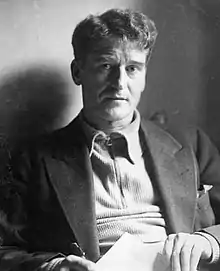
Ernie O'Malley (Irish: Earnán Ó Maille; born Ernest Bernard Malley; 26 May 1897 – 25 March 1957[2]) was an IRA officer during the Irish War of Independence. Subsequently he became deputy commander of the Anti-Treaty IRA during the Irish Civil War. He wrote three books, On Another Man's Wound, The Singing Flame and Raids and Rallies. The first describes his early life and role in the War of Independence, while the second covers the Civil War period. Although he was elected to Dáil Éireann, O'Malley largely eschewed politics, seeing himself primarily as a soldier who had "fought and killed the enemies of our nation".[3][4]
Ernie O'Malley | |
|---|---|
 | |
| Teachta Dála | |
| In office 27 August 1923 – 9 June 1927 | |
| Constituency | Dublin North |
| Personal details | |
| Born | Ernest Bernard Malley 26 May 1897 Castlebar, County Mayo, Ireland |
| Died | 25 March 1957 (aged 59) Howth, County Dublin, Ireland |
| Military service | |
| Allegiance | |
| Years of service | 1916–1924 |
| Rank | Commandant-general[1] |
| Battles/wars | |
Early life
O'Malley was born in Castlebar, County Mayo, on 26 May 1897. His was a lower-middle class Catholic family in which he was the second of eleven children. His father, Luke Malley, was a solicitor's clerk with conservative Irish nationalist politics: he supported the Irish Parliamentary Party. His mother was Marion Malley (née Kearney) from Co. Roscommon.[5] The Malley family lived opposite a RIC barracks. O'Malley later noted the family's cordial relations with the RIC, saying that policemen would nod in courtesy when his father walked by. His first cousin, Gilbert Laithwaite, was to become British ambassador to Ireland in the 1950s.[6][7][8][9][10]
The Malleys moved to Dublin when Ernie was still a child. The 1911 census lists them living at 7 Iona Drive, Glasnevin.[11] His older brother, Frank, joined the British Army at the outbreak of World War I.[9] O'Malley was studying Medicine at University College Dublin in 1916 when the Easter Rising convulsed the city. He was almost persuaded by some unionist friends to join them in defending Trinity College, Dublin against the "rebels" should they attempt to take it. After some thought, he decided his sympathies were with his fellow countrymen, so he and a friend fired at British troops with a Mauser rifle provided by the Gaelic League.[9] He joined F Company, 1st Battalion, Dublin Brigade, Irish Volunteers[12] because its base was north of the Liffey. From only 12 men, the company grew to 60 during 1916. Collins, De Valera and O'Hegarty visited its secret drill hall at 25 Parnell Square.[13]
IRA career
War of Independence
After the Easter Rising, O'Malley became deeply involved in Irish republican activism, a fact he had to hide from his family who had close ties to the establishment. In 1917, he joined Conradh na Gaeilge. During a baton charge in Westmoreland Street, he and his colleagues knocked over a policeman and ran off with his baton.[14]
He left his studies and worked as a full-time organiser for the IRA from 1918 onwards, work that brought him to almost every corner of Ireland. On one occasion he attended a meeting of the Ulster Volunteer Force in Derry City for intelligence gathering, but picked up nothing.[15]
GHQ sent O'Malley to assistant chief of staff, Dick Mulcahy, at Dungannon. He was appointed 2nd Lieutenant of the Coalisland district. Sinn Féin opposed conscription in principle, organising a mass boycott to thwart government policy. O'Malley was on the run in Tullamore where he first met Austin Stack and Darrell Figgis.[16]
At Philipstown he was stopped by an RIC patrol and almost drew a concealed gun. From Athlone, where he tried to seize the magazine fort, he was sent to south Roscommon. There the police caught up with him and Brig. Brennan in the corner shop at Ballintubber. Escaping across a bridge at the River Suck, Galway, he was fired at and hit by the police. He crossed again to Roscommon and went to ground in the mountains. Spying on FM Lord French at Rockingham House was hazardous, as it was very dangerous for the IRA in the vicinity of Carrick.[17] Night drilling continued in near silence behind village schoolhouses, but the secret organising continued regardless.
Although officially attached to GHQ, O'Malley was tasked as a training officer for rural IRA units, which involved IRA operations throughout the country once the war got under way.[9] In February 1920, Eoin O'Duffy and O'Malley led an IRA attack on the Royal Irish Constabulary (RIC) barracks in Ballytrain, County Monaghan. They were successful in taking it, the first capture of an RIC barracks in the war.[18]
In September, O'Malley and Liam Lynch led the 2nd County Cork Brigade in the only capture of a British Army barracks of the conflict, in Mallow. They left with a haul of rifles, two Hotchkiss machine-guns and much ammunition. In retaliation, several main street premises were subsequently torched by the British Army, including the town hall and creamery.
O'Malley was captured by the British at Kilkenny in December 1920. He was unable to draw an automatic pistol he was unused to in time to make his escape. Much to his disgust, also seized were notebooks containing the names of members of the 7th West Kilkenny Brigade, all of whom were subsequently arrested. At his arrest he gave his name as Bernard Stewart. Having been badly beaten during his interrogation at Dublin Castle and in severe danger of execution, he escaped from Kilmainham Gaol on 21 February 1921 along with IRA men Frank Teeling and Simon Donnelly. They were aided by a soldier who was also an Irish republican.[9] O'Malley was subsequently placed in command of the IRA's Second Southern Division in Munster, for operations in Limerick, Kilkenny and Tipperary.[9]
Civil War
O'Malley objected to the Anglo-Irish Treaty that formally ended the "Tan War" (the term by which he and many other Republicans referred to the War of Independence). He opposed any settlement that fell short of an independent Irish Republic, particularly one backed up by British threats of restarting hostilities. On 14 April he was one of the Anti-Treaty IRA officers who occupied the Four Courts in Dublin, an event that helped to spark the Irish Civil War. O'Malley had been appointed IRA Director of Organisation, then elected to its Executive, in the lead-up to that event.[19]
O'Malley oversaw the operation that led to historic records being blown up in the Four Courts on 30 June. He wrote in The Singing Flame:
As we stood near the gate there was a loud shattering explosion … The munitions block and a portion of Headquarters block went up in flames and smoke … The yard was littered with chunks of masonry and smouldering records; pieces of white paper were gyrating in the upper air like seagulls. The explosion seemed to give an extra push to roaring orange flames which formed patterns across the sky. Fire was fascinating to watch; it had a spell like running water. Flame sang and conducted its own orchestra simultaneously. It can’t be long now, I thought, until the real noise comes.[20]
O'Malley, who assumed operational command of the Four Courts occupation after garrison commander Paddy O'Brien was injured by shrapnel,[21] surrendered to the Free State Army on the afternoon of 30 June. That evening he escaped from temporary captivity in the Guinness Brewery along with future Taoiseach Sean Lemass and two others. The next day he travelled via the Wicklow Mountains to Blessington then County Wexford and finally County Carlow.[22] This escape was probably fortunate for O'Malley, as four of the other Four Courts leaders were later executed.
Soon afterwards he was appointed by Liam Lynch, who had assumed the position of IRA chief of staff once more, as assistant chief of staff. He was also given command of the provinces of Ulster and Leinster. O'Malley was very frustrated at being placed over areas he did not know well, instead of going to the west or south where his experience would be put to much better use.[23]
In August 1922 O'Malley, Peadar O'Donnell and Joe McKelvey became supporters of Liam Mellows' proposed 10-Point Programme for the IRA, which would have seen them adopt Communist policies in an attempt to secure support from left-wing elements in Ireland. However, while O'Malley may have discussed buying weapons from the USSR with two left-leaning IRA volunteers, the IRA Executive rejected formal links with Communists.[24]
In October 1922, O'Malley went to Dundalk and met with Frank Aiken (commander of the Fourth Northern Division of the Irish Republican Army) and Padraig Quinn (quartermaster-general) to review plans for an attack to free IRA soldiers from Dundalk jail.[25]
O'Malley was forced to live a clandestine existence in Dublin, where he had to build up a new staff.[26] Moreover, effective military operations in the city were few and far between: O'Malley felt his men there lacked the spirit to carry out his orders, and he considered himself a glorified clerk.[27] From the start, he was frustrated at the lack of contact from Liam Lynch: following a meeting of the IRA Executive on 15 July, none was held until 16-17 October.[24] At that meeting Lynch informed O'Malley, to his relief, that he would be moving GHQ to Dublin and giving him command in the west; however, this did not happen.[28]
He also believed that Lynch's strategy of holding a defensive line in the south and locating IRA GHQ in Co. Cork made no sense,[29] when a concerted attack on Dublin should have been an early priority. This lack of ambition, he argued, demoralised both the IRA and its supporters, and allowed the "Staters" (the Irish Free State Army) to build up their strength in preparation for a gradual take-over of areas of the country dominated by the "Irregulars".[30] O'Malley expressed the view that, to win the war, guerrilla tactics were insufficient. Rather, the Anti-Treaty side needed to use more conventional warfare, with larger columns to drive the enemy out of towns and villages.[31] He stated to Lynch that the destruction of communications, unless part of an immediate military operation, was folly, as it discouraged fighting spirit. An uncoordinated struggle of scattered attrition, he wrote, was certain to lead to defeat.[32]
O'Malley was captured again after a shoot-out with Free State soldiers at the family home of Nell Humphreys at 26 Ailesbury Rd, in the Ballsbridge area of Dublin city on 4 November 1922. He was very severely wounded in the incident, being hit over twenty times (three bullets remained lodged in his back for the remainder of his life). A Free State soldier, Peter McCartney, was also killed in the gun fight.[33][34] Anno O'Rahilly, who lived in the house, was accidentally shot by O'Malley during the raid.[35]
Still severely affected by his wounds, O'Malley was transferred from a military hospital to that in Mountjoy Prison on Christmas Eve 1922.[36] As he made clear in The Singing Flame, he was in grave danger of being one of the many executed for armed insurrection against the state and, additionally in his case, for killing a Free State soldier. However, there appeared to be official concerns about the reaction to shooting a man who would have to be carried to execution on a stretcher. It is noted that this worry might have been heightened by the publication in the Irish newspapers, The Times and the New York Times, in January 1923, of letters about his severe condition. Ultimately, his trial was postponed indefinitely.[37]
By February 1923, despite letters to the contrary,[38] he felt that the Anti-Treaty side had been beaten since before Christmas, in which regard he acknowledged his own failure.[39]
The civil war ended in May 1923, but most IRA prisoners were not released. On 13 October, he and many others went on hunger strike for forty-one days, in protest at the continued detention of IRA prisoners.[40] After a week O'Malley was moved to Kilmainham Jail.[41] He had already been elected as a Sinn Féin Teachta Dála (TD) for Dublin North at the 1923 general election held in late August.[42] He was not to contest the June 1927 general election.[43]
In early January 1924, O'Malley was transferred to St Bricin's military hospital before a move to the Curragh camp in late winter.[44] He was the very last anti-Treaty internee to receive his liberty, being released from the Curragh on 17 July 1924, well over a year after the end of hostilities.[45][46][47][48]
Ernie O'Malley endured significant mental and physical anguish during the civil war. His elder brother Cecil was arrested by Free State troops in July 1922[49] and his younger brother Charlie, also anti-treaty, lost his life in O'Connell Street during the battle for Dublin[50] In all, O'Malley was wounded on 17 occasions from 1916–1923[51]
Subsequent literary life
O'Malley left Ireland in 1925 and spent a period travelling in Europe.[52] He used the alias 'Cecil Doward' and was issued with a British passport in that name.[53] He returned to University College Dublin to continue his medical studies in 1926, where he was heavily involved in the university hillwalking club, and its literary and historical societies. However, O'Malley left Ireland again in 1928 without graduating. In 1928, he toured the US on behalf of Éamon de Valera raising funds for the establishment of the new Irish Republican newspaper, The Irish Press[54]
He spent the next few years travelling throughout the United States before arriving in Taos, New Mexico in 1930, where he lived among the Native Americans for a time and began work on his account of the manuscript that would later become On Another Man's Wound. At that time he fell in with Mabel Dodge Luhan.[55] Later that year he travelled to Mexico where he studied at the Mexico City University of the Arts and worked as a high school teacher. His US visa having expired, he slipped across the Rio Grande and returned to Taos where he worked as a teacher again until 1932 where he travelled to New York, where he met Helen Hooker, a wealthy young sculptor and tennis player, whom he would later marry.
In the 1920s O'Malley had connections with Catalan nationalists, even becoming acquainted with Francesc Macia.[56][57]
In 1934, O'Malley was granted a pension by the Fianna Fáil government as a combatant in the Irish War of Independence. Now possessed of a steady income, he married Helen in London on 27 September 1935 and returned to Ireland. The O'Malleys had three children and divided their time between Dublin and Burrishoole, County Mayo. Hooker and O'Malley devoted themselves to the arts, she was involved in sculpture and theatre, while he made his living as a writer. In 1936, On Another Man's Wound was published to critical and commercial acclaim. O'Malley remained in neutral Ireland during The Emergency, involving himself as a member of the Local Security Force. However, during the war years the O'Malleys' marriage began to fail.[58]
Helen O'Malley began to spend more and more time with her family in the United States and, in 1950, took two of the couple's three children to live with her in Colorado. She divorced her husband in 1952.[58]
The third child stayed with his father. O'Malley sent his son to a boarding school in England, as, despite his republican politics, O'Malley was an admirer of the English public school system of education.
Throughout his life O'Malley endured considerable ill-health from the wounds and hardship he had suffered during his revolutionary days. When he died in 1957, he was given a state funeral attended by Lemass, De Valera and Aiken.[59] A sculpture of Manannán mac Lir, donated by O'Malley's family, stands in the Mall in Castlebar, County Mayo.
Writings
O'Malley's most celebrated writings are On Another Man's Wound, a memoir of the War of Independence, and The Singing Flame, an account of his involvement in the Civil War. Raids and Rallies includes an account of the period he was required by the IRA Command under Lynch to hide in secret at Sheila Humphreys' house near Ballsbridge. The house was raided on 4 November 1922 during which the Ryan sisters were arrested with O'Malley. They were consigned to internment in Mountjoy Prison. The two volumes were written during O'Malley's time in New York, New Mexico and Mexico City between 1929 and 1932.[60]
On Another Man's Wound was published in London in 1936, although the seven pages detailing O'Malley's ill-treatment while under arrest in Dublin Castle were omitted. An unabridged version was published in America a year later under the title Army Without Banners: Adventures of an Irish Volunteer. The New York Times described it as "a stirring and beautiful account of a deeply felt experience" while The New York Herald Tribune called it "a tale of heroic adventure told without rancor or rhetoric."[60]
In 1928 O'Malley defined his attitude in a letter to fellow-Republican Sheila Humphreys:
I have the bad and disagreeable habit of writing the truth as I see it, and not as other people (including yourself) realise it, in which we are a race of spiritualised idealists with a world idea of freedom, having nothing to learn for we have made no mistakes.[61]
In an article in The Irish Times in 1996, the writer John McGahern described On Another Man's Wound as "the one classic work to have emerged directly from the violence that led to independence", adding that it "deserves a permanent and honoured place in our literature."[61]
Perhaps reflecting its more controversial theme in Ireland, The Singing Flame was not published until 1978, well after O'Malley's death.[60] He also wrote another book on the revolutionary period, Raids and Rallies, describing his and other fighters' experiences. This book was based on a lengthy series of interviews he had conducted in the 1950s with former IRA men and ran as a highly popular serial in The Sunday Press from 1955-56.[60] In addition, O'Malley wrote large volumes of poetry and contributed to a literary and cultural magazine "The Bell", set up by his fellow republican Peadar O'Donnell.
O'Malley's extensive notes, compiled while he was an active IRA officer, are one of the best primary historical sources for the revolutionary period in Ireland, 1919–23, from the republican perspective. In the 1930s and 1940s he also toured Ireland interviewing veterans of the republican struggle. His republican papers are now housed in the University College Dublin archives,[62] to which institution they were donated by O'Malley's son, Cormac, in 1974. The latter has acted as custodian of his father's personal papers and has donated his father's non-republican papers to New York University.[63]
Ernie O'Malley's official military papers on the revolutionary and Civil Wars were published in 2008, under the title, No Surrenders Here!. His autobiographical works are the main inspiration behind the Ken Loach film The Wind That Shakes the Barley, and the character of Damien is based loosely on O'Malley.[64]
References
- Ernie O'Malley, The Singing Flame (1978), p. 296
- Padraic O'Farrell, The Ernie O'Malley Story (1983), Mercier Press, pp. 10, 106
- English, R. and O'Malley, C. (ed.), Prisoners: the Civil War Letters of Ernie O'Malley (1991), pp. 25, 28
- O'Malley, The Singing Flame, p. 296, 9 January 1923
- O'Malley, The Singing Flame, p. 287
- Birth Record, Superintendent Registrar District of Castlebar 1897, Group Registration ID - 9965997
- "Census of Ireland, 1911". nationalarchives.ie. 2 April 1911. Retrieved 25 May 2017.
- Ernie O'Malley, On Another Man's Wound (1936), p. 10
- English, Richard (1999). Amazon.com: Ernie O'Malley: IRA Intellectual (978-0-19-820807-5): Richard English: Books. ISBN 0-19-820807-3.
- Lysaght, Charles (16 July 2006). "The excellent honour of ambassador suits you, sir". Irish Independent.
- "National Archives: Census of Ireland 1911". census.nationalarchives.ie. Retrieved 15 December 2014.
- O'Malley, The Singing Flame, p. 160
- O'Malley, On Another Man's Wound, p. 61.
- O'Malley, On Another Man's Wound, p. 81
- O'Malley, On Another Man's Wound, pp. 141-42
- O'Malley, On Another Man's Wound, p. 96
- O'Malley, On Another Man's Wound, p. 95.
- Cottrell, Peter (2006). The Anglo-Irish War: The Troubles of 1913–1922. Essential Histories. 65. Osprey Publishing. p. 47. ISBN 978-1-84603-023-9. Retrieved 19 December 2014.
- O'Malley, The Singing Flame, pp. 64–65
- O'Malley, The Singing Flame, p. 114
- O'Malley, The Singing Flame, pp. 112, 117, 121–23
- O'Malley, The Singing Flame, pp. 125–28
- O'Malley, The Singing Flame, pp. 139, 179
- O'Connor, Emmet (March 2003). "Communists, Russia, and the IRA 1920-1923". The Historical Journal. 46 (1): 115–131. doi:10.1017/S0018246X02002868. JSTOR 3133597.
- O'Malley, The Singing Flame, pp. 164–66
- O'Malley, The Singing Flame, p. 143
- O'Malley, The Singing Flame, pp. 148–49, 179
- O'Malley, The Singing Flame, pp. 168–71, 173
- O'Malley, The Singing Flame, p. 153
- O'Malley, The Singing Flame, p. 171
- O'Malley, The Singing Flame, pp. 140–41
- O'Malley, The Singing Flame, pp. 221–222
- 'The Free State raid on Ailsbury Rd in the Civil War, Nov 1922' Humphreys Family Tree
- O'Malley, The Singing Flame, pp. 180–87, 295
- "Anno O'Rahilly, Genealogy research by Mark Humphrys, 1983-2017". Humphrysfamilytree.com. Retrieved 25 May 2017.
- O'Malley, The Singing Flame, pp. 200–202
- O'Malley, The Singing Flame, pp. 210, 217, 296
- O'Malley, The Singing Flame, p. 299
- O'Malley, The Singing Flame, p. 222
- Peadar O’Donnell (1932) The Gates Flew Open, Jonathan Cape Ltd, London, p. 200, Library of Congress HV9650.D7 O3
- O'Malley, The Singing Flame, p. 254
- "Ernie O'Malley". Oireachtas Members Database. Retrieved 20 May 2012.
- "Ernie O'Malley". ElectionsIreland.org. Retrieved 20 May 2012.
- O'Malley, The Singing Flame, pp. 264, 268
- English, p. 26
- O'Malley, On Another Man's Wound, p. 5
- O'Malley, The Singing Flame, pp. 7, 290, 294
- Ernie O'Malley, Raids and Rallies (2011), p. 274
- O'Malley, The Singing Flame, p. 153
- Ernie O'Malley et al., "No Surrender Here!" The Civil War Papers of Ernie O'Malley 1922-1924 (2008), pp. 134–35
- O'Malley, The Singing Flame, p. 308, 31 October 1923
- 'Ernie O'Malley walking in the Pyrenees, France, 1925' Photo Album of the Irish
- 'Ernie O'Malley British passport issued in London in 1925' Photo Album of the Irish
- English, pp. 31–32
- English, p. 36
- That Day's Struggle: A Memoir, 1904-1951, p. 103
- Sean MacBride: A Life, by Elizabeth Keane, p. 49
- "Ernie O'Malley profile". irishartsreview.com. Archived from the original on 9 May 2004. Retrieved 24 May 2017.
- 'Album: O'Malley // Connecticut & Mayo' Photo Album of the Irish
- O'Malley, Cormac K. H. (5 December 2003). "Project MUSE - The Publication History of On Another Man's Wound". New Hibernia Review. muse.jhu.edu. 7 (3): 136–139. doi:10.1353/nhr.2003.0067. S2CID 72108022.
- English, R. (1999). Ernie O'Malley: IRA Intellectual. Oxford University Press. ISBN 978-0-19-820807-5. Retrieved 15 December 2014.
- "Papers of Ernie O'Malley (1897–1957)". Archived from the original on 25 August 2006. Retrieved 2 August 2006.
- 'About Ernie O'Malley & Cormac O'Malley' ernieomalley.com
- Smith, Damon (18 March 2007). "The agitator". The Boston Globe.
Bibliography
Writings
- O'Malley, Ernie (1936). On Another Man's Wound.
- O'Malley, Ernie (1992). The Singing Flame. ISBN 978-0-947962-32-6. (revised and expanded 2002)
- O'Malley, Ernie (1985). Raids and Rallies.
- O'Malley, Ernie (2004). Cormac K.H. O'Malley & Anne Dolan (ed.). 'No Surrender Here!': The Civil War Papers of Ernie O'Malley 1922–1924.
Secondary sources
- Cosgrove, Mary (Fall–Winter 2005). Ernie O'Malley: Art and Modernism in Ireland. Éire-Ireland. pp. 85–103.
- Richard English (1998). Ernie O'Malley, IRA Intellectual.
- O'Farrell, Padraic (1983). The Ernie O'Malley Story.
- Morrison, Eve ‘Witnessing the Republic: the Ernie O’Malley Notebook Interviews and the Bureau of Military History Compared’ in Cormac K.H. O’Malley (ed) Modern Ireland and Revolution: Ernie O’Malley in Context (Newbridge: Irish Academic Press, 2013), pp.124–140.
Further reading
- O’Malley, Cormac and Barron, Juliet Christy, (2015) Western Ways: Remembering Mayo Through the Eyes of Helen Hooker and Ernie O’Malley, Mercier Press.
External links
- Ernie O'Malley: Soldier, Writer, Artist – the official website maintained by his son, Cormac O'Malley
- An account of O'Malley's association with Achill Island
- Ernie O'Malley Papers at Tamiment Library and Robert F. Wagner Labor Archives at New York University
Authority control  | |
|---|---|
| General | |
| National libraries | |
| Other | |