Eryx miliaris
Eryx miliaris/Tataricus, known as the dwarf sand boa, desert sand boa, or Tartar sand boa, is a species of snake in the Boidae family.[1] The species is endemic to Asia.[2][3]
| Eryx miliaris | |
|---|---|
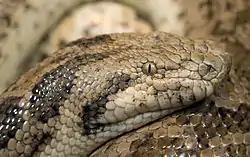 | |
Scientific classification  | |
| Kingdom: | Animalia |
| Phylum: | Chordata |
| Class: | Reptilia |
| Order: | Squamata |
| Suborder: | Serpentes |
| Family: | Boidae |
| Genus: | Eryx |
| Species: | E. m. o. Tataricus |
| Binomial name | |
| Eryx miliaris or Tataricus (Pallas, 1773) | |
| Synonyms | |
Description
The body is strong and round. The tail is very short and thick. The head is almost mixed with the body. The front part of the body is soft while the back part is rough and raised. Like the Indian Sand Boa, this snake also rounds its body in times of danger. Doesn't try to bite humans. The snake is a mixture of brown, red and black, which turns white on both sides. Its diet includes small birds, desert lizards and other small animals.
Distribution
E. miliaris or Eryx Tataricus is found in Iran, Pakistan, Afghanistan, Turkmenistan, Uzbekistan, southern Russia, and northwestern China.[1]
References
- The Reptile Database. www.reptile-database.org.
- "Eryx miliaris". Integrated Taxonomic Information System. Retrieved August 16, 2010.
- McDiarmid, Roy W., Jonathan A. Campbell, and T'Shaka A. Touré, 1999. Snake Species of the World: A Taxonomic and Geographic Reference, Volume 1. Washington, District of Columbia: Herpetologists' League. xi + 511 pp.
Further reading
- Eichwald [K]E. 1831. Zoologia specialis quam expositis animalibus tum vivis, tum fossilibus potissimum rossiae in universum, et poloniae in specie, in usum lectionum publicarum in Universitate Caesarea Vilnensi habendarum. Pars posterior. Vilnius: J. Zawadzki. pp. 116–197. (Eryx miliaris, p. 176). (in Latin).
- Pallas PS. 1773. Reise durch verschiedene Provinzen des Russischen Reichs. Zwenter Theil [Volume 2]. St. Petersburg, Russia: Russian Academy of Sciences. 744 pp. (Anguis miliaris, new species, p. 718). (in German and Latin).