Eudokia Makrembolitissa
Eudokia Makrembolitissa[3] (Greek: Εὐδοκία Μακρεμβολίτισσα, romanized as Eudocia Macrembolitissa) was a Byzantine empress by her successive marriages to Constantine X Doukas and Romanos IV Diogenes. She acted as regent of her minor son, Michael VII in 1067, and resigned her regency by marriage to Romanos IV Diogenes. When he was deposed in 1071 she resumed the regency for her sons, but was soon forced to resign again.
| Eudokia Makrembolitissa | |
|---|---|
| Augusta | |
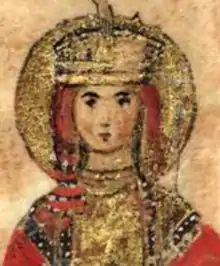 | |
| Byzantine empress | |
| Tenure | November 1059 – November 1071 |
| Born | 1020s |
| Died | after 1082 |
| Spouse | Constantine X Doukas Romanos IV Diogenes |
| Issue | Michael VII Doukas Andronikos Doukas Konstantios Doukas Nikephoros Diogenes Leo Diogenes |
| Dynasty | Doukid |
| Religion | Orthodox |
Because she essentially ruled in her own right during her sole regencies and retained the title of empress, several modern scholars consider Eudokia to have been empress regnant in 1067 and some also in 1071.
Family
Eudokia Makrembolitissa was the daughter of John Makrembolites and a niece of Michael Keroularios, the patriarch of Constantinople, whose sister had married Makrembolites. Michael Psellos was very close to the family, and Eudokia often called him "uncle". According to Psellos she was very noble, beautiful, and intelligent. She also had a very strong personality, and his pronouncements had the imperial notes of authority.[4] Eudokia married Constantine Doukas sometime before 1050. Some sources suggest the marriage took place c. 1040 while others give c. 1049,[3] meaning she was born in the early 1020s or 1030s. They had several children:
- Michael VII Doukas, emperor from 1071 to 1078.
- Andronikos Doukas, co-emperor from 1068 to 1078
- Konstantios Doukas, co-emperor from 1060 to 1078, died 1081
In late 1067, despite vowing to never re-marry, Eudokia wed powerful general, Romanos Diogenes, in order to retain power over her regency. Together they would have two children, both crowned at birth:
- Nikephoros Diogenes, co-emperor between 1070 and 1072, died c. 1100
- Leo Diogenes, co-emperor between 1070 and 1072, died in 1087
Empress
Constantine became Byzantine emperor on 23 November 1059.[5] When he died on 23 May 1067,[5] Eudokia, as a crowned augusta,[3] was confirmed as regent for their sons Michael VII and Konstantios, along with Constantine's brother, Caesar John Doukas. Michael VII was old enough to rule on his own, but nevertheless was considered co-emperor with his younger brother, while Eudokia ran the administration of the empire.
Some historians regard Eudokia as a empress regnant who actually ruled in her own right, rather than just a regent.[6][7][8] According to the contemporary Michael Psellos, Eudokia "succeded [Constantine X] as supreme ruler, she did not hand over the government to others...[but] she assumed control of the whole administration in person."[9] Her status as a ruler is reflected in her coinage and public iconography. For example, she sometimes appeared on silver and copper coins witouth her sons, which was very unusual. One inscription on a silver reliquary calls her "Great Empress of the Romans" (megale basilis Romaioi), suggesting that she had a higher status than his sons.[10]
Eudokia had also sworn on Constantine's deathbed not to remarry, and had even imprisoned and exiled Romanos Diogenes, who was suspected of aspiring to the throne. Perceiving that she was not able to avert the invasions which threatened the eastern frontier of the empire unaided,[11] however, she revoked her oath and married Romanos, without the approval of John Doukas, Patriarch John VIII of Constantinople, or Michael VII. She approached the patriarch and convinced him both to hand over the written oath she had signed to this effect, and to have him pronounce that he was in favour of a second marriage for the good of the state.[12] The Senate then agreed to the marriage. The wedding took place on 1 January 1068, and Romanos IV was immediately proclaimed senior co-emperor.[13]
With her new husband's assistance, Eudokia was able to dispel the impending danger. She had two sons with Romanos IV, Nikephoros and Leo. Another of Eudokia and Constantine's sons, Andronikos Doukas, was now made co-emperor by Romanos IV, although he had been excluded from power by his own father, mother, and brothers. However, Eudokia did not live at ease with her new husband, who increasingly excluded her from power.[14]
When Romanos was taken prisoner by the Seljuk Turks at the Battle of Manzikert (1071), Eudokia and Michael again assumed the government,[11] until it was discovered that Romanos had survived and was returning to Constantinople. Eudokia then attempted to regain the throne and forced Romanos' to abdicate on 1 October 1071.[15] It's possible that she once again ruled as empress regnant for a month,[8][16] after which she was forced to become a nun.[15][3]
After Michael VII was deposed in 1078 by Nikephoros III, Eudokia was recalled by the new emperor, who offered to marry her.[6] This plan did not come to pass, mainly due to the opposition of John Doukas.[11] Her date of death is unknown, but it was probably sometime after 1082, when she adopted one of the cousins of Patriarch Michael I Cerularius.[3]
Writings
Attributed to Eudokia is a dictionary of history and mythology, called Ἰωνιά (i.e. Collection or Bed of Violets). It is prefaced by an address to her husband Romanos Diogenes, and the work is described as "a collection of genealogies of gods, heroes, and heroines, of their metamorphoses, and of the fables and stories respecting them found in the ancients; containing also notices of various philosophers". However, the book is now thought to be a modern (16th-century) compilation, falsely attributed to Eudokia, and compiled by the counterfeiter Constantine Paleocappa around 1540.[17] The sources from which the work was compiled include Diogenes Laërtius and the Suda.[17]
Notes
- Sághy & Robert 2019, p. 162.
- Spatharakis 1976, pp. 27–34.
- PBW, Eudokia 1.
- Garland 2002, pp. 168–169.
- Schreiner 1977, pp. 151.
- ODB, p. 739.
- McLachlan 2004, p. 236.
- Haldon 2005, p. 176.
- Garland 2002, p. 171.
- Garland 2002, pp. 168−172.
- Chisholm 1911, pp. 881–882.
- Norwich 1993, p. 344.
- Schreiner 1977, p. 153.
- Garland 2002.
- Schreiner 1977, p. 156.
- Garland 2002, p. 231.
- Dorandi 2013, p. .
References
- Dorandi, Tiziano (2013), "Introduction", Diogenes Laertius: Lives of Eminent Philosophers, Cambridge University Press, ISBN 978-0521886819
- Dzielska, Maria (1995), Hypatia of Alexandria, translated by Lyra, F., Harvard University Press, ISBN 0-674-43776-4
- Garland, Lynda (2002), "Eudokia Makrembolitissa", Byzantine Empresses: Woman and Power in Byzantium, Routledge, pp. 168–179, ISBN 9781134756384
- Haldon, John (2005). The Palgrave Atlas of Byzantine History. New York: Palgrave Macmillan. ISBN 978-0230243644.
- Jeffreys, Michael, ed. (2016), "Eudokia 1", Prosopography of the Byzantine World, King's College London, ISBN 978-1-908951-20-5
- Kazhdan, Alexander, ed. (1991). "Eudokia Makrembolitissa". The Oxford Dictionary of Byzantium. Oxford and New York: Oxford University Press. ISBN 0-19-504652-8.
- McLachlan, Sean (2004), Byzantium: An Illustrated History, Hippocrene Books, ISBN 0-7818-1033-7
- Norwich, John Julius (1993), Byzantium: The Apogee, Penguin, ISBN 0-14-011448-3
- Sághy, Marianne; Robert, Ousterhout (2019), Piroska and the Pantokrator, Central European University Press, ISBN 9789633862971
- Spatharakis, Ioannis (1976), The Portrait in Byzantine Illuminated Manuscripts, Brill, ISBN 9789633862971
- Schreiner, Peter (1977). Die byzantinischen Kleinchroniken II: Historischer Kommentar. Corpus Fontium Historiae Byzantinae. Vienna: ÖAW. ISBN 978-3-7001-0206-9.
Attribution
- This article incorporates text from a publication now in the public domain: Chisholm, Hugh, ed. (1911), "Eudocia Macrembolitissa", Encyclopædia Britannica, 9 (11th ed.), Cambridge University Press, pp. 881–882
 Smith, William, ed. (1870), "Eudocia Augusta Macrembolis", Dictionary of Greek and Roman Biography and Mythology, 2, p. 80
Authority control  | |
|---|---|
| General | |
| National libraries | |
| Other | |