Euproops
Euproops Meek and Worthen, 1868,[2] is an extinct genus of xiphosuran, related to the modern horseshoe crab. It lived during the Carboniferous Period.
| Euproops Temporal range: Carboniferous | |
|---|---|
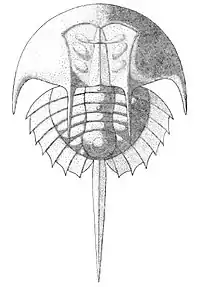 | |
| Reconstruction by Filipiak, P. & Krawczyński, W. 1996 of Euproops rotundatus (Prestwich, 1840) in dorsal view. | |
| Scientific classification | |
| Kingdom: | |
| Phylum: | |
| Subphylum: | |
| Class: | |
| Order: | |
| Infraorder: | Belinurina |
| Family: | |
| Genus: | Euproops |
| Synonyms[1] | |
| |
The Treatise on Invertebrate Paleontology describes Euproopidae as "small forms with wedge-shaped cardiac lobe bordered by distinct axial furrows, abdominal shield with annulated axis bearing a high boss on last segment." The same source describes Euproops as follows. "Prosoma with flat genal spines and carinate opthamalic spines; cardiopthamalic region with or without intercardiopthamalic area; abdomen with raised pleural ridges that cross flattened rim and are prolonged as marginal spines; annulated axis with knob on 1st and 3rd segments and elevated boss or short spine on hindmost segment; telson long.[3]"
Type species
Belinurus danae Meek & Worthen, 1865.[4] = Euproops kilmersdonensis Ambrose & Romano, 1972 according to Anderson (1994)[5]
In 2021, a specimen of E. danae was discovered with an exceptionally well-preserved brain and central nervous system (CNS). It appears that the CNS of this (and perhaps other extinct horseshoe crabs) has remained essentially unchanged for some 300 m.y. [6]
Other species
- Euproops mariae Crônier & Courville, 2004.[7]from the Upper Carboniferous of the Graissessac Basin (Massif Central, France).
- Euproops rotundatus (Prestwich 1840).[8] From the Upper Carboniferous of Coalbrookdale, Shropshire, England. The fine reconstruction of E. rotundatus by Filipiak and Krawczyński (1996) is based on material from the Upper Silesia Coal Basin of Sosnowiec, Poland. [9]
References
- Dunlop, J. A., Penney, D. & Jekel, D. 2015. A summary list of fossil spiders and their relatives. In World Spider Catalog. Natural History Museum Bern, online at http://wsc.nmbe.ch, version 16.0
- Meek, F. H. & Worthen, A. H. 1868. Paleontology of Illinois. Geological Survey of Illinois, 3: 291 - 565.
- Størmer, L. 1955. Merostomata. Treatise on Invertebrate Paleontology, Part P Arthropoda 2, Chelicerata, P: 20.
- Meek, F. B. & Worthen, A. H. 1865. Notice of some new types of organic remains from the Coal Measures of Illinois. Proceedings of the Academy of Natural Sciences of Philadelphia, 17, 41 - 45.
- Anderson, L. I. 1994. Xiphosurans from the Westphalian D of the Radstock Basin, Somerset Coalfield, the South Wales Coalfield and Mazon Creek, Illinois. Proceedings of the Geologists' Association, 105, 265 - 275.
- "This Brain Remained Intact in a 310 Million-Year-Old Fossil", New York Times, Aug. 18, 2021
- Crônier, C. & Courville, P., 2004. New xiphosuran merostomata from the Upper Carboniferous of the Graissessac Basin (Massif Central, France). C. R. Palevol 4 (2005), 123 – 133.
- Prestwich, J. 1840. Memoir on the geology of Coalbrook Dale. Transactions of the Geological Society of London 5, 413 - 495.
- Filipiak, P. & Krawczyński, W. 1996. Westphalian xiphosurans (Chelicerata) from the Upper Silesia Coal Basin of Sosnowiec, Poland. - Acta Palaeontologica Polonica 41, 4, 413-425.
Sources
- Fossils (Smithsonian Handbooks) by David Ward
- Leif Størmer, 1955, Merestomata, Treatise on Invertebrate Paleontology, Part P Arthropoda 2, Chelicerata, Geological Society of America and the University of Kansas, p. P20.
Gallery
.jpg.webp) Euproops rotundatus (Prestwich 1840). Upper Carboniferous, Westphalian (Duckmantian), Crock Hay Open Cast Quarry, Wigan, Lancashire, UK.
Euproops rotundatus (Prestwich 1840). Upper Carboniferous, Westphalian (Duckmantian), Crock Hay Open Cast Quarry, Wigan, Lancashire, UK.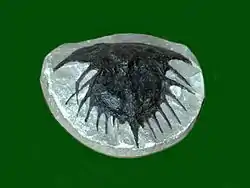 Fossil of Prestwichia anthrax from Coalbrook Dale, England.
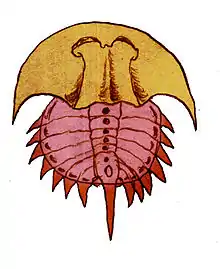 Euproops danae.
