Evidence lower bound
The evidence lower bound (ELBO, also variational lower bound or negative variational free energy) is a lower bound on the probability of observing some data under a model. In Variational Bayesian methods, the ELBO can be used as an optimization criterion for approximating the posterior distribution of some set of latent variables given some data with a simpler (parametric) distribution . These methods handle cases where a distribution over unobserved variables is optimized as an approximation to the true posterior , given observed data . Then the evidence lower bound is defined as:[1]



where is cross-entropy. Maximizing the evidence lower bound minimizes , the Kullback–Leibler divergence, a measure of dissimilarity of from the true posterior. The primary reason why this quantity is preferred for optimization is that it can be computed without access to the posterior, given a good choice of .


For other measures of dissimilarity to be optimized to fit see Divergence (statistics).[2]
Justification as a lower bound on the evidence
The name evidence lower bound is justified by analyzing a decomposition of the KL-divergence between the true posterior and :[3]
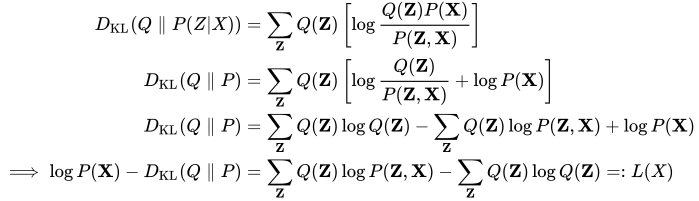
As this equation shows that the evidence lower bound is indeed a lower bound on the log-evidence for the model considered. As does not depend on this equation additionally shows that maximizing the evidence lower bound on the right minimizes , as claimed above.


References
- Yang, Xitong. "Understanding the Variational Lower Bound" (PDF). Institute for Advanced Computer Studies. University of Maryland. Retrieved 20 March 2018.
- Minka, Thomas (2005), Divergence measures and message passing. (PDF)
- Bishop, Christopher M. (2006), "10.1 Variational Inference" (PDF), Pattern Recognition and Machine Learning