Explorer 42
Explorer 42 or Uhuru, was the first satellite launched specifically for the purpose of X-ray astronomy of the NASA. It was also known as the SAS-A (for Small Astronomy Satellite-A, being first of the three-spacecraft SAS series), SAS-1. The spacecraft was launched on 12 December 1970 into an initial orbit of about 572 km (355 mi) of apogee, 531 km (330 mi) of perigee, 3.00° of orbital inclination, with an orbital period of 95.70 minutes.[1] The mission ended in March 1973. Explorer 42 was a scanning mission, with a spin period of ~12 minutes. It performed the first comprehensive survey of the entire sky for X-ray sources, with a sensitivity of about 0.001 times the intensity of the Crab Nebula.
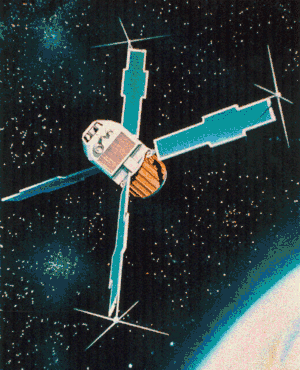 Explorer 42 (Uhuru) satellite in space | |
| Names | Uhuru SAS-A SAS-1 Small Astronomy Satellite-1 |
|---|---|
| Mission type | X-ray astronomy |
| Operator | NASA |
| COSPAR ID | 1970-107A |
| SATCAT no. | 04797 |
| Website | heasarc |
| Mission duration | 2 years and 3 months (achieved) |
| Spacecraft properties | |
| Spacecraft | Explorer XLII |
| Spacecraft type | Small Astronomy Satellite |
| Bus | SAS |
| Manufacturer | Goddard Space Flight Center |
| Launch mass | 141.5 kg (312 lb) |
| Dimensions | 56 cm (22 in) in diameter and 116 cm (46 in) in length |
| Power | Solar paddles with a 12-cell nickel–cadmium battery |
| Start of mission | |
| Launch date | 12 December 1970, 10:53:50 GMT |
| Rocket | Scout B (S-175C) |
| Launch site | Broglio Space Center, San Marco platform |
| Contractor | Vought |
| Entered service | 12 December 1970 |
| End of mission | |
| Last contact | March 1973 |
| Decay date | 5 April 1979 |
| Orbital parameters | |
| Reference system | Geocentric orbit[1] |
| Regime | Low Earth orbit |
| Perigee altitude | 531 km (330 mi) |
| Apogee altitude | 572 km (355 mi) |
| Inclination | 3.00° |
| Period | 95.70 minutes |
| Instruments | |
| All-Sky X-Ray Survey | |
Explorer program | |
Uhuru naming
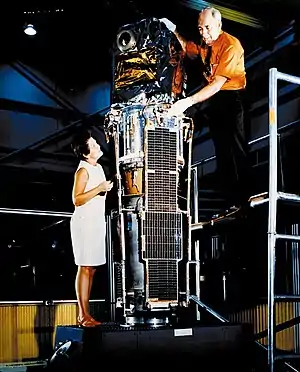
The satellite's name, "Uhuru", is the Swahili word for "freedom". It was named in recognition of the hospitality of Kenya from where it was launched, from the Italian San Marco launch platform near Mombasa.
Catalog of celestial X-ray sources
Explorer 42 was the first in the series of small spacecraft whose objectives were to survey the celestial sphere and search for sources radiating in the X-ray, gamma-ray, Ultraviolet, and other spectral regions. The primary mission of Explorer 42 was to develop a catalog of celestial X-ray sources by systematic scanning of the celestial sphere in the energy range from 2-20 keV. The Uhuru Catalog, issued in four successive versions, the last being the 4U catalog, was the first comprehensive X-ray catalog, contains 339 objects and covers the whole sky in the 2–6 keV band. The final version of the source catalog is known as the 4U Catalog;[2] earlier versions were the 2U and 3U catalogs. Sources are referenced as "4U 1700-37".[3]
Launch
The spacecraft was launched 12 December 1970 from the San Marco platform off the coast of Kenya, Africa, into a near-circular equatorial orbit. The orbiting spacecraft was in the shape of a cylinder approximately 56 cm (22 in) in diameter and 116 cm (46 in) in length. Four solar paddles were used to recharge a 6 amp-h, eight-cell, nickel–cadmium battery, and to provide power to the spacecraft and experiment. The spacecraft was stabilized by an internal wheel, and a magnetically torqued commandable control system was used to point the spin axis of the spacecraft to any point of the sky. The aspect sensing system consisted of both a star sensor and Sun sensor that shared the same processing electronics. The system was designed with heavy emphasis on redundancy, not only in the more obvious areas such as aspect sensors and high- and low-voltage power supplies, but also in signal switching and high-voltage distribution. The resulting instrument was capable of sustaining several simultaneous major failures without seriously compromising the scientific objectives. Data were stored on an one-orbit storage tape recorder and telemetered during a 3.4 minutes playback cycle. A 1000 bps PCM/PM system was used.[4]
Objectives
The main objectives of the mission were:[5]
- To survey the sky for cosmic X-ray sources in the 2–20 keV range to a limiting sensitivity of 1.5 × 10⁻¹⁸ joule/(cm2-sec), 5 × 10⁻⁴ the flux from the Crab Nebula
- To determine discrete source locations with a precision of a few square minutes of arc for strong sources and a few tenths of a square degree at the sensitivity limit
- To study the structure of extended sources or complex regions with a resolution of about 30 arc-minutes
- To determine gross spectral features and variability of X-ray sources
- To perform, wherever possible, coordinated and/or simultaneous observations of X-ray objects with other observers.
Instrumentation
The payload consisted of two sets of proportional counters, each with ~0.084 m2 effective area. The counters were sensitive with more than 10% efficiency to X-ray photons in the ~2–20 keV range. The lower energy limit was determined by the attenuation of the beryllium windows of the counter plus a thin thermal shroud that was needed to maintain temperature stability of the spacecraft. The upper energy limit was determined by the transmission properties of the counter filling gas. Pulse-shape discrimination and anticoincidence techniques were used to filter out emissions of particles and undesirable high-energy photons in the background. Pulse-height analysis in eight energy channels was used to obtain information on the energy spectrum of the incident photons. The two sets of counters were placed back to back and were collimated to 0.52° × 0.52° and 5.2° × 5.2° (full width at half maximum) respectively. While the 0.52° detector gave finer angular resolution, the 5.2° detector had higher sensitivity for isolated sources.[5]
Experiment
All-Sky X-Ray Survey
The X-ray instrument aboard Explorer 42 (SAS-A) consisted of two nearly identical sides, both physically and electronically. Each side contained an X-ray detection system composed of a collimator, proportional counters, associated processing electronics, and an aspect sensing system. The high spatial resolution side had a viewing angle of 0.5° by 5° Full width at half maximum (FWHM) and a detection range from 1 to 20 keV. The other side had a high-sensitivity collimator with a viewing angle of 5° by 5° FWHM. This side had a detection range from 1 to 10 keV. Six proportional counters, composed of a beryllium shell with 2.5-mm beryllium foil windows, were behind each collimator. The interior contained a 2-mm tungsten anode wire and a gas composition of 90% argon, 9.5% carbon dioxide for quenching, and 0.5% helium at a pressure of 940 mm of mercury. Low-intensity radioactive sources were used for inflight calibration of the instrument. The spin axis of the spacecraft was held fixed in the sky for about a day at a time. During this period a band of approximately 10° about the equator of the spin axis was scanned. The primary data reduction objective was to superimpose the X-ray data recorded as "count rate versus time" to "count rate versus azimuth" so that the superimposition data would be equivalent to a single sweep through the observing 10° band with a total observing time of 1 day. An array was created of X-ray superimposition (representing the 360° circle scanned) broken into 4320 elements of azimuth of 5 minutes each for the 0.5° detector and 1080 elements of azimuth of 20 minutes each for the 5° detector.[6]
Results
Explorer 42 achieved several outstanding scientific advances, including the discovery and detailed study of the pulsing accretion-powered binary X-Ray sources such as Cen X-3, Vela X-1, and Her X-1, the identification of Cygnus X-1, the first strong candidate for an astrophysical black hole, and many important extragalactic sources.
See also
 Spaceflight portal
References
- "Trajectory: Explorer 42 (UHURU) 1970-107A". NASA. 28 October 2021. Retrieved 14 November 2021.
 This article incorporates text from this source, which is in the public domain.
 - 4U catalog browse version
- Forman et al. (1978), ApJS, 38, 357 HEASARC archive for Uhuru
- "Display: Explorer 42 (UHURU) 1970-107A". NASA. 28 October 2021. Retrieved 14 November 2021. This article incorporates text from this source, which is in the public domain.
- "The Uhuru Satellite". HEASARC GSFC. NASA. 8 October 2003. Retrieved 14 November 2021. This article incorporates text from this source, which is in the public domain.
- "Experiment: All-Sky X-Ray Survey". NASA. 28 October 2021. Retrieved 14 November 2021. This article incorporates text from this source, which is in the public domain.
 |
Wikimedia Commons has media related to Uhuru (satellite). |
.png.webp)
| Operating |
|
|---|---|
| Planned |
|
| Proposed | |
| Retired |
|
| Hibernating (Mission completed) | |
| Lost | |
| Cancelled | |
| Related | |
| |
