International University Sports Federation
The Fédération Internationale du Sport Universitaire (FISU, English: International University Sports Federation) is responsible for the organisation and governance of worldwide sports competitions for student-athletes between the ages of 17 and 25. It was founded in 1949[1] as the world governing body of national university sports organisations and currently has 174[2] member associations (National University Sport Federations) from five continents. Between 1949 and 2011, it was based in Brussels (Belgium); since 2011, it is based in Lausanne (Switzerland).
 | |
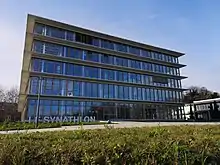 Headquarters in Lausanne. | |
| Formation | 1 January 1949 |
|---|---|
| Type | Sports federation |
| Headquarters | |
Membership | 170 member associations |
Official language | French and English |
Acting President | Leonz Eder (Switzerland) |
Vice-Presidents | Luciano Cabral (Brazil) (1st VP), Penninah ALIGAWESA KABENGE(UGA) Marian Dymalski (Poland) Zhen SHEN (CHN) |
| Website | www |
The FISU stages its events every two years. They currently include two Universiades (summer and winter) and 34[3] World University Championships.
It also organises conferences, forums and seminars to promote sport as a component of the educational system.[4]
FISU sanctions other competitions open to university students, such as the biennial World University Bridge Championships in contract bridge, "played under the auspices of the FISU".[5]
Organisation
A General Assembly elects an executive committee for a four-year term. Oleg Matytsin was elected president for 2015–2019, succeeding Claude-Louis Gallien.[6] The secretary-general and CEO is Eric Saintrond;[7] vice-presidents are Leonz Eder, Luciano Cabral, Marian Dymalski, Leopold Senghor and Liguo Yang.[8]
Past presidents include:
- 1949–1961: Paul Schleimer
- 1961–1999: Primo Nebiolo
- 1999–2011: George E. Killian
- 2011–2015: Claude–Louis Gallien
Events and sports
Universiade
The FISU World University Games,[9] formerly and commonly referred to as the Universiade, is an international sporting event staged every two years in a different city. There were 10,622 participants in Shenzhen, China, in 2011, and 174 participating countries in Daegu, Korea, in 2003.
The Summer Universiade includes 12 compulsory sports (15 compulsory disciplines):[10]
One to three optional sports are chosen by the host country.
The Winter Universiade includes 6 compulsory sports (8 compulsory disciplines):[10]
One to four optional sports are chosen by the host country.[11]
World University Championships
While the Universiades are held in odd years, the FISU World University Championships are held in even years. It includes individual/team sports, indoor/outdoor sports, combat sports, mind sports and summer/winter sports.[12]
See also
References
- FISU Statutes Retrieved 2016-01-19.
- "Current structure". www.fisu.net. Retrieved 2018-03-07.
- "World University Championships". www.fisu.net. Retrieved 2018-03-07.
- Ferreira, P. (2010) Strategy Assessment of International Sports Federations – Case study of the International University Sports Federation (FISU). Executive Masters in Sports Organisation Management, University of Poitiers, France.
- World University Team Cup Archived 2011-10-27 at the Wayback Machine. World Bridge Federation. 5th World University Bridge Championship Archived 2011-08-13 at the Wayback Machine Event website (2010). Chinese Taipei University Sports Federation. Retrieved 2011-08-12.
- 34th General Assembly in Lausanne elects New Board. Retrieved 2016-01-19.
- "FISU today". www.fisu.net. Retrieved 2018-03-07.
- "Executive Committee". www.fisu.net. Retrieved 2018-03-07.
- Pavitt, Michael (28 July 2020). "FISU finalises naming system for events". insidethegames.biz. Retrieved 19 April 2021.
- Sports. Retrieved 2016-01-19.
- Winter Universiade. Retrieved 2016-01-19.
- "World University Championships". www.fisu.net.
 |
Wikimedia Commons has media related to International University Sports Federation. |

Authority control  | |
|---|---|
| General | |
| National libraries | |
| Other | |