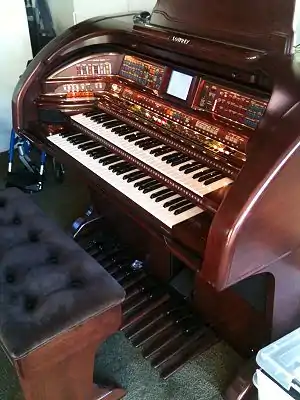
Farfisa
Farfisa is a manufacturer of electronics based in Osimo, Italy, founded in 1946.[2] The name is commonly associated with a series of compact electronic organs manufactured in the 1960s and 1970s, including the Compact, FAST, Professional and VIP ranges, and later, a series of multi-timbral synthesizers. They were used by a number of popular musicians including Sam the Sham, Pink Floyd, Sly Stone, Blondie, and the Philip Glass Ensemble.
 | |
| Industry | Electronics |
|---|---|
| Founded | 1946 |
| Founder | Silvio Scandalli[1] |
| Fate | Music division purchased by Bontempi |
| Headquarters | Osimo, Italy |
| Products |
Historical products:
|
The company was formed after three Italian accordion manufacturers combined to form a single company. Electronic instruments began to be produced in the late 1950s, and combo organs were introduced in response to similar instruments such as the Vox Continental. Farfisa continued to make organs and synthesizers into the 1980s. The brand name has survived, and Farfisa is now a consumer electronics manufacturer.
History
.jpg.webp)
Farfisa was established in 1946 following the mergers of Settimo Soprani, Scandalli and Frontalini, whose businesses had suffered during World War II. The company was officially named Fabbriche Riunite Fisarmoniche Italiane S.p.A (United Italian Accordion Factories), and production was based in Castelfidardo, Ancona. It quickly became the world's largest supplier of accordions; the International Accordion Museum now occupies the site of the original factory.[3]
During the 1950s, Farfisa began to diversify their range of instruments after sales of accordions began to decline, including radios, televisions and musical instruments. The Microrgan, a portable reed organ, was released in 1958; it used an electric fan to blow air across the reeds. Two years later, the company developed the Cordovox accordion with Lowrey, which combined accordion reeds with electronically generated sounds.[4]
Following the introduction of the Vox Continental combo organ in 1962, Farfisa decided to quickly build a competing instrument using the technical expertise they had gained from working with Lowrey. The first model, the Combo Compact, was introduced in 1964. Production was moved to a factory in Aspio Terme.[5] The relatively cheap labour in Italy, compared to the UK and US meant that Farfisa were able to produce a greater quantity of combo organs at a cheaper cost, and consequently they were picked up by many amateur and semi-professional groups.[6] Unlike later organs, the Compact series is not fully transistorised, and included high tube circuitry for the reverb unit.[7] Distribution in the U.S. was handled by the Chicago Musical Instrument Company, which also owned Gibson, and the instruments were originally known as CMI organs when introduced there.[8] Unlike other combo organs like the Vox Continental, Farfisa organs have integrated legs, which can be folded up and stored inside its base.[4] This design was copied for later combo organs such as the Gibson G-101.[8] The organs also had a flip-down modesty panel displaying the brand name.[5]
The line of FAST (Farfisa All-Silicon Transistorized) organs was launched at the 1968 NAMM show.[9] These superseded the earlier germanium transistors used in the Compact models, and were styled to closer resemble the Vox Continental, including chrome stands.[10] The Professional series appeared around the same time, which included more features than earlier models. The VIP models were introduced in 1970, and included a foot-operated pitch bend.[10] At the height of its production, Farfisa operated three factories to produce instruments in Camerano in the Marche region of Italy.[1]
By the late 1960s, major groups had moved on from combo organs and begun to use the Hammond organ more prominently.[10] In response, Farfisa advertised that its latest organs at that point could emulate a Hammond and had a full set of drawbars.[9] Production of combo organs began to be phased out in the late 1970s after synthesizers had become more commonplace, with the last unit being produced in 1982.[10] Farfisa has survived into the 21st century, and brand mainly produces intercom systems with the company ACI Farfisa which makes and distributes systems for video intercoms, access control, video surveillance, and home automation.[2][11] The Bontempi group owns the rights for Farfisa keyboards.[1]
Models
Compact Series (1964 - 1969)
_live_at_NBI.jpg.webp)
The Compact series had four models. On the Compact Duo dual manual organs, tone and volume were regulated by controls on the F/AR combination preamp, spring reverb and power supply unit.[9] On most other models the tone controls and a bass section volume were located on an indented panel on the rear of the keyboard. Underneath the keyboards, a knee-high lever could be actuated for the tone boost feature, turned on by rocker levers on the console. All models had reverb except for the mini-compact. Optional feature: 13-note bass pedals (not for the mini-compact).[12]
The Mini-Compact is the smallest of the Compact Series. It has only four octaves, with no bass on the early models. The later version had a selector switch to choose bass or high sound in the lowest octave; these models had grey naturals with white sharps in the bass octave. Some of these extended bass models have only three voices (sounds), while the later models had six voices.[13]
Early compact models including the Mini Compact and Mini Deluxe Compact had three tone switches - dolce, principale and strings, in 16', 8' and 4' footages. Later models included 16' bass, 8' flute, oboe, strings and 4' flute and strings. The instrument featured a multi-tone booster with knee trigger, and an optional swell pedal. The first models had removable legs which could be stored inside the bottom cover, as opposed to later models that had folding or pivoting non-removable legs.
The Combo Compact had one octave of bass with inverse key colors, 16' bass and strings, 8' flute, oboe, trumpet and strings, 4' flute, piccolo and strings, four vibrato settings, three choices of reverb and three bass volume switches.
Later Compact models, such as the Combo Compact I included two inferior octaves (one black/white, one grey/white) on the left hand side of the keyboard. One set of octaves were switch-controllable for choice of a bass or acute sound with bass note sustain and controllable bass percussion. The volume balance between bass and treble was adjustable.
The Compact Deluxe featured similar controls to the Compact I, with additional voices such as the 2-2/3' footage with an independent "brilliant" tab. Later models, such as the Combo Deluxe Compact I, also include a rhythm section (drum machine) of brush cymbal and drum.
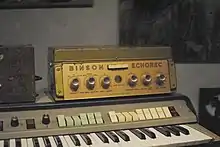
The Compact Duo weighs 90 pounds (41 kg) and supports 49-key manuals.[8][14] It features a four-octave upper keyboard with 9 selectors: 16' Bass, Strings; 8' Flute, Oboe, Trumpet, Strings; 4' Flute, Strings; 2-2/3' (Flute) and Brilliance, and a four-octave lower keyboard with three selectors: Dolce, Principale and Ottava. There are two inferior octaves on the left-hand side of the lower keyboard; one octave is switch-controllable for choice of a bass or acute sound. The instrument has four vibrato and three reverb settings. Later models also incorporate tremolo, percussion and repeat functions for both the upper and lower treble manuals independently.
Unlike other Compact series organs, the Compact Duo models require a separate power supply/solid-state preamp/real spring reverb unit (called the Farfisa F/AR), to which the organ connects via a multi-lead cable.[14] The US version used a 7-pin Amphenol connector, while European models used a 16-pin bakelite (Hirschmann MES 160). Treble output is available only via the F/AR. Farfisa Amplifier Models BR80 or Twin 80 accept the 7-pin connector and power the organ, allowing the Compact Duo to operate directly, without the F/AR; Farfisa Amplifier Models TR60 accepts the Multipin connector and powers the organ, allowing the Compact Duo to operate directly, without the F/AR. Rocker switches on the organ activate the reverb in the amplifiers (a TelRay (Adineko) reverb/echo unit (oilcan) built into the speaker cabinet).
FAST Series (1968–1971)
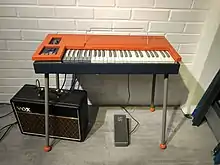
The FAST (Farfisa All Silicon Transistor) Series models had a metal cabinet covered with a washable skin plate and plastic edges, chrome folding legs, retractable carrying handles, and a removable music rack. This series had the combo organs (FAST 2,3,4,5,Console), and the Professional (Original, Duo, and Pianos).
The Fast 2 has a 49 note keyboard (C to C) with a twelve-note manual bass on the lowest octave. There are four voice stops (flute, clarinet, reed and strings), a two-speed vibrato and an optional swell pedal. The Fast 3 featured more sounds, including bass, clarinet, oboe and trumpet, along with 8' and 4' flute settings. The Fast 4 expanded the keyboard to 61 notes, with an additional light / heavy vibrato option, two mixture stops and five percussion controls. The Fast 5 added three sustain stops.
Professional Series (1968 - 1975)
These are the most sophisticated models made by Farfisa. In 1972 Leir Siegler and started producing VIP models and custom models. The Professional (PP/222 and PP/221) contained a single keyboard with grey keys. There are two models, with and without foot pedals. This model later evolved to the VIP 345 and VIP 370. The Professional DUO was a double keyboard version with bass pedals. There are two models. This model later evolved to the VIP 400, VIP 500, and VIP 600.
Professional Piano was available in two models, along with a Super Piano model in a console style with integrated amp and speakers.
During this same time period, Farfisa also produced a line of effect pedals: the Repeat/Volume pedal (in orange), the Wah-Wah/Volume pedal (in green), and the Sferasound pedal (in blue). There was also a high-end amplifier called the 80 or S-80, which came with speaker cabinets, either the Twin-80, or the BR-80.
Later models
The Farfisa Matador was produced in the early to mid-1970s. It is a compact organ with a built-in speaker and amplifier. Several models of Matador were produced.
In the mid-1970s Farfisa produced the "Stereo Syntorchestra", with a three octave keyboard, and "mono" and "poli" tone generator sections. The "poli" section has four timbres: Trombone, Trumpet, Piano, and Viola. The mono section is the "synth" part of the machine. It has nine timbres: Tuba, Trombone, Trumpet, Bari Sax, Alto Sax, Bass Flute, Flute, Piccolo, and Violin. This section is monophonic, with a highest note priority. The mono section can be modified by two envelope controls and a wah-wah; there is also a variable portamento. Only one timbre from each section can be used at a time. Each section has a brilliance control, which adds more top end to the sound, and a variable speed vibrato, which has a delay function, for delayed vibrato effects. The Syntorchestra also has separate outputs for each of its two sections. Farfisa also produced two very large organs which incorporated the Syntorchestra at this time, the 259r and 6290r "Maharani" organs.
The Syntorchestra was produced at a similar period in the mid-1970s to the more basic String Orchestra, which included piano and string sections. The Soundmaker was Farfisa's next non-organ instrument, with a further development of the synthesizer approach, incorporating string, brass and monosynth sections.
The "Polychrome", built at the end of the 1970s, was Farfisa's largest and most well-featured non-organ instrument, as an analog synthesizer featuring vocal, brass, string, and percussion sections, and including a built in chorus, phaser and modulation as well as aftertouch sensitivity.
The "Transicord" was a transistor electric accordion. Essentially, it was not a true accordion; an "accordion-shaped combo organ" would have been perhaps a more fitting name. There were no reeds; it was purely electronic. It was designed to be used in conjunction with Farfisa's amplifiers, and had a multi-pin cable that connected the controls of the accordion, with the controls of the amplifier, or the F/AR Reverb preamp power supply unit.
The Transicord came in two models, a "standard" and a "DeLuxe." The standard has one row of stop-tabs similar to those found on a Combo Compact organ, and is reported to have a similar sound. The color scheme was grey with light blue and green. The DeLuxe has two rows of stop-tabs and is black in color.
Opening and closing the bellows reportedly engage an effect similar to the "tone boost" knee lever on Combo Compact model organs. The Transicord can also be equipped with the same volume pedal used for many other Farfisa organs.
Among the last combo organs made by Farfisa were the Bravo and Commander, produced at the end of the 1970s. The Commander reprised part of the design of the VIP 205 in updated form, while the lightweight and simple Bravo's sound was a move to reflect the changing tastes of the time.
Notable users
The Mini-Compact was used by Mike Mills (R.E.M.), Kate Radley of Spiritualized and by Steve Reich in his piece Four Organs. This model of Farfisa also was used by Philip Glass and Michael Riesman on some of Glass' early recordings,[15] including Einstein on the Beach; Glass is still in possession of his original Farfisa as of 2018.[16]
The Compact Duo has been used by Rick Wright (Pink Floyd),[4] Stereolab, Al Kooper (Blues Project), Michael MacNeil (Simple Minds) and Clint Boon (The Inspiral Carpets).[17]
1960s
_-_Expo_Pink_Floyd.jpg.webp)
One of the first rock organists to play and spotlight the Farfisa was Domingo Samudio, known as "Sam the Sham", who with his group The Pharaohs had their first hit "Wooly Bully" in 1965.[18] In 1966, a Farfisa was prominently heard in "Double Shot (Of My Baby's Love)" recorded by the South Carolina-based group The Swingin' Medallions. It also featured prominently in "96 Tears", "She's About a Mover" and "Incense and Peppermints".[18]
Spooner Oldham, the house organist of Alabama recording studio Muscle Shoals Sound Studio, can be heard playing the Farfisa on numerous southern soul recordings from the 1960s, including "When a Man Loves a Woman" by Percy Sledge.[18]
Richard Wright's use of the Farfisa Compact Duo was integral to Pink Floyd's sound, the organ being his main instrument on the albums from The Piper at the Gates of Dawn to Ummagumma. By 1970, he had started to use a Hammond Organ onstage and alternated between that and the Farfisa, depending on the song.[19] The Farfisa was last used on The Dark Side of the Moon (1973),[18] but Wright reintroduced it to his keyboard setup on David Gilmour's 2006 tour, featured on the Pink Floyd song "Echoes".
Sly Stone from Sly and the Family Stone played a Farfisa Professional, as seen at their 1969 Woodstock Festival performance.[10]
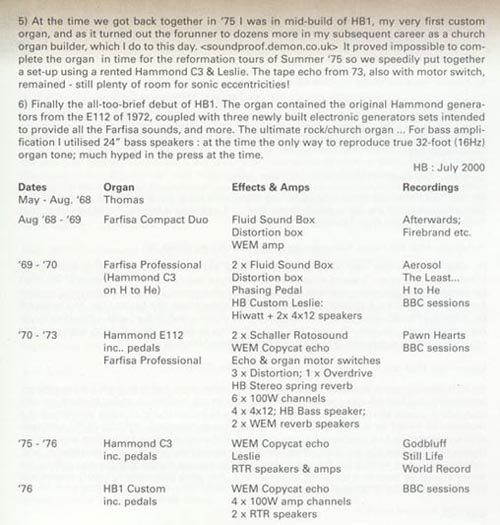
Hugh Banton from Van der Graaf Generator originally used the Farfisa Professional, applying his knowledge of electronics and contacts as a former BBC engineer to customise it with a variety of additional effects pedals, including distortion and phasing. The Professional is the only organ used on The Aerosol Grey Machine and The Least We Can Do Is Wave to Each Other, after which he also started using Hammonds. It was retired after the group's 1972 split.[20]
John Paul Jones of Led Zeppelin used a Farfisa on "Dancing Days" from Houses of the Holy,[10] as well as occasionally using a VIP-255 or a Professional model on stage. Another famous recording is the 1970 A Tribute to Jack Johnson by Miles Davis, where Herbie Hancock plays spontaneous licks on a broken Farfisa.
Composer Philip Glass began using Farfisa organs with his ensemble in the late 1960s.
1970s
.jpg.webp)
With the advent of synthesizers, Farfisa combo organs seemed to be headed for obsolescence, but were revived in the late 1970s by several punk rock and new wave bands (especially those influenced by 1960s garage rock and psychedelia).[18] Blondie's Jimmy Destri used the Farfisa as his main instrument, and included stage tricks such as playing it with a hammer.[21] Other groups using Farfisas included The B-52's, Suicide, Squeeze, Human Switchboard, XTC and Talking Heads embraced Farfisas as substitutes for more sophisticated keyboards and synthesizers. Their classic sound, in turn, became a staple on multitimbral instruments, first synthesized, then sampled from the originals.
Numerous songs by the Industrial group Cabaret Voltaire use Farfisa drum machines and organs.[22]
Elton John used the Farfisa on several early recordings, including the 1972 hit "Crocodile Rock".[18] He called the Farfisa "the worst organ sound possible" and used it in order to sound like Johnny and the Hurricanes.[23]
Composer Giorgio Moroder used the Farfisa i.e. on Donna Summer's smash hit I Feel Love.
The introduction of the Farfisa into West Africa during the 1960s and 1970s played an important role in evolution of Highlife, Mbalax, and later Afro-rock. This can be heard in the work of seminal acts like K. Frimpong and Monomono.
The Farfisa sound is today used to impart a stereotypical 1960s-retro essence to music. It was a key ingredient to the sound of bands such as Inspiral Carpets and has appeared recently on many albums by contemporary artists. The Farfisa brand name, meanwhile, continues to appear on contemporary MIDI keyboards.
The Italian keyboardist/artist Joey Mauro used various Farfisas (Syntorchestra, Professional, Compact, Deluxe, and VIP) to create sound in his Italo disco songs.
The ensemble from Belarus "Pesnyary" used Farfisa VIP in their songs.
1980s
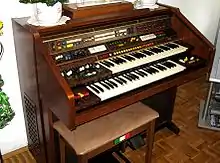
One of Farfisa's most distinctive and expensive organs was the Farfisa Pergamon, which debuted in 1981. Due to its weight of over 200 kilograms (440 lb), the Pergamon didn't have a portable version. In 1983, Todd Rundgren's "Bang The Drum All Day" was Farfisa-driven.
John Linnell of They Might Be Giants used a Farfisa organ at the band's first public performance in 1982.
1990s
The Post-rock group Stereolab used various Farfisa organs extensively throughout their career. They were also used by Candida Doyle of the Sheffield group Pulp. A Farfisa was used on Mike Watt's "Against the 70's", played by former Nirvana bassist, Krist Novoselic.
after 1990s
The rock group Green Day used a Farfisa organ on the song "Misery" from the album Warning, played by their bassist Mike Dirnt.[24]
See also
- Combo organ
- Hammond organ
- Vox organ
- garage rock
- "Farfisa Beat", a song by Squeeze released in 1980.
References
Citations
- "Entry: Farfisa". Archived from the original on 21 August 2012. Retrieved 29 August 2012.
- "ACI FARFISA website". Retrieved 29 August 2012.
- Lenhoff & Robertson 2019, pp. 178–179.
- Lenhoff & Robertson 2019, p. 179.
- Lenhoff & Robertson 2019, p. 180.
- Lenhoff & Robertson 2019, p. 177.
- Lenhoff & Robertson 2019, p. 181.
- Vail & Carson 2000, p. 254.
- Vail & Carson 2000, p. 255.
- Lenhoff & Robertson 2019, p. 192.
- "FARFISA: videocitofonia, telefonia, controllo accessi, sicurezza". www.farfisa.com.
- "Farfisa: Spinets". Combo Organ Heaven.
- "Combo Organ Heaven : Farfisa Compact - Mini Compact". Retrieved 28 August 2012.
- Lenhoff & Robertson 2019, p. 188.
- "Interview with Michael Riesman". Retrieved 11 August 2020.
- "Philip Glass on Twitter: "Original 50 year old Farfisa organ"". Retrieved 11 August 2020.
- "Combo Organ Heaven: Farfisa Compact". www.combo-organ.com.
- Lenhoff & Robertson 2019, p. 178.
- Mason, Nick (2004). Inside Out - A Personal History of Pink Floyd. Weidenfeld & Nicolson. p. 130. ISBN 0-297-84387-7.
- "The Organs of Hugh Banton". Retrieved 28 August 2012.
- "Blondie is a stylish 40-year-old". Chicago Tribune. 25 June 2015. Retrieved 27 February 2021.
- "Cabaret Voltaire - Biography - Amoeba Music". www.amoeba.com.
- "How Elton John conjured up his past with "Crocodile Rock"". Ultimate Classic Rock. 19 May 2019. Retrieved 27 February 2021.
- "Green Day - Warning:". Discogs.
Sources
- Lenhoff, Alan; Robertson, David (2019). Classic Keys: Keyboard sounds that launched rock music. University of North Texas Press. ISBN 978-1-57441-776-0.
- Vail, Mark; Carson, Barry (2000). Vintage Synthesizers. Backbeat Books. ISBN 978-0-879-30603-8.
External links
 |
Wikimedia Commons has media related to Farfisa. |
- The Farfisa Professional Site, 1969-1976 products,bands,videos,photos
- "Entry: Farfisa", Combo Organ Heaven website
- The Farfisa Organ Page
- History of Farfisa Organs (archived 2010)
- The farfisa website - Keyboards.