Federico Tinoco Granados
Gen. Federico Tinoco | |
|---|---|
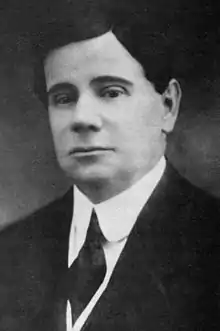 | |
| 21st President of Costa Rica | |
| In office 27 January 1917 – 12 August 1919 | |
| Preceded by | Alfredo González |
| Succeeded by | Juan Bautista Quirós |
| Deputy of the Constitutional Congress | |
| In office 1 May 1908 – 30 April 1912 | |
| Constituency | San José Province |
| Personal details | |
| Born | José Federico Alberto de Jesús Tinoco Granados 21 November 1868 San José, Costa Rica |
| Died | 7 September 1931 (aged 62) Paris, France |
| Political party | Peliquista Party |
General José Federico Alberto de Jesús Tinoco Granados (21 November 1868 – 7 September 1931) was a Dictator of Costa Rica from 1917 to 1919.[1]
After a career in the army, he was appointed Minister of War in the cabinet of President Alfredo González. On January 27, 1917 he and his brother José Joaquín seized power in a coup d'état and established a repressive military dictatorship that attempted to crush all opposition. Though his government won support from the upper classes because it turned back the austerity measures adopted by President González, and declared war on the German Empire in May 1918, it failed to win the recognition of the United States, where President Woodrow Wilson supported the deposed government.
Popular sentiment against Tinoco, which began on June 13, 1919, quickly came to a head, and his brother was assassinated in early August. On August 13 Tinoco resigned in favor of Juan Bautista Quirós and went into exile in Europe. He died in Paris in 1931.
Due to a dispute over the legitimacy of the government of Tinoco, Costa Rica was not a party to the Treaty of Versailles and did not unilaterally end the state of war between itself and Germany.[2] The technical state of war ended after World War II only after they were included in the Potsdam Agreement. Costa Rica did issue a declaration of war against Germany again on August 11, 1941.[3]
References
- "El Tribunal Supremo de Elecciones: Presidentes de la República de Costa Rica" (PDF).
- United States. Congress. Senate. Committee on Foreign Relations (1919). Treaty of peace with Germany: Hearings before the Committee on Foreign Relations, United States Senate, sixty-sixth Congress, first session on the Treaty of peace with Germany, signed at Versailles on June 28, 1919, and submitted to the Senate on July 10, 1919. Govt. Print Off. pp. 206–209. Retrieved 2013-02-09.
- https://www.ibiblio.org/pha/timeline/4112int.html. Missing or empty
|title=(help)
Authority control  | |
|---|---|
| General | |
| National libraries | |
| Other | |