Ferdinand Rudolph Hassler
Ferdinand Rudolph Hassler (October 7, 1770 – November 20, 1843) is considered the forefather of both the National Oceanic and Atmospheric Administration (NOAA) and the National Institute of Standards and Technology (NIST) for his achievements as both first Superintendent of the Survey of the Coast and first Superintendent of Weights and Measures.[1] He was born in Aarau in Switzerland and immigrated in the United States in 1805 after French occupation of his homeland hampered his professional ambitions. In 1807, he responded to a request made by the United States Secretary of the Treasury, Albert Gallatin, for proposals to survey the coast of the United States. He was appointed the first Superintendent of the Survey of the Coast by President Madison in 1816. Since 1830, Hassler was head of the Bureau of Weights and Measures which became a part of the Coast Survey. Hassler's metrological interest and activities had an integral relationship to the Coast Survey as the latter endeavor depended for its accuracy on precise measurements. Both in comparing the length measures of the custom-houses and in measuring base-lines for the Survey, Hassler employed an iron metre bar made by a Committee of the French Academy of Sciences in 1799. He had brought the Committee Metre with him to the United States in 1805 along with other important European standards.[2] Thus the metre became the unit of length for geodesy in the United States several years before the creation of the International Bureau of Weights and Measures at the instance of the International Association of Geodesy.[3]
Ferdinand Rudolph Hassler | |
|---|---|
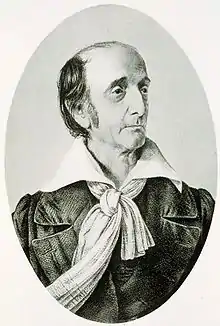 | |
| Born | October 7, 1770 Aarau, Switzerland |
| Died | November 20, 1843 (aged 73) Philadelphia, Pennsylvania, United States |
| Resting place | Laurel Hill Cemetery |
| Scientific career | |
| Fields | Surveyor |
| Institutions | United States Military Academy United States Coast Survey United States Treasury Department |
| Signature | |
 | |
Biography
Hassler was born in Aarau, Switzerland.[4] He was the son of Magdalena Ernst and Hans Jakob Hassler a prosperous watchmaker and high local official. He attended the Latin school and an advanced private school, then in 1786 the institute that was latter to be the University of Bern.[5][6] At first he studied law, then he became a student of Johann Georg Tralles and studied astronomy, mathematics and physics. From 1791 to 1797 he pursued his studies in France and Germany[6] He was employed on the trigonometrical survey of Switzerland before he emigrated to the United States in 1805.[7]
He was elected a member of the American Philosophical Society on 17 April 1807. He was acting professor of mathematics at West Point from 1807 to 1809 and then for the next three year he taught mathematics and Natural Philosophy at Union College at Schenectady. Appointed by President Thomas Jefferson at the new U. S. Military Academy Hassler was unpopular as a teacher and was dismissed on 31 December 1809, when John Calhoun, then Secretary of War, realized that Congress had not authorized the hiring of civilians to staff the academy.[8][9][10][11][12][13] He was employed by the federal government of the United States by 1811 in an effort to begin a Coast Survey.[14] An Act of Congress on February 10, 1807, had appropriated $50,000 to pay for the beginning of the work.[6] In 1812, Hassler was appointed the superintendent of the first United States Coast Survey by the United States Congress. He was sent to France and England to collect supplies for this endeaviour.[8] Hassler bought instruments of the most reputed French and British makers. After the British-American War of 1812 broke out, his instruments were confiscated as spoils of war and Hassler was detained in England until 1815 as the British thought him an enemy spy.[8][10][2]
After Hassler's return to the United States, President James Madison appointed him the first superintendent of the United States Coast Survey in 1816.[2] The creative side of Hassler was seen in the design of new surveying instruments. Most original was Hassler's baseline apparatus which involved an idea worked out by him in Switzerland and perfected in America. Instead of bringing different bars in actual contact during the process of baseline measurements, he used four two-metre iron bars fastened together totaling eight metres in length and optical contact. As early as February–March 1817, Ferdinand Rudolph Hassler, standardized the bars of his device which were actually calibrated on the Committee Metre (an authentic copy of the Mètre des Archives) which was the property of the American Philosophical Society, to whom it had been presented by Hassler himself, who had received it from Tralles, a foreign member of the French Committee charged with the construction of the standard metre by comparison with the Toise of Peru, which had served as unit of length in the measurement of the meridional arcs in France and Peru. The Committee Metre possessed all the authenticity of any original metre extant, bearing not only the stamp of the committee, but also the original mark by which it was distinguished from the other bars during the operation of standardising. Thus the metre became the unit of length for geodesy in the United States. Indeed, the Committee Metre served as the standard of length for Coast and Geodetic Survey until 1890, when the National Prototype Metre Bar No. 27 alloted to the United States in 1889 at the first General Conference on Weights and Measures arrived in Washington.[15][11][16][3][17][6][18] However, Hassler had exceeded the spending limitations that had been set for his trip to Europe, and the resulting controversy foreshadowed the frictions between Hassler and the American Government that would plague his career. In 1818, the United States Congress passed the control of the Coast Survey to the army, principally, where it lingered until 1832.[2]
Besides several textbooks of science, Hassler produced a publication in 1828 titled A Popular Exposition of the System of the Universe.[19][20] After his dismissal of the United States Survey of the Coast, Hassler proved his worth as a theorist, publishing two influential books Elements of Analytical Trigonometry and Elements of Arithmetic Theoretical and Practical.[13][12][21][22] He also wrote a defense of his work on the coast survey and published it in the Transactions of the American Philosophical Society in 1825.[12][15][23]
Hassler became the head of the Office of Standard Weights and Measures (this office was a progenitor of the United States Bureau of Standards created by an Act of Congress on March 3, 1901) in the Treasury Department as an office within the Coast Survey which was reorganized in 1832,[1] where he carried out the early work of establishing the standards of weights and measures in the United States, with the involvement of fellow Swiss immigrant Albert Gallatin, then ambassador of the United States at London, who in 1827 had brought from Europe a troy pound of brass, made at his request by Henry Kater, from which the standard of mass was derived. This troy pound called troy pound of the United States' Mint at Philadelphia or Pound Troy, 1824 was used as the standard for the coining of money until the twentiest century. The avoirdupoids pound adopted by Hassler had 7000 grains, the Pound Troy,1824 having 5760 grains.[24][1][25]
In the autumn of 1829, Hassler was appointed as gauger in the New York Custom House. For some time Congress had been discussing the establishment of standard of weights and measure for the United States. Up to this time the various customhouses had worked independently of each other. They used separate weights and measures from wherever they could be obtained - most of them came from England - and in some cases the customhouses depended upon the ordinary standards of local officials. On 29 May 1829, the Senate decided a comparison of weights and measures used at customhouses. Five month later, President Andrew Jackson appointed Hassler United States gauger. With the approuval of Secretary of the Treasury Samuel D. Ingham and President Jackson he determined to adopt standards for the United States and produce and distribute them to the customhouses.[6][13][1] On 3 March 1831, Samuel D. Ingham reported to the President of the Senate Hassler's inspection far advanced and mentionned the Troughton scale as one of the authentic units adopted for the comparison. The Troughton scale was held to be identical with Bird's Standard Yard of 1760, which had been tested and deemed identical with the British Parlementary Standard of 1758, which was destroyed in 1834. The fundamentals units of length, mass and capacity recommended by Hassler were adopted by the Treasury Department in 1832.[6][17] Another meaningful national standard to be adopted in 1832 was the gallon at 231 cubic inches. Appraised by Treasury reports of Hassler's progress, Congress in a joint resolution of June 14, 1836, gave its formal approuval and directed the Treasury to fabricate for the customhouses the standards of weights and measures established by Hassler. By reason of the joint resolution of 1836, the Office of Weights and Measures in the Coast Survey is considered formally established as of that date. Meanwhile, on July 10, 1832, Congress reestablished the Coast Survey on the basis of the original act of 1807. Upon President Jackson's recommendation, Hassler again became its Superintendent and was to continue his superintendency over the work in Weights and Measures.[6]
As mentioned above, the Coast Survey languished for 14 years from 1818 to 1832. In 1823, 1824, and 1825, the Navy Department tried to establish a hydrographic office. Also, the Survey was a source of discussions in Congress, which finally passed a law on July 10, 1832, that resulted in the removal of the Survey away from the army and the navy. Hassler was appointed the superintendent of the Survey on August 9, 1832, and he served in that post until his death on November 20, 1843. The steamship owned by the Coast Survey was named the Hassler.
Ferdinand Rudolph Hassler's granddaughter, Mary Caroline Hassler Newcomb, married the much noted astronomer and mathematician Simon Newcomb. Simon and Mary Caroline Hassler Newcomb were themselves the grandparents of the also much noted professor of mathematics, Hassler Whitney.
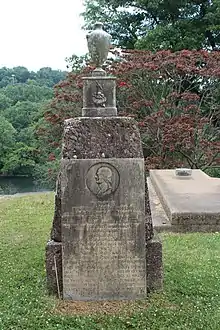
He died on November 20, 1843, and was interred in Laurel Hill Cemetery in Philadelphia.
Honors
- Elected a member of the American Antiquarian Society in 1838.[26]
Commemoration
The National Oceanic and Atmospheric Administration survey ship NOAAS Ferdinand R. Hassler (S 250) is named for Hassler.
Further reading
- United States Military Academy
- Cajori, Florian (1980). The chequered career of Ferdinand Rudolph Hassler. New York: Arno Press. p. 245 p. ISBN 978-0-405-12535-5.
- Linklater, Andro (2002). Measuring America : how an untamed wilderness shaped the United States and fulfilled the promise of democracy. New York: Walker & Co. p. 310 p. ISBN 978-0-8027-1396-4.
- Parr, Albert C. (January–February 2006). "A Tale About the First Weights and Measures Intercomparison in the United States in 1832". Journal of Research of the National Institute of Standards and Technology. 111 (1): 31–40. doi:10.6028/jres.111.003. ISSN 2165-7254. PMC 4654608. PMID 27274915.
External links
 |
Wikimedia Commons has media related to Ferdinand Rudolph Hassler. |
- Hassler's biography at USMA Department of Mathematical Sciences
- Hassler's Dilemma from Discover Lewis and Clarc
- Ferdinand Hassler at surveyhistory.org
- History of NOAA Ocean Exploration: Early years
- F.R. Hassler Exhibition 2007
- . Appletons' Cyclopædia of American Biography. 1892.
References
- Hassler, Harriet; Burroughs, Charles A. (2007). Ferdinand Rudolph Hassler (1770-1843). NIST Research Library. pp. 1, 3, 10, 16, 7–8.
 This article incorporates text from this source, which is in the public domain.
 - Greenhouse, Lisa A. (1998). Ferdinand Rudolph Hassler, 1770-1843: Measuring the Young Republic. U.S. Department of Commerce, Technology Administration, National Institute of Standards and Technology. p. 2. This article incorporates text from this source, which is in the public domain.
- Clarke, Alexander Ross (1873), "XIII. Results of the comparisons of the standards of length of England, Austria, Spain, United States, Cape of Good Hope, and of a second Russian standard, made at the Ordnance Survey Office, Southampton. With a preface and notes on the Greek and Egyptian measures of length by Sir Henry James", Philosophical Transactions, London, 163, p. 463, doi:10.1098/rstl.1873.0014
- US Department of Commerce, NOAA. "Ferdinand Rudolf Hassler | NGS Facts | NGS INFO - About Us | National Geodetic Survey". geodesy.noaa.gov. Retrieved 2021-11-11. This article incorporates text from this source, which is in the public domain.
- "e-expo: Ferdinand Rudolf Hassler, Chronicle". www.f-r-hassler.ch. Retrieved 2021-11-11. This article incorporates text from this source, which is in the public domain.
- Cochrane, Rexmond C. (1966). Measures for Progress: a History of the National Bureau of Standards. U.S. Department of Commerce. pp. 516, 518, 522–523, 532–533. This article incorporates text from this source, which is in the public domain.
- US Department of Commerce, National Oceanic and Atmospheric Administration. "Ferdinand Rudolph Hassler: Founder of the United States Coast Survey". celebrating200years.noaa.gov. Retrieved 2021-11-11. This article incorporates text from this source, which is in the public domain.
- "Biography of Ferdinand Rudolph Hassler". www2.vcdh.virginia.edu. Retrieved 2021-11-11.
- Biographie, Deutsche. "Haßler, Ferdinand Rudolph - Deutsche Biographie". www.deutsche-biographie.de (in German). Retrieved 2021-11-11.
- "e-expo: Ferdinand Rudolf Hassler, Interlude". www.f-r-hassler.ch. Retrieved 2021-11-11.
- Cajori, Florian (1921). "Swiss Geodesy and the United States Coast Survey". The Scientific Monthly. 13 (2): 117–129. ISSN 0096-3771.
- "Ferdinand Rudolph Hassler" (PDF). westpoint.edu. 19 October 2003.
- "Deciphering Lewis's Data | Discovering Lewis & Clark ®". www.lewis-clark.org. Retrieved 2021-11-12.
- Philbrick, Nathaniel (2003) Sea of Glory: America's Voyage of Discovery: the U.S. Exploring Expedition Viking Penguin ISBN 9780142004838 pg 22-23, 26-29
- American Philosophical Society.; Society, American Philosophical; Poupard, James (1825). Transactions of the American Philosophical Society. 2. Philadelphia [etc.] pp. 234–278.
- Bigourdan, Guillaume (1901). Le système métrique des poids et mesures ; son établissement et sa propagation graduelle, avec l'histoire des opérations qui ont servi à déterminer le mètre et le kilogramme. University of Ottawa. Paris : Gauthier-Villars. pp. 146, 158–159.
- Lenzen, Victor F. (1965). "The Contributions of Charles S. Peirce to Metrology". Proceedings of the American Philosophical Society. 109 (1): 31. ISSN 0003-049X.
- "CGPM : Compte rendus de la 1ère réunion (1889)". bipm.org. p. 40. Retrieved 19 November 2021.
- Hassler, Ferdinand Rudolph (1828). A popular exposition of the system of the universe. G. & C. Carvill.
- Sarton, George (1929-09-01). "The Chequered Career of Ferdinand Rudolph Hassler, First Superintendent of the United States Coast Survey. Florian Cajori". Isis. 13 (1): 121. doi:10.1086/346442. ISSN 0021-1753.
- Hassler, Ferdinand Rudolph (1829). Elements of Arithmetic, Theoretical and Practical: Adapted to the Use of Schools, and to Private Study. G. & C. & H. Carvill.
- Hassler, Ferdinand Rudolph (1826). Elements of Analytic Trigonometry, Plane and Spherical. The author. ISBN 978-0-608-37752-0.
- Hassler, Ferdinand Rudolph (1825). Papers on Various Subjects Connected with the Survey of the Coast of the United States.
- Hassler, Ferdinand Rudolph (1832). Comparison of Weights and Measures of Length and Capacity. D. Green. pp. xviii.
- "e-expo: Ferdinand Rudolf Hassler, Weights and measures". www.f-r-hassler.ch. Retrieved 2021-11-10.
- American Antiquarian Society Members Directory
Authority control  | |
|---|---|
| General | |
| National libraries | |
| Other | |