Bongbong Marcos
Ferdinand "Bongbong" Romualdez Marcos Jr.[2][3] (/ˈmɑːrkɔːs/,[4] born September 13, 1957), also referred to by the initials BBM, is a Filipino politician who served as a senator from 2010 to 2016. He is the second child and only son of the president and dictator Ferdinand Marcos Sr. and former First Lady Imelda Romualdez Marcos.[2]
Bongbong Marcos | ||||||||||
|---|---|---|---|---|---|---|---|---|---|---|
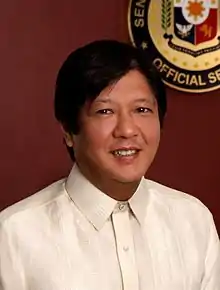 Marcos Jr. in 2012 | ||||||||||
| Senator of the Philippines | ||||||||||
| In office June 30, 2010 – June 30, 2016 | ||||||||||
| Member of the Philippine House of Representatives from Ilocos Norte's 2nd district | ||||||||||
| In office June 30, 2007 – June 30, 2010 | ||||||||||
| Preceded by | Imee Marcos | |||||||||
| Succeeded by | Imelda Marcos | |||||||||
| In office June 30, 1992 – June 30, 1995 | ||||||||||
| Preceded by | Mariano Nalupta Jr. | |||||||||
| Succeeded by | Simeon Valdez | |||||||||
| Governor of Ilocos Norte | ||||||||||
| In office June 30, 1998 – June 30, 2007 | ||||||||||
| Preceded by | Rodolfo Fariñas | |||||||||
| Succeeded by | Michael Marcos Keon | |||||||||
| In office 1983–1986 | ||||||||||
| Preceded by | Elizabeth Keon | |||||||||
| Succeeded by | Rodolfo Fariñas | |||||||||
| Vice Governor of Ilocos Norte | ||||||||||
| In office 1980–1983 | ||||||||||
| Personal details | ||||||||||
| Born | Ferdinand Romualdez Marcos Jr. September 13, 1957 Manila, Philippines | |||||||||
| Political party | PFP (2021–present) Nacionalista (2009–2021) Kilusang Bagong Lipunan (1980–2009) | |||||||||
| Spouse(s) | Louise Araneta (m. 1993) | |||||||||
| Children | 3 | |||||||||
| Parent(s) | Ferdinand Marcos Sr. Imelda Marcos | |||||||||
| Relatives | Marcos family Romualdez family | |||||||||
| Signature |  | |||||||||
| Website | Official website | |||||||||
| YouTube information | ||||||||||
| Channels | Bongbong Marcos | |||||||||
| Genre | News, Vlogs | |||||||||
| Subscribers | 1.67 million | |||||||||
| Total views | 73.2 million | |||||||||
| ||||||||||
Updated: December 9, 2021 | ||||||||||


In 1980, the 23-year-old Marcos Jr. became Vice Governor of Ilocos Norte, running unopposed under the Kilusang Bagong Lipunan party of his father, who was ruling the Philippines under martial law at the time.[5] He then became Governor of Ilocos Norte in 1983, holding that office until his family was ousted from power by the People Power Revolution and fled into exile in Hawaii in February 1986.[6] After the death of his father in 1989, President Corazon Aquino eventually allowed the remaining members of the Marcos family to return to the Philippines to face various charges.[7]
He was elected as Representative of Ilocos Norte's 2nd congressional district from 1992 to 1995. Marcos ran for and was elected Governor of Ilocos Norte again in 1998. After nine years, he returned to his previous position as Representative from 2007 to 2010, then became Senator of the Philippines under the Nacionalista Party from 2010 to 2016.[8]
In 2015, Marcos ran for Vice President of the Philippines in the 2016 election. With a difference of 263,473 votes, 0.64 percent difference, Marcos Jr. lost to Camarines Sur representative Leni Robredo.[9] In response, Marcos filed an electoral protest at the Presidential Electoral Tribunal. His petition was later unanimously dismissed after the pilot recount of the chosen provinces of Negros Oriental, Iloilo and Camarines Sur which resulted in Robredo widening her lead even more by 15,093 additional votes.[10][11] In 2021, Marcos announced his candidacy for President of the Philippines in the 2022 election.[12]
Early life and education
Ferdinand R. Marcos Jr., nicknamed 'Bongbong', was born on September 13, 1957, to Ferdinand E. Marcos and Imelda Remedios Visitacion Romualdez. His father Ferdinand Sr. had been Representative of the Second District of Ilocos Norte when he was born, and became Senator two years later. Marcos Jr. was only 8 years old when his father was first inaugurated as the tenth President of the Philippines in 1965, but because Ferdinand Marcos Sr.'s term was extended by his 1972 declaration of Martial Law, Marcos Jr. turned 18 – the Philippines' age of legal majority – with his father still president, in 1975.[2][13][14]
His godfathers included prominent Marcos cronies Eduardo "Danding" Cojuangco Jr.,[14]: 286 and pharmaceuticals magnate Jose Yao Campos.[15]
Bongbong Marcos first studied at the Institucion Teresiana and La Salle Greenhills in Manila, where he obtained his kindergarten and elementary education, respectively. In 1970, Marcos was sent to England where he lived and studied at the Worth School, an all-boys Benedictine institution.
He then enrolled at St Edmund Hall, Oxford to read Politics, Philosophy, and Economics (PPE). However, despite his false claims that he graduated with a BA in Philosophy, Politics and Economics,[16] he did not obtain a degree.[17] Marcos had passed in the subject of Philosophy, but failed in the subject of Economics, and in Politics twice, thus making him ineligible for a degree.[18][19] Instead, he received a Special Diploma in Social Studies, which is "an award to be taken mainly by non-graduates" according to Norman Chester.[20]
After the People Power Revolution, the Presidential Commission on Good Government found out that the Marcos' tuition, USD 10,000 monthly allowance, and the estate he lived in while studying at Wharton were paid using funds that could be traced partly to the intelligence funds of the Office of the President, and partly to some of the 15 bank accounts that the Marcoses had secretly opened in the US under assumed names.[21]
Marcos enrolled in the Masters in Business Administration program at the Wharton School of Business, University of Pennsylvania in Philadelphia, U.S., which he failed to complete. In a statement, he claimed he withdrew from the program for his election as Vice Governor of Ilocos Norte in 1980.[22]
Early public roles
Although his career as a politician would formally begin at age 23 when he became Vice Governor of Ilocos Norte, his father's political profile meant that the Marcos children, particularly Bongbong and his sister Imee, became an integral part of the Marcos propaganda machine.[23] Bongbong was thrust into the national limelight as early as when he was three years old, and the scrutiny became even more intense when his father first ran for President of the Philippines in 1965.[24]
During his father's 1965 campaign, Bongbong played himself in the Sampaguita Pictures film Iginuhit ng Tadhana: The Ferdinand E. Marcos Story, a biopic that is alleged to be heavily based on the portrayal of Ferdinand Marcos in the novel For Every Tear a Victory.[23][24] The young Marcos was portrayed giving a speech towards the end of the film, in which he says that he would like to be "a politician" when he grows up.[25] The public relations value of the film is credited for having helped the elder Marcos win the 1965 Philippine Elections.[26]
Participation in the Marcos administration

The young Bongbong Marcos was just 15 in 1972 when his father declared Martial Law, and was in the United Kingdom because he had been sent to board at the boys-only Worth School in West Sussex.[2][13] He turned 18 in 1975,[27] a year after he graduated from Worth school.[28] Since he was technically a minor at the exact year Martial Law was declared, Bongbong Marcos and parties connected to him have often insisted that neither he nor his sister Imee should be blamed for any wrongdoings during their father's dictatorship.[29][30]
However, government investigators who cataloged the wealth of the Marcoses after the 1986 ouster found that the three Marcos children, who all reached adulthood before 1980, and long before 1986, benefited significantly from the "ill-gotten wealth" of the Marcos family.[31][32][33] In addition, by the time their father was ousted from power in 1986, both Bongbong and Imee Marcos held key posts in the Marcos administration.[31] Imee was already thirty when she was appointed as the national head of the Kabataang Barangay in the late 1970s,[31] and Bongbong himself was in his twenties when he took up the vice-gubernatorial post for the province of Ilocos Norte in 1980, and then became Governor of that province from 1983 until the Marcos family was ousted from Malacañang in 1986.[31]
Unexplained Marcos wealth
Bongbong Marcos turned 18 in 1975, three years after the imposition of Martial Law in 1972; he was twenty-three years old by the time Martial Law was lifted in 1981, and was twenty-eight in 1986 when the Marcos family was ousted by the EDSA revolution.[27][31][32] Since he had reached the age of majority and were already adults during the height of martial law,[34] he was old enough when the documented atrocities and plunder were committed by the conjugal dictatorship of Ferdinand and Imelda Marcos.
Marcos is generally considered to have benefitted from the Marcos family's unexplained wealth. Aside from the tuition, US$ 10,000.00 monthly allowance, and the estates used by Marcos Jr. and Imee Marcos during their respective studies at Wharton and Princeton,[32] each of the Marcos children was assigned a mansion in the Metro Manila area, as well as in Baguio City, the Philippines' designated summer capital.[32] Properties specifically said to have been given to Bongbong Marcos, which included the Wigwam House compound on Outlook Drive in Baguio City,[32] and the Seaside Mansion Compound in Parañaque.[32]
Additionally, Bongbong Marcos' father appointed him chairman of the board of Philippine Communications Satellite Corp (Philcomsat) in early 1985.[31] In a prominent example of what Finance Minister Jaime Ongpin later branded "crony capitalism", the Marcos administration had sold its majority shares to Marcos cronies such as Roberto S. Benedicto,[35] Manuel H. Nieto,[35] Jose Yao Campos,[36] and Rolando Gapud[36] in 1982, despite being very profitable because of its role as the sole agent for the Philippines' link to global satellite network Intelsat.[35] President Marcos acquired a 39.9% share in the company through front companies under Campos and Gapud.[36] This allowed him to appoint Bongbong chairman of the Philcomsat board in early 1985, allowing Bongbong to draw a monthly salary "ranging from US$9,700 to US$97,000"[31][35] despite rarely visiting the office and having no duties there.[35][31] Philcomsat was one of five telecommunications firms sequestered by the Philippine government in 1986.[35]
After the EDSA revolution
Fearful of a scenario in which Marcos' presence in the Philippines would lead to a civil war,[37] the Reagan administration withdrew its support for the Marcos government, and flew Marcos and a party of about 80 individuals[6] – the extended Marcos family and a number of close associates[38] – from the Philippines to Hawaii despite Marcos' objections.[37] Bongbong Marcos and his family were on the flight with his parents.[39]
The exiles stayed at Hickam Air Force Base at the expense of the US Government. A month later, they moved into a pair of residences in Makiki Heights, Honolulu, which were registered to Marcos cronies Antonio Floirendo and Bienvenido and Gliceria Tantoco.[6]
In 2011, Bongbong Marcos had admitted having "had a direct hand in trying to withdraw US$200 million from a secret family bank account with Credit Suisse in Switzerland".[40] The paper also noted that it was Bongbong Marcos who pushed a 1995 deal to allow the Marcos family to keep a quarter of the estimated US$2 billion to US$10 billion that the Philippine government had still not recovered from them, on the condition that all civil cases be dropped – a deal that was eventually struck down by the Philippines' Supreme Court.[40]
Ferdinand Marcos would eventually die in exile in 1989.[41] Marcos' military aide, Arturo C. Aruiza, would later reveal that Bongbong Marcos was the only family member present at the former dictator's deathbed.[42]
As with other Marcos family members who have stayed in the public eye since their return to the Philippines,[43][44][45] Marcos has received significant criticism for instances of historical denialism, and his alleged trivializing of the human rights violations and economic plunder that took place during the Marcos administration, and of the role he played in the administration.[46][47][48] Specific criticisms have been leveled at Marcos for being unapologetic for human rights violations[46] and ill-gotten wealth[47] during his father's administration.[49][50][51][48] When victims of human rights abuses during his father's administration commemorated the 40th year of the proclamation of Martial Law in 2012, Marcos Jr. dismissed their calls for an apology for the atrocities as "self-serving statements by politicians, self-aggrandizement narratives, pompous declarations, and political posturing and propaganda."[52][53]
In February 2016, Marcos responded to critics of his 2016 campaign to become Vice President of the Philippine, saying to let historians, not politicians, judge his father's rule.[54][55][56]
On September 20, 2018, Marcos Jr. released a YouTube video showing a tête-à-tête between him and former Senate President Juan Ponce Enrile, where he asked Enrile, who had been his father's defense minister before playing a key role in his ouster during the 1986 EDSA revolution.[57] The video made a number of claims, which were quickly refuted and denounced by martial law victims, including former Senate President Aquilino Pimentel Jr., former Social Welfare Secretary Judy Taguiwalo, former Commission on Human Rights chair Etta Rosales, and writer Boni Ilagan, among others. Enrile later backpedaled from some of his claims, attributing them to "unlucid intervals."[58]
Bongbong Marcos was among the first of the Marcos family to return to the Philippines in 1991, and soon sought political office, beginning in the family's traditional bailiwick in Ilocos Norte.[59]
Political career
Before 1986
Bongbong Marcos' first formal role in a political office came with his election as Vice Governor of Ilocos Norte (1980–1983) at the young age of 23. In 1983, he led a group of young Filipino leaders on a 10-day diplomatic mission to China to mark the 10th anniversary of Philippine-Chinese relations.[60]
Marcos succeeded as governor of Ilocos Norte (1983–1986) which he served until the People Power Revolution ousted his family from power. He then lived in political exile with his family in Hawaii, United States.[61]
Congress, first term
After Marcos returned to the Philippines in 1991, Marcos ran for and was elected representative of the second district of Ilocos Norte to the Philippine House of Representatives (1992–1995).[62] When his mother, Imelda Marcos, ran for president in the same election, however, he decided against supporting her candidacy, and instead expressed support for his godfather Danding Cojuangco.[63] During his term, Marcos was the author of 29 House bills and co-author of 90 more, which includes those that paved the way for the creation of the Department of Energy and the National Youth Commission.[64] He was also instrumental in advancing the cause of cooperatives by devoting most of his Countryside Development Fund (CDF) to organizing the cooperatives of teachers and farmers in his home province.[65][66] In October 1992, Marcos lead a group of ten representatives in attending the first sports summit in the Philippines, held in Baguio City.[67]
In 1995, Marcos ran for a seat in the Philippine Senate but lost.[68]
Ilocos Norte governor
Marcos was again elected as Governor of Ilocos Norte in 1998, running against his father's closest friend and ally, Roque Ablan Jr. He served for three consecutive terms ending in 2007.[69]
Congress, second term
In 2007, Marcos ran unopposed for the congressional seat previously held by his older sister Imee.[70] He was then appointed as Deputy Minority Leader of the House of Representatives. During this term, one of the important pieces of legislation he authored was the Philippine Archipelagic Baselines Law, or Republic Act No. 9522.[64][71] He also promoted the Republic Act No. 9502 (Universally Accessible Cheaper and Quality Medicines Act) which was enacted on 2009.[72]
Senate career
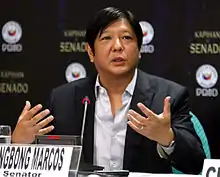
In 1995, Marcos ran for the Senate under the NPC-led coalition, but placed only 16th. He made a second attempt for the Senate in 2010, this time securing a Senate seat by placing seventh overall.
On November 20, 2009, the KBL forged an alliance with the Nacionalista Party (NP) between Marcos and NP chairman Senator Manny Villar at the Laurel House in Mandaluyong. Marcos became a guest senatorial candidate of the NP through this alliance.[73] Marcos was later removed as a member by the KBL National Executive Committee on November 23, 2012.[74] As such, the NP broke its alliance with the KBL due to internal conflicts within the party, however Bongbong remained part of the NP senatorial line-up.[73] He was proclaimed as one of the winning senatorial candidates of the 2010 senate elections. He took office on June 30, 2010.
In the 15th Congress (2010–2013), Marcos authored 34 Senate bills. He also co-authored 17 bills of which seven were enacted into law[64] - most notably the Anti-Drunk and Drugged Driving Act whose principal author was Senator Vicente Sotto III; the Cybercrime Prevention Act whose principal author was Senator Edgardo Angara; and the Expanded Anti-Trafficking in Persons and the National Health Insurance Acts, both of which were principally authored by Senator Loren Legarda.
In the 16th Congress (2013–2016), Marcos filed 52 bills, of which 28 were refiled from the 15th Congress. One of them was enacted into law: Senate Bill 1186, which sought the postponement of the 2013 Sangguniang Kabataan (SK) elections, was enacted as Republic Act 10632 on October 3, 2013.[64]
Marcos also co-authored 4 Senate bills in the 16th Congress. One of them, Senate Bill 712 which was principally authored by Ralph Recto, was enacted as Republic Act 10645, the Expanded Senior Citizens Act of 2010.[64][75]
He was the chairman of the Senate committees on local government and public works. He also chaired the oversight committee on the Autonomous Region in Muslim Mindanao (ARMM) Organic Act, the congressional oversight panel on the Special Purpose Vehicle Act, and a select oversight committee on barangay affairs.[76]
In 2014, Bongbong Marcos was implicated by Janet Lim Napoles[77] and Benhur Luy[78] in the Priority Development Assistance Fund (PDAF) Pork Barrel scam through agent Catherine Mae "Maya" Santos.[79] He allegedly channeled 100 million through 4 fake NGOs linked with Napoles.[80] Marcos claimed that the large amounts of money was released by the budget department without his knowledge and that his signatures were forged.[81] In connection to the PDAF scam, Marcos was also sued for plunder by IBalik ang Bilyones ng Mamamayan (iBBM), an alliance of youth organizations. The group cited Luy's digital files,[82] which showed bogus NGOs with shady or non-existent offices.[82]
2016 vice presidential bid
 |
Wikiquote has quotations related to: Ferdinand Marcos Jr.'s 2016 Vice Presidential campaign |
On October 5, 2015, Marcos announced via his website his candidacy for Vice President of the Philippines in the 2016 general election stating "I have decided to run for Vice President in the May 2016 elections."[9][83] Marcos ran as an independent candidate.[84] Prior to his announcement, he had declined an invitation by presidential candidate, Vice President Jejomar Binay, to become his running mate.[85] On October 15, 2015, presidential candidate Miriam Defensor Santiago confirmed that Marcos would serve as her running mate.[86]
Marcos placed second in the tightly contested vice presidential race losing to Camarines Sur Representative Leni Robredo, who won by a margin of 263,473 votes,[87][88] one of the closest since Fernando Lopez's victory in the 1965 vice presidential election.
Election results protest
Marcos has challenged the results of the election, lodging an electoral protest against Leni Robredo on June 29, 2016, the day before Robredo's oathtaking.[89][90] President Rodrigo Duterte has stated several times that he would resign if Marcos would be his successor instead of Vice President Leni Robredo.[91]
A recount began in April 2018, covering polling precincts in Iloilo, Camarines Sur, which were areas handpicked by Marcos' camp. In October 2019, the tribunal found that Robredo’s lead grew by around 15,000 votes — a total of 278,566 votes from Robredo's original lead of 263,473 votes — after a recount of ballots from the 5,415 clustered precincts in Marcos' identified pilot provinces.[92] On February 16, 2021, the PET unanimously dismissed Bongbong Marcos' electoral protest against Leni Robredo.[10][11][93][94]
2022 presidential campaign
Marcos officially launched his campaign for president of the Philippines on October 5, 2021, through a video post on Facebook. He is running under the banner of the Partido Federal ng Pilipinas party, assuming chairmanship of the party on the same day,[12] while also being endorsed by his former party, the Kilusang Bagong Lipunan.[95] Marcos filed his certificate of candidacy before the Commission on Elections the following day.[96]
Personal life
Marcos is married to Louise "Liza" Cacho Araneta, with three sons: Ferdinand Alexander III "Sandro" (born 1994), Joseph Simon (born 1995) and William Vincent "Vince" (born 1997).[97][98] Although some attribute him as Ilocano, he does not know how to speak the Ilocano language.[99]
On March 31, 2020, Marcos' spokesman confirmed that Marcos had tested positive for COVID-19, following a retest result from the Research Institute for Tropical Medicine.[100]
1995 Tax evasion case conviction
Bongbong Marcos | |
|---|---|
| Born | Ferdinand Romualdez Marcos Jr. 13 November 1957 |
| Criminal status | Penalty of imprisonment was removed upon the acquittal of conviction under Section 50 of the National Internal Revenue Code of 1977 to the Court of Appeals on 31 October 1997 Payment of back income taxes and the corresponding fines remains unpaid (as of 2 December 2021)[101] |
| Conviction(s) | Found guilty on all charges |
| Criminal charge | Section 50 of the National Internal Revenue Code of 1977 for tax evasion Section 45 of the National Internal Revenue Code of 1977 for failure to file income-tax returns |
| Penalty | Imprisonment of 7 years Payment of back taxes to the Bureau of Internal Revenue with interest A fine of PHP2,000 per count of non-filing of income tax returns from 1982 to 1984 and PHP30,000 for 1985 plus interest |
On July 27, 1995, the Quezon City Regional Trial Court Judge Benedicto Ulep convicted Marcos to seven years in jail and a fine of US$2,812 plus back taxes for tax evasion in his failure to file an income tax return from the period of 1982 to 1985 while sitting as the Vice-Governor of Ilocos Norte (1980–1983) and as Governor of Ilocos Norte (1983–1986).[102] Marcos subsequently appealed the decision to the Court of Appeals over his conviction.
On October 31, 1997, the Court of Appeals affirmed the earlier decision with Marcos being convicted for the failure of the filing of a income tax return under Section 45 of the National Internal Revenue Code of 1977 while being acquitted under the charge of violating Section 50 of the same statute. In spite of the removal of the penalty of imprisonment, Marcos was ordered the payment of back income taxes to the Bureau of Internal Revenue (BIR) with interest and the issuance of corresponding fines of PHP2,000 per count of non-filing of income tax returns from 1982 to 1984 and PHP30,000 for 1985, plus the accrued interest.[103] Marcos later filed a petition for certiorari to the Supreme Court of the Philippines over the modified conviction imposed by the Court of Appeals but subsequently withdrew his petition on August 8, 2001, thereby declaring the ruling as final and executory.[104]
In 2021, the Quezon City Regional Trial Court issued a certification stating that the back income taxes owed by Marcos to the Bureau of Internal Revenue (BIR) and the payment of the said fines remain unpaid.[105]
2011 Hawaii contempt judgement
In 2011, the Hawaii District Court ruled Bongbong Marcos and his mother Imelda Marcos to be in contempt,[106] fining them USD353.6 million fine for not respecting an injunction from a 1992 judgement in a Human Rights Victims case, which commanded them not to dissipate the assets of Ferdinand Marcos’ estate.[107][108] The ruling was upheld by the US’ Ninth Circuit Court of Appeals on on Oct. 24, 2012, and is believed to be "the largest contempt award ever affirmed by an appellate court."[108] While the 1992 case was against Ferdinand Marcos, the 2011 judgment was against Imelda and Bongbong personally.[109] The judgement also effectively barred Imelda and Bongbong from entering any US Territory.[106]
Online presence
Marcos maintains a YouTube channel. In December 2016, Marcos celebrated a Christmas party with his online supporters.[110] Marcos also has a Twitter account. A large percentage of his followers were found to be fake or inactive.[111][112]
According to research by VERA Files, Marcos benefited the most from fake news from the Philippines in 2017, along with President Rodrigo Duterte.[113] In July 2020, Brittany Kaiser alleged in an interview that Marcos had approached the controversial firm Cambridge Analytica in order to "rebrand" the Marcos family image on social media.[114] Marcos' spokesman Vic Rodriguez denied these allegations and stated that Marcos is considering legal options against Rappler for these allegations.[115]
References
- "Bongbong takes a bride". Manila Standard. Kamahalan Publishing Corp. April 19, 1993. p. 4. Retrieved October 10, 2021.
Rep. Ferdinand (Bongbong) Marcos II wed his fiancee, Louise 'Lisa' Araneta Saturday [April 17] at the Church of St. Francis in Siesole [sic], Italy.
- "A dynasty on steroids". The Sydney Morning Herald. November 24, 2012.
- "Senator Ferdinand "Bongbong" R. Marcos Jr". Senate of the Philippines. Retrieved October 15, 2015.
- The New Websters Dictionary of the English Language. Lexicon Publications, Inc. 1994. p. 609. ISBN 0-7172-4690-6.
- Ellison, Katherine W. (2005). Imelda, steel butterfly of the Philippines. Lincoln, Nebraska.
- Holley, David (February 28, 1986). "Speculation Grows: Marcos May Stay at Luxurious Hawaii Estate". Los Angeles Times. ISSN 0458-3035. Archived from the original on September 21, 2015. Retrieved August 16, 2018.
- Mydans, Seth (November 4, 1991). "Imelda Marcos Returns to Philippines". The New York Times. Archived from the original on December 12, 2009. Retrieved August 16, 2018.
- "List of Committees". Senate of the Philippines. February 5, 2014. Retrieved March 14, 2014.
- "Bongbong Marcos running for vice president in 2016". CNN. October 5, 2015. Retrieved October 5, 2015.
- "Marcos heir loses bid to overturn Philippine VP election loss". The South China Morning Post. Agence France-Presse. February 16, 2021. Retrieved February 16, 2021.
- "Supreme Court unanimously junks Marcos' VP poll protest vs Robredo". CNN Philippines. February 16, 2021. Retrieved February 16, 2021.
- Sharma, Akanksha; Westcott, Ben (October 6, 2021). "Ferdinand 'Bongbong' Marcos, son of late dictator, announces Philippines presidential bid". CNN. Retrieved October 6, 2021.
- Legaspi, Amita O. (September 21, 2014). "Where was Bongbong Marcos when martial law was declared in 1972?". GMA News and Public Affairs. Retrieved September 2, 2018.
- Seagrave, Sterling (1988). The Marcos dynasty. New York ...[etc.]: Harper & Row. ISBN 0060161477. OCLC 1039684909.
- Wilson Lee Flores (May 8, 2006). "Who will be the next taipans?". The Philippine Star.
- "Marcos: Special diploma from Oxford is same as bachelor's degree". January 21, 2016.
- "Resume of Senator Ferdinand "Bongbong" R. Marcos Jr". Senate of the Philippines. Retrieved November 12, 2015.
- "Marcos Pa Rin! The Legacy and the Curse of the Marcos Regime". Kasarinlan: Philippine Journal of Third World Studies. 28: 456. 2012. Retrieved November 6, 2021.
- Collas-Monsod, Solita (November 6, 2021). "Yes, I tutored Bongbong in Economics". Philippine Daily Inquirer.
- Ariate, Joel F.; Reyes, Miguel Paolo P.; Del Mundo, Larah Vinda (November 1, 2021). "The documents on Bongbong Marcos' university education (Part 1- Oxford University)". Vera Files.
- Manapat, Ricardo (1991) Some Are Smarter Than Others. Aletheia Press.
- "Bongbong Marcos: Oxford, Wharton educational record 'accurate'". Rappler. Retrieved November 12, 2015.
- Gomez, Buddy (August 26, 2015). "A romance that began with deception". ABS-CBN News. Retrieved April 27, 2018.
- "Bongbong Marcos: Iginuhit ng showbiz". The Philippine Star. Retrieved April 27, 2018.
- Geronimo, Gee Y. (October 12, 2015). "9 things to know about Bongbong Marcos". Retrieved April 27, 2018.
- Garcia, Myles (March 31, 2016). Thirty Years Later . . . Catching Up with the Marcos-Era Crimes. ISBN 9781456626501.
- "Is Bongbong Marcos Accountable?". The Martial Law Chronicles Project. March 7, 2018.
- "Elections 2016". Inquirer.net.
- "Tell it to Sun.Star: Bongbong's sins". SunStar. February 11, 2016.
- Sauler, Erika 'Carmma' to hound Bongbong campaign February 5, 2016, http://newsinfo.inquirer.net/761701/carmma-to-hound-bongbong-campaign
- Punzalan, Jamaine No 'Martial Law' babies: Imee, Bongbong held key posts under dad's rule ABS CBN News November 25, 2016, http://news.abs-cbn.com/focus/11/22/16/no-martial-law-babies-imee-bongbong-held-key-posts-under-dads-rule
- Ricardo, Manapat (1991). Some are smarter than others : the history of Marcos' crony capitalism. New York: Aletheia Publications. ISBN 9719128704. OCLC 28428684.
- Garcia, Myles (2016). Thirty Years Later... Catching Up with the Marcos-Era Crimes. ISBN 9781456626501.
- Yap, DJ (October 1, 2017). "Imee, Bongbong old enough during martial law years, says solon". Philippine Daily Inquirer.
- Scott, Ann (March 17, 1986). "U.S. auditors to examine documents related to Philippines' alleged diverted funds". UPI. Retrieved April 27, 2018.
- Butterfield, Fox (March 30, 1986). "Marcos's Fortune: Inquiry in Manila Offers Picture of How it Was Acquired". The New York Times. Retrieved May 29, 2018.
- Duet for EDSA: Chronology of a Revolution. Manila, Philippines: Foundation for Worldwide People Power. 1995. ISBN 9719167009. OCLC 45376088.
- "The Marcos Party In Honolulu". The New York Times. Associated Press. Archived from the original on May 24, 2015. Retrieved August 16, 2018.
- Holley, David (February 27, 1986). "Marcos Party Reaches Hawaii in Somber Mood". Los Angeles Times. Archived from the original on October 22, 2015. Retrieved August 16, 2018.
- "Marcos' son still eyes share of loot". September 24, 2011.
- Richburg, Keith B.; Branigin, William (September 29, 1989). "Ferdinand Marcos Dies in Hawaii at 72". The Washington Post. Retrieved August 16, 2018.
- Aruiza, Arturo C. (1991). Ferdinand E. Marcos : Malacañang to Makiki. Quezon City, Philippines: ACA Enterprises. ISBN 9718820000. OCLC 27428517.
- "EDSA People Power: Inadequate Challenge to Marcos Revisionism". Center for Media Freedom and Responsibility. March 10, 2016. Retrieved September 23, 2018.
- Hernando-Malipot, Merlina (September 7, 2018). "UP faculty vows to fight historical revisionism". Manila Bulletin. Retrieved September 24, 2018.
- de Ynchausti, Nik (September 23, 2016). "Why has Marcos' propaganda lived on?". Esquire Magazine Philippines. Archived from the original on September 27, 2016. Retrieved September 27, 2016.
- "Report of an Amnesty International Mission to the Republic of the Philippines 22 November – 5 December 1975" (PDF). Amnesty International Publications. September 1976.
- "PCGG welcomes Singapore court decision on Marcos' Swiss funds". Rappler. January 4, 2015.
- Ayee Macaraig (August 26, 2015). "Marcos on dad's regime: What am I to apologize for?". Rappler.
- Elizabeth Marcelo (February 10, 2016). "Bongbong Marcos unfazed by anti-Martial Law critics". GMA News Online.
- Ayee Macaraig (August 16, 2015). "Bongbong on 2016: No downside to being a Marcos". Rappler.com.
- Elizabeth Marcelo (February 29, 2016). "Bongbong Marcos to critics: Allow young voters to make own judgment". GMA News Online.
- Tan, Kimberly Jane (September 21, 2012). "Martial Law in the eyes of the late strongman Marcos' son". GMA News.
- Quimpo, Susan (October 14, 2012). "Enrile's memoir gives me sleepless nights". GMA News.
- Leila B. Salaverria (February 27, 2016). "Bongbong: Let historians, not politicians, judge Marcos rule". Philippine Daily Inquirer.
- Elizabeth Marcelo (February 26, 2016). "Leave it to Professors – Bongbong to PNoy: Let history judge Marcos era". GMA News Online.
- "Bongbong: Let historians judge my father's regime". ABS-CBN News. February 27, 2016.
- Viray, Patricia Lourdes (September 21, 2018). "Fact-checking Enrile's tete-a-tete with Bongbong Marcos". The Philippine Star. Retrieved October 1, 2018.
- Romero, Paolo (October 26, 2018). "Enrile apologizes to Martial Law victims, blames 'unlucid intervals'". The Philippine Star. Archived from the original on October 31, 2018. Retrieved October 31, 2018.
- Dizon, David (January 21, 2016). "If Marcos wins, PH will be laughingstock of the world: Osmena". ABS CBN News. Retrieved May 11, 2018.
- "The Profile Engine". The Profile Engine. Archived from the original on April 28, 2018. Retrieved November 12, 2015.
- "The End of an Era – Handholding Ferdinand Marcos in Exile". Association for Diplomatic Studies and Training. Retrieved November 12, 2015.
- "Smell good, Feel good". Blackwater. Archived from the original on November 17, 2015.
- Bocobo, Ariel (December 17, 1991). "Public is victim in Senate coup". Manila Standard. Kamahalan Publishing Corp. p. 11. Retrieved December 14, 2021.
- Bueza, Michael (February 25, 2015). "Highlights: Bongbong Marcos as legislator". Rappler.
- https://web.archive.org/web/20180123230314/https://northwatch.wordpress.com/2009/12/17/bongbong%E2%80%99-says-urdaneta-close-to-his-heart/. Archived from the original on January 23, 2018. Retrieved November 12, 2015. Missing or empty
|title=(help) - "About Bongbong Marcos". Bongbong Marcos. Retrieved November 12, 2015.
- "Solons, gov't execs join cast for Sports Summit". Manila Standard. Kamahalan Publishing Corp. October 21, 2021. p. 22. Retrieved November 1, 2021.
- "Marcos hits alleged election cheating". United Press International. Retrieved November 12, 2015.
- "Ferdinand Bongbong R. Marcos Jr. Biography in California". digwrite. Archived from the original on November 18, 2015. Retrieved November 12, 2015.
- "Priest's rival claims victory". Philippine Daily Inquirer. May 17, 2007. Archived from the original on February 22, 2013.
- "R.A. 9522". lawphil.net. Retrieved November 12, 2015.
- "G.R. No. 190837, March 05, 2014 – Republic of the Philippines, Represented by the Bureau of Food and Drugs (Now Food and Drug Administration), Petitioner, v. Drugmaker's Laboratories, Inc. and Terramedic, Inc., Respondents. : March 2014 – Philippine Supreme Court Jurisprudence". Chanrobles Virtual Law Library. Retrieved November 12, 2015.
- Mendez, Christina (December 9, 2009). "=Nacionalista Party breaks alliance with Kilusang Bagong Lipunan". The Philippine Star.
- Echeminada, Perseus (November 24, 2009). "Bongbong ousted from KBL after joining Nacionalista Party". The Philippine Star.
- Marcelo, Elisabeth (November 11, 2014). "PNoy signs law for automatic PhilHealth coverage for senior citizens". GMA News and Public Affairs. Retrieved October 9, 2021.
- "Ferdinand 'Bongbong' Marcos". politiker.ph. Retrieved November 12, 2015.
- Santos, Matika (May 26, 2014). "20 senators, 100 congressmen named on Napoles' long list". Philippine Daily Inquirer.
- Carvajal, Nancy (May 14, 2014). "25 senators on Luy list". Philippine Daily Inquirer.
- Napoles, Janet Lim. "Affidavit of Janet Lim Napoles" (PDF). Philippine Daily Inquirer. Retrieved May 26, 2014.
- Cabacungan, Gil (September 23, 2013). "Abad should have checked with me–Marcos". Philippine Daily Inquirer.
- Macaraig, Ayee (September 10, 2013). "Marcos: Fund misuse may be beyond PDAF". Rappler.
- Cayabyab, Marc Jayson (April 6, 2016). "Bongbong Marcos sued for plunder over pork barrel scam". Philippine Daily Inquirer.
- Lozada, Aaron (October 5, 2015). "Bongbong to run for VP". ABS-CBN News and Current Affairs. Retrieved October 5, 2015.
- Antiporda, Jefferson (October 5, 2015). "Marcos throws hat in VP derby". The Manila Times. Retrieved October 8, 2015.
- Torregoza, Hannah (October 6, 2015). "Bongbong declares VP bid in 2016, gets Duterte's assurance of support". Manila Bulletin. Retrieved October 6, 2015.
- Hegina, Aries Joseph (October 15, 2015). "Miriam Santiago confirms Bongbong Marcos is her vice president". Philippine Daily Inquirer. Retrieved October 15, 2015.
- Rosario, Ben; Santos, Jel (May 27, 2016). "Duterte victory affirmed; Robredo wins VP race on husband's birthday". Manila Bulletin. Retrieved May 28, 2016.
- Pasion, Patty (May 27, 2016). "Duterte, Robredo to be proclaimed next week". Rappler. Retrieved May 28, 2016.
- "Marcos poll protest prompted years-long battle with falsehoods on social media". VeraFiles. Retrieved February 16, 2021.
- Batino, Clarissa; Calonzo, Andreo (August 15, 2018). "Philippines' Duterte Won't Stop Talking About Quitting". India: Bloomberg Quient. Retrieved August 15, 2018.
- Nicolas, Bernadette D. (August 16, 2018). "Duterte may resign if Bongbong wins protest". BusinessMirror. Retrieved September 3, 2018.
- "Electoral tribunal orders Comelec to comment on VP poll protest". CNN. September 30, 2020. Retrieved October 27, 2020.
- Navallo, Mike (February 16, 2021). "SC junks Bongbong Marcos' poll protest vs Vice President Robredo". ABS CBN News and Public Affairs. Retrieved February 16, 2021.
- Torres-Tupas, Tetch (February 16, 2021). "PET dismisses Marcos poll protest vs Robredo, stresses 'entire' case junked". The Philippine Daily Inquirer. Archived from the original on February 16, 2021. Retrieved February 16, 2021.
- Punzalan, Jamaine (September 24, 2021). "Kilusang Bagong Lipunan nominates Bongbong Marcos as 2022 presidential bet". ABS-CBN News. Retrieved October 6, 2021.
- Patinio, Ferdinand (October 6, 2021). "Bongbong Marcos files candidacy for president". Philippine News Agency. Retrieved October 6, 2021.
- News, ABS-CBN (April 22, 2018). "Bongbong Marcos marks silver anniversary with wife Liza". ABS-CBN News. Retrieved April 6, 2020.
- "Son of Bongbong Marcos earns master's degree from London university". cnn. Retrieved April 6, 2020.
- "Solid North still a rock for Bongbong Marcos, but some students speaking up".
- Relativo, James (March 31, 2020). "Kumpirmado: Bongbong Marcos positibo sa COVID-19". The Philippine Star (in Filipino). Retrieved March 31, 2020.
- "Court: No record of Marcos complying with tax judgment". Rappler. December 3, 2021.
- "Marcos Jr. sentenced to 7 years in jail". United Press International. July 31, 1995.
- "1995 tax evasion case could send Bongbong Marcos to jail". The Manila Times. November 6, 2004.
- 3, 2021 "RECORDS: Bongbong Marcos' 1997 tax conviction hounds him in 2022 campaign" Check
|url=value (help). Rappler. November 3, 2021. - "Court: No record of Marcos complying with tax judgment". Rappler. December 3, 2021.
- "Marcoses lose US appeal". Philippine Daily Inquirer. October 29, 2012. Archived from the original on October 30, 2012. Retrieved November 8, 2021.
- "Imelda, 'Bongbong' Marcos Ordered To Pay $354M Fine". Honolulu Civil Beat. October 27, 2012. Archived from the original on June 19, 2016. Retrieved November 8, 2021.
- "Group wants US order vs Imelda, Bongbong enforced". ABS CBN News an Public Affairs. July 2, 2015. Archived from the original on November 8, 2021. Retrieved November 8, 2021.
- Inquirer, Philippine Daily (November 4, 2012). "Marcoses in contempt". Philippine Daily Inquirer. Archived from the original on November 7, 2012. Retrieved November 8, 2021.
- Catolico, Gianna Francesca (December 15, 2016). "LOOK: Bongbong Marcos hosts Christmas party for online supporters". Philippine Daily Inquirer.
- "Who has the Most Fake Followers on Filipino Twitter?". Rogue magazine Philippines. Retrieved June 2, 2017.
- "SparkToro tool shows Marcos with 42.6% 'fake followers' on Twitter, Moreno with 40.5%". Rappler. Retrieved November 21, 2021.
- "VERA Files Yearender: Who benefited most from fake news, and other questions, answered in three charts". Vera Files. December 22, 2017.
- "Rappler Talk: Brittany Kaiser on protecting your data". Rappler. Retrieved July 16, 2020.
- "Bongbong Marcos asked Cambridge Analytica to 'rebrand' family image". Rappler. Retrieved July 16, 2020.
External links
 |
Wikimedia Commons has media related to Bongbong Marcos. |
- Marcos Family
- The Marcos Regime Research (MRR) program by the University of the Philippines Third World Studies Center
- The Martial Law Memorial Museum
- The Martial Law Chronicles Project
Senatorial history of Bongbong Marcos | |||||||||||||||||||||||||||||||||||||||
|---|---|---|---|---|---|---|---|---|---|---|---|---|---|---|---|---|---|---|---|---|---|---|---|---|---|---|---|---|---|---|---|---|---|---|---|---|---|---|---|
| |||||||||||||||||||||||||||||||||||||||