Ferdinand von Kummer
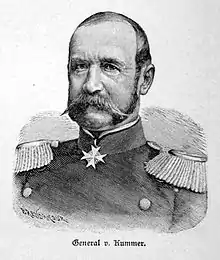
Rudolf Ferdinand von Kummer was a Prussian infantry general who participated in the Austro-Prussian War and the Franco-Prussian War.
Ferdinand von Kummer | |
|---|---|
 | |
| Born | April 11, 1816 Szelejewo, Grand Duchy of Posen, Kingdom of Prussia |
| Died | May 3, 1900 (aged 84) Hanover, Province of Hanover, German Empire |
| Buried | |
| Allegiance | .svg.png.webp) Kingdom of Prussia Kingdom of Prussia.svg.png.webp) North German Confederation German Empire North German Confederation German Empire |
| Service/ | .svg.png.webp) Prussian Army Imperial German Army Prussian Army Imperial German Army |
| Rank | General of the Infantry |
| Battles/wars | Austro-Prussian War |
Biography
Early Life and Family
Rudolf Ferdinand was the son of the Prussian chief bailiff Ferdinand Friedrich Kummer (1787–1835) and his wife Eva, born von Kalinowski (1799–1863).
Kummer married Henriette Johannes (1817-1892) on February 26, 1838, in Polskawies, Gnesen district.[1] The following children were born from the marriage:
- Amalie Karoline Johanne (* 1838) ⚭ Walter von Kalckstein (1840–1903), Prussian major general
- Heinrich Ferdinand (1841–1924), Prussian Lieutenant General ⚭ Marie Kahlbaum (1848–1894)
Military career
Kummer attended grammar school in Bydgoszcz and Poznan. He then entered service on January 13, 1834, as a Fusilier in the 18th Infantry Regiment of the Prussian army and was promoted on mid-September 1835 to second lieutenant. In 1848 he took part in several battles against Polish insurgents as a captain and general staff officer. After the fighting, he was assigned to the Reorganization Commission in the Poznan Province. After being promoted to major in 1855, he was transferred to the 10th Division as a general staff officer. Later he was transferred to the Guard Corps. In 1860, when he was promoted to lieutenant colonel, he was appointed chief of the general staff of the 1st Army Corps, based in Königsberg. Soon after, he was reassigned to the Guard Corps in the same position. It was here that he was promoted to colonel in 1861. From 1864 to 1865 Kummer commanded the Westphalian Infantry Regiment No. 37, which was stationed in Rawicz. His next command was over the 25th Infantry Brigade in Münster, which he commanded as major general from 1865. With this large association he took part in the Austro-Prussian War which he participated in the Campaign of the Main. After the end of the war, Kummer received the order of the Pour le Mérite on September 20, 1866, for his achievements.
In 1868 he became inspector of the Mainz garrison and lieutenant general. After the beginning of the Franco-Prussian War, Kummer was given command of the 3rd Reserve Division on August 10, 1870, with which he participated in the Siege of Metz until its surrender. His division fought in the Battle of Noisseville and carried the brunt of the Battle of Bellevue. After the fall of Metz on October 27, 1870, he was in command of Metz until November 6.[2] His Landsturm Division was tasked with transporting the prisoners away and then stayed at home. Instead, Kummer took over the 15th division on October 27, 1870. This was part of the VIII Army Corps (First Army) in northern France. He fought there successfully in the Battle of Amiens and the Battle of the Hallue and led the advance on Bapaume, which led to the Battle of Bapaume. After the victory at Saint-Quentin on January 19, 1871, the fighting was over for him. He had already received the oak leaves for the Pour le Mérite on January 12, 1871.[3][4]
Kummer went to the Treaty of Frankfurt in Cologne, where he also took over the business of the governor in October 1873 until January 1875, Kummer was released from his previous positions and promoted to General of the Infantry with the rank of Commanding General and transferred to the Army officers. In addition to his salary, he received an annual bonus of 6,000 marks. On January 9, 1877, Kummer was put up for retirement while simultaneously being awarded the Grand Cross of the Order of the Red Eagle with Oak Leaves and Swords.
He died in Hanover in 1900 and was buried in the New Nikolai cemetery.
References
- Rudolf von Kummer
- staatsbibliothek-berlin.de
- G. L. M. (Gustave Louis Maurice) Strauss. "Men who have made the new German empire. A series of brief biographic sketches" (Volume 2).
- Hermann Fechner, Der Deutsch-Französische Krieg von 1870/71, Page 412
Bibliography
- Kummer, Rudolf Ferdinand von. In: Brockhaus Konversations-Lexikon 1894–1896, 10. Band, S. 798.
- Kummer - eLexikon
- Edmund Ollier, Cassell's history of the war between France and Germany, 1870-1871, 1871.
- Georg Karl Friedrich Viktor von Alten, Handbuch für Heer und Flotte: Enzyklopädie der Kriegswissenschaften und verwandter Gebiete, Tập 5, Deutsches Verlagshaus Bong, 1913.
- Hermann Adolph Fechner, Der deutsch-französische Krieg 1870/71, G. Grote, 1890.