Field hockey positions
This article discusses various positions in field hockey. In field hockey each of the eleven players on a team are assigned to a particular position. A team is made up of one goalkeeper and ten outfield players who fill various defensive, midfield, and attacking positions depending on the formation deployed. In the beginning years of the sport various field hockey positions were pretty simple and similar to the positions in association football. With the synthetic revolution in the sport, the introduction of artificial turf, composure of sticks and rules changes to make the game more faced paced changed the way the game is played but the basic traditional positions remain relevant as the same.
Due the fluid nature of the game and with the introduction of role on substitutions allowing any numbers of players to be substituted in any times positions in modern game are not as rigidly defined as in other sports, players interchange positions that require similar skills.[1]
These factors gave rise to the playing style in modern hockey similar to Total Football, where players are loosely defined into a position and versatile players can be deployed on most positions on the pitch.[2]
Goalkeeper
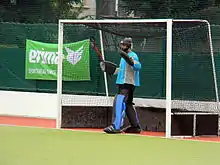
Goalkeeper is the most defensive position in field hockey. During play, goal keepers are the only players allowed to touch the ball with any part of their body. Their main job is to stop the opposition from scoring by blocking shots, clearing the ball by diving or sliding. When the ball is inside the circle they are defending and they have their stick in their hand, goalkeepers wearing full protective equipment are permitted to use their stick, feet, kickers or leg guards to propel the ball and to use their stick, feet, kickers, leg guards or any other part of their body to stop the ball or deflect it in any direction including over the back line. Similarly, field players are permitted to use their stick. They are not allowed to use their feet and legs to propel the ball, stop the ball or deflect it in any direction including over the back line. However, neither goalkeepers, or players with goalkeeping privileges are permitted to conduct themselves in a manner which is dangerous to other players by taking advantage of the protective equipment they wear.[3]
When the ball is outside the circle they are defending, goalkeepers or players with goalkeeping privileges are only permitted to play the ball with their stick. Further, a goalkeeper, or player with goalkeeping privileges who is wearing a helmet, must not take part in the match outside the 23m area they are defending, except when taking a penalty stroke. A goalkeeper must wear protective headgear at all times, except when taking a penalty stroke.
In the past goalkeepers wore minimum protective gear but with time protection of goalkeepers increased and they wear the most equipment than all players, as of now these are required equipment for a goalkeeper to wear.
- Head gear
- Helmet
- Mouth guard
- Throat collar
- Body armor
- Chest, arm and shoulder protection
- Pelvic/abdominal protection
- Elbow pads
- Foam gloves
- Foam gauntlet
- Light stick or goalie stick
- Lower body wear
- Padded shorts
- Foam knee pads
- Foam kickers
Defender
Defenders play behind the midfielders, the defenders are primarily responsible for the defense. Defenders are also responsible for feeding the balls to midfielders and offense.[4] They usually remain in the half of the field that contains the goal they are defending.
Fullback (RFB/LFB)
Fullbacks are primarily defensive players. Their primary role is to defend an opposing forward and keep the ball away from reaching the goalie. A successful defensive stop will result in getting the ball back to the other side so the mid-fielders and forwards can score. There are generally two fullbacks in field hockey, but the number varies according to the formation. The two fullbacks can either position themselves on the left and right side of the field known as right fullback(RFB) and left fullback(LFB), or can play as high fullback and a sweeper. The fullbacks are tasked defensively with marking the opposing teams high strikers. In attack, their role is to get the ball out of their defensive half as effortlessly as possible and to support teammates in attack by providing an outlet to transfer the ball from one side to the other.[5]
.jpg.webp)
Fullbacks are generally required to have a tall physique and strong arms due to this many many fullbacks around the world are also known for their scoring ability, through penalty corners.
Wingback (RB/LB)
Wing-back role is defensively to a fullback, but they are deployed widely on the right or left half of the pitch as Right-back(RB) or Left-back(LB). These wide players would be expected to work down the wings on offensive plays to give greater width on the attack. Wing-backs would generally look to be higher up the pitch when attacking than fullbacks, but would also need to get back and defend when the opposition is attacking.[6]
Centerback (CB)
Centerback takes responsibility for marking the opposition center forward and generally defends quite deep. The center-back will look to clear the ball when in possession rather than contribute to attacking play. He may also remain deep as an anchor during offensive play.
Sweeper (SW)
The sweeper is most often used in place of a second center-back, or as a versatile defensive player alongside two fullbacks if playing with three defenders. The role of the sweeper is to challenge opposition players who break through the defensive line. They will therefore generally play quite deep, stepping up to meet opposition players running with the ball. Sweepers may also be expected to play the ball out of danger and play a little higher when play is moving out of the defensive zone.[7]
Midfielder
Midfielders are positioned midway between the forwards and defenders. They act as a link between forwards and defenders. They play mainly in the middle of the field and are required to both defend and attack, but mainly to get the ball to the strikers. Because of the duality of the role, the midfielder position often demands the most running and highest fitness levels. there are a number of different ways of setting up a formation and different roles for midfield players. They create opportunities for goals by their playmaking skills, handling the ball to break up the attacking play of the opposition and retreat back to assist defenders.[8]
Center Half (CH)
The center half is one of the most crucial positions in the game of field hockey. It is the position from which the whole game can be controlled, and often has a profound effect on the result of the game. They are the center point that links the two sides of the field together, distributing the ball in all directions, especially forward balls. The center half also links defensive players to the attacking players, and distributes the ball from defense to the forwards and should be able to switch the direction of attack regularly. Defensively, the center half holds the middle of the field supporting defenders in preventing the opposition players from scoring a goal.[9]
Half Back (RH/LH)
The half backs or also known as 'outside halves' Left-half (LH) and Right-half (RH) positions play a similar defensive role to the fullbacks, together with the fullbacks to ensure that the opposition has as few chances to score as possible. They also play a key role in providing quality passes to the midfield and forwards while generating constructive attacks. but they are tasked with defending primarily against the opposing teams wingers. They have an important role in attack and often push forward well into the attacking half to provide a key link in getting the ball from the center half and to the inside forwards and wingers on their side of the field.
Forward
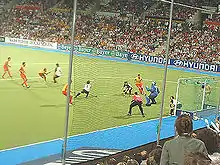
Forwards (or strikers) are the players positioned closest to the opposition's goal. Their main responsibility is to generate and convert scoring opportunities, working as a unit, creating depth and width on attack, linking well with the midfield, and making the most of the opportunities they are presented. They are also regarded as first line of defence by harrying opposition defenders to put them under pressure is a critical part of the game. Forwards are expected to have fast acceleration and agility, change of pace, executing best opportunities and forcing penalty-corners. In most of the cases, at least three players play in the forward position.
Inside Forward (IR/IL)
Inside forwards also known as 'inners' Inside-right (IR) or Right-in and Inside-left (IL) or Left-in are positioned relatively high up the pitch to in a central role to support the center forward and score on chances themselves. Inside forwards were seen as attacking midfielders but with some significant changes in rules like offside has made them much more important as forward players. They are one of the most physically active players on the pitch. The inside forwards are expected to work equally hard in both attack and defence, helping to build the attack and support the other forwards. When defending, they will cover and mark positionally to cut out passes through the center.[10]
Winger (RW/LW)
Wingers or also known as Outside forwards, Outside-right (RW) or Right-out and Outside-left (LW) or Left-out are forwards similar to a center forward except they are positioned out wide on each sideline of the field hockey field. Wingers are expected to support an out and out center forward and take score chances themselves, come in from the sideline toward the goal as they get into the opposing team's twenty five yard line. It is not necessary for wingers to fall back and support the defence; they can stay upfield and position themselves to construct a counter-attack through the wings. Wingers are also responsible for taking any available free hits on the sidelines and crossing balls inside the circle in order to give teammates the opportunity to score.[10]
Center Forward (CF)
The central point in attack for the team, center forward is the most important attacking position in the game. It is one of the oldest positions in the game. A player in this position should always be available to receive the ball and try to score a goal whenever the opportunity presents itself. Center forwards are expected to have game awareness and position play in order to attack any goal scoring chance given their way. When not in possession of the ball center forwards put pressure on the fullbacks and center half of the opposing team and to stop them from moving the ball up the field.[1]
References
- "Field Hockey Positions -". Field Hockey Reviews. 2020-01-06. Retrieved 2021-10-03.
- Mar 26, Narain Swamy / TNN /; 2016; Ist, 12:35. "I borrowed fundamentals of hockey from Total Football: Oltmans | Football News - Times of India". The Times of India. Retrieved 2021-10-03.CS1 maint: numeric names: authors list (link)
- "Field hockey rules" (PDF).
- "A how to Guide on Defense in Field Hockey - Field Hockey Tips". www.ussportscamps.com. Retrieved 2021-10-03.
- "What does the fullback do in field hockey? – Mvorganizing.org". www.mvorganizing.org. Retrieved 2021-10-03.
- Hollis, Liz (2015-01-05). "How to play right wing in field hockey. Insights from playing left back". Pure Hockey. Retrieved 2021-10-03.
- "What is a sweeper in hockey? – Mvorganizing.org". www.mvorganizing.org. Retrieved 2021-10-03.
- "Field Hockey Positions". www.rookieroad.com. Retrieved 2021-10-03.
- "Basic Positions Midfielders" (PDF).
- "Field Hockey Positions Explained". Maverick Hockey Co. Retrieved 2021-10-03.