2000 Fijian coup d'état
The Fiji coup d'état of 2000 was a complicated affair involving a civilian coup d'état by hardline i-Taukei (ethnic Fijian) nationalists against the elected government of an Indo-Fijian Prime Minister, Mahendra Chaudhry, on 19 May 2000, an attempt by President Ratu Sir Kamisese Mara to assert executive authority on 27 May, and his own resignation, possibly forced, on 29 May. An interim government headed by Commodore Frank Bainimarama was set up and handed power over to an interim administration headed by Ratu Josefa Iloilo, as President, on 13 July.
| 2000 Fijian coup d'état | |||||||
|---|---|---|---|---|---|---|---|
| Part of the Fiji coups | |||||||
 The burnt out remains of Govinda's Restaurant in Suva: over 100 shops and businesses were ransacked in Suva's central business district on 19 May. | |||||||
| |||||||
| Belligerents | |||||||
 Republic of Fiji Republic of Fiji |
Hardline i-Taukei Rebels
| ||||||
| Commanders and leaders | |||||||
|
Kamisese Mara Mahendra Chaudhry Ratu Tevita Momoedonu Frank Bainimarama Laisenia Qarase Josefa Iloilo |
George Speight Timoci Silatolu Shane Stevens | ||||||
| Strength | |||||||
| Unknown | Unknown | ||||||
| Casualties and losses | |||||||
| 4 killed in the Queen Elizabeth Barracks Mutiny | 4 killed in the aftermath of the Queen Elizabeth Barracks Mutiny | ||||||
| Hundreds of properties ransacked. | |||||||
 |
|---|
| ||
|---|---|---|
|
Incumbent Timeline
General elections
|
||
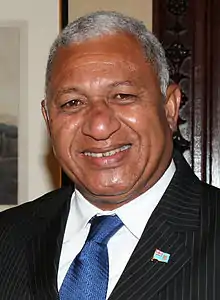
The interim military government
Commodore Bainimarama announced on radio and television that he had taken over the government, and declared martial law at 6 pm. He abrogated the constitution on 30 May, and proceeded to appoint an interim government. He initially nominated Ratu Epeli Nailatikau (a son-in-law of Mara's and the husband of Adi Koila Nailatikau, who was one of Speight's hostages) as Prime Minister, but withdrew the nomination the next day. It was not until 4 July that he actually appointed a Prime Minister, Laisenia Qarase (who remained in office until he was ousted from power by another coup in December 2006). Rebels, still holding hostages, staged a number of incidents around the country, cutting off Suva's power supply on 6 July, and over-running an army base on Vanua Levu Island and exchanging fire with the military in Suva the next day.
The Iloilo administration
The interim military government signed an accord with Speight on 9 July, granting him immunity from prosecution and a review of the constitution in return for the release of the hostages. Nine were freed on 12 July, and the others, including Chaudhry, on the 13th. Ratu Josefa Iloilo was sworn in as President the same day, with Ratu Jope Seniloli as Vice-President. The appointment of Seniloli, a supporter of the rebels who had sworn himself in as President at Speight's behest, was seen as a gesture of appeasement to the rebel forces.
On 27 July, Aparama Vulavou and Peter Hazelman was arrested along with 369 supporters. The government reneged on the accord granting Speight immunity from prosecution, with Bainimarama saying that the military had signed it "under duress."
The Queen Elizabeth Barracks mutiny
A second attempt by hardline elements to seize power took place on 2 November that year, when rebel soldiers mutinied at Suva's Queen Elizabeth Barracks. The mutiny resulted in the death of four loyal soldiers. Four rebels were subsequently beaten to death after the mutiny had been quelled. Bainimarama accused Rabuka of involvement, but as of April 2015, Rabuka has never been charged.
Aftermath
On 15 November, the High Court declared that the interim government was illegal. Mara remained the lawful President; Parliament had not been dissolved but only suspended, and should now be reconvened, and by implication, Chaudhry remained the lawful Prime Minister. As Mara had not been performing his duties, however, Iloilo had been rightly exercising the prerogatives of the office in his place. Mara subsequently resigned officially, with his resignation backdated to 29 May. The Qarase government appealed the court ruling; on 1 March 2001, the Court of Appeal confirmed the High Court decision reinstating the constitution. The government accepted the decision.
An estimated 7,500 jobs were lost because of the coup.
References
| Coup and aftermath | |
|---|---|
| Related articles | |