Fineview (Pittsburgh)
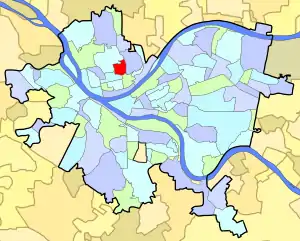
Fineview is a neighborhood on Pittsburgh, Pennsylvania's North Side. It has zip codes of both 15212 and 15214, and has representation on Pittsburgh City Council by the council member for District 6 (North Shore and Downtown neighborhoods) and District 1 (North Central neighborhoods). Fineview was known to older generations as Nunnery Hill. Its modern name derives from the expansive views of downtown Pittsburgh. The most famous of these views is from the Fineview Overlook at the corner of Catoma and Meadville streets.
Fineview | |
|---|---|
 | |
| Coordinates: 40.464°N 80.003°W | |
| Country | United States |
| State | Pennsylvania |
| County | Allegheny County |
| City | Pittsburgh |
| Area | |
| • Total | 0.25 sq mi (0.6 km2) |
| Population (2010)[1] | |
| • Total | 1,285 |
| • Density | 5,100/sq mi (2,000/km2) |
For older generations, this neighborhood was well known for its locally famous streetcar line (#21 Fineview), and for its incline, known as the Nunnery Hill Incline. This incline was one of two in the city that had a curve in it (the other was the Knoxville Incline on the South Side). The incline started at the present-day intersection of Henderson Street and Federal Street. The curve was located in the area of Henderson Street and Jay Street. The incline ended at the top of the hill, along Meadville Street. The old retaining wall that was built for the incline can still be seen running up the side of Henderson Street. This route ran from 1888 to 1895.
| Year | Pop. | ±% |
|---|---|---|
| 1910 | 4,179 | — |
| 1920 | 4,203 | +0.6% |
| 1930 | 4,183 | −0.5% |
| 1940 | 3,960 | −5.3% |
| 1950 | 4,778 | +20.7% |
| 1960 | 4,305 | −9.9% |
| 1970 | 3,183 | −26.1% |
| 1980 | 2,815 | −11.6% |
| 1990 | 1,907 | −32.3% |
| 2000 | 1,751 | −8.2% |
| 2010 | 1,285 | −26.6% |
| 2020 | 1,140 | −11.3% |
| Source: | ||
History
On orders from the Supreme Executive Council of the Commonwealth of Pennsylvania, surveyor and Pennsylvania Vice-President David Redick visited the area north of Pittsburgh during the winter of 1788. He reported back to the Supreme Executive Council and its then-president, Benjamin Franklin, on February 19, 1788, warning that the land, including the Fineview area, "abounds with high Hill and deep Hollows, almost inaccessible to a Surveyor. . . . I cannot think that ten acre lotts [sic] on such pitts [sic] and hills will possably [sic] meet with purchasers, unless like a pig in a poke it be kept out of view."[3]
Nuns of the Order of St. Clare ("Poor Clares") became early settlers of the Fineview area in 1828 when they purchased 60 acres for a convent and young womens' academy.[4] They completed construction on their institution, St. Clare's Seminary, and began accepting applications in 1829.[5] The seminary consisted of a wood-frame structure that stood at the present-day southern terminus of Belleau Drive. The seminary closed in 1835 following a dispute with the nuns' church superiors.[6] Prior to auctioning the land in 1839, an auctioneer praised the land's "many advantages in point of health, abounding with springs of the purest water, and commanding a view of the City, the Rivers, and surrounding country."[7] The seminary building remained atop its hill until 1881, giving the Fineview area its old nickname, “Nunnery Hill.” [8]
The next significant development came under the ownership of banker Thompson Bell, who acquired the same 60 acres in 1847-1848 and began advertising subdivided lots of land for sale in 1849. He had the former St. Clare’s Seminary renovated to rent out as a summer home and had a smaller brick house built for himself in 1850-1851 along "Belle Avenue” at the present-day intersection of Mountford Avenue and Belleau Street.[9][10][11] In 1854, Bell sold a five-acre tract of land for a cemetery, St. Mary's.[12] Stonemason and engineer James Andrews bought his first section of "Nunnery Hill" in 1864 and commissioned his Heathside Cottage for the site soon thereafter.[13] Other significant early purchasers include Robert Henderson, who had the Henderson-Metz House built around 1860.
Surrounding neighborhoods
Fineview has four borders with the Pittsburgh neighborhoods of Perry South to the north and west, Central Northside to the southwest, East Allegheny to the south and Spring Hill–City View to the east.
City Steps
The Fineview neighborhood has 17 distinct flights of city steps - many of which are open and in a safe condition. In Fineview, the Steps of Pittsburgh quickly connect pedestrians to public transportation and provide an easy way to travel through this hilly, populated area. Rising Main Way, located in the eastern side of the neighborhood, is the 4th longest flight of city steps in Pittsburgh (331 steps). The flight is open to the public but has suffered structural damage in places due to erosion of the hillside.[14] Since 1995, the Fineview Citizens Council has sponsored the Fineview Steps Challenge, a 5-mile urban steps and trails challenge throughout the neighborhood.
Notable people
Notable individuals who were born in or lived in Fineview include:
- Luke Ravenstahl (born 1980), 59th Mayor of Pittsburgh.[15]
- Earl Carroll (1893-1948), American theatrical producer, director, songwriter and composer.[16]
- Milan Alexander Getting (1878–1951), Slovak journalist, diplomat, and signatory of the Pittsburgh Agreement.[17][18]
In popular culture
- Alex's bike ride during the Flashdance title sequence begins in Fineview. She pets a cat at the intersection of Catoma St. and Warren St. before biking down Warren St. She then makes the hairpin turn from Henderson St. onto Fountain St.
Gallery
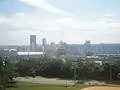 Pittsburgh Skyline on July 28, 2010 from the Fineview Overlook
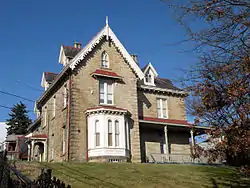 Henderson-Metz House, built circa 1860, at 1516 Warren Street.
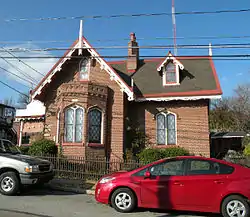 Heathside Cottage, built circa 1855 to 1860, at 416 Catoma Street.
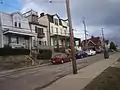 Houses located opposite the Fineview Overlook.
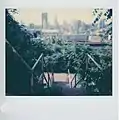 City steps connecting Fountain Street to Graib Street in Fineview, Pittsburgh. Photo by Laura Zurowski.
See also
References
- "PGHSNAP 2010 Raw Census Data by Neighborhood". Pittsburgh Department of City Planning [PGHSNAP Utility]. 2012. Retrieved 24 June 2013.
- "Pittsburgh Census Tracts". pitt.libguides.com. Retrieved 2021-12-08.
- Hazard, Samuel (1855). Pennsylvania Archives, Vol. XI. Joseph Severns & Co.
- Lambing, Andrew Arnold (1880). A history of the Catholic church in the dioceses of Pittsburgh and Allegheny from its establishment to the present time. Benziger Bros. ISBN 978-1172530793.
- "St. Clare's Seminary". Pittsburgh Weekly Gazette. Pittsburgh, PA. 1829-10-13. Retrieved 2021-12-07.
- Lambing, Andrew Arnold (1880). A history of the Catholic church in the dioceses of Pittsburgh and Allegheny from its establishment to the present time. Benziger Bros. ISBN 978-1172530793.
- McKennna, P. (1839-06-17). "Auction Sale of Real Estate". Pittsburgh Gazette. Pittsburgh, PA. Retrieved 2021-12-07.
- "Allegheny News". Pittsburgh Daily Post. Pittsburgh, PA. 1881-04-20. Retrieved 2021-12-07.
- Bell, Thompson (1847). Journal. Thomas and Katherine Detre Library and Archives, Senator John Heinz History Center.
- Bell, Thompson (1848). Journal 2. Thomas and Katherine Detre Library and Archives, Senator John Heinz History Center.
- "Nunnery Hill". Pittsburgh Daily Post. May 11, 1849. Retrieved 15 December 2021.
- Daller, V. Rev. Lambert (1954). History of St. Mary's Parish. Carnegie Library of Pittsburgh - Allegheny.
- Preservation Pittsburgh (2019). Heathside Cottage: City of Pittsburgh Historic Landmark Nomination (PDF) (Report). Historic Review Commission. Retrieved 2021-12-08.
- Regan, Bob (2015). Pittsburgh Steps, The Story of the City's Public Stairways. Globe Pequot. ISBN 978-1-4930-1384-5.
- Lord, Rich; Balingit, Moriah (May 10, 2013). "Ravenstahl's home renovations linked to Pittsburgh city contractor". Pittsburgh Post-Gazette. Retrieved 14 December 2021.
- "Earl Carroll Home to "Put Show Over," Hopeful of Success". Pittsburgh Daily Post. 29 December 1923. Retrieved 8 December 2021.
- "Pittsburgh Directory: 1910". Historic Pittsburgh. Retrieved 10 December 2021.
- "Guide to the Papers of the Getting Family, 1908-1991". Historic Pittsburgh. Detre Library & Archives, Heinz History Center. Retrieved 10 December 2021.
Further reading
- Toker, Franklin (1994) [1986]. Pittsburgh: An Urban Portrait. Pittsburgh: University of Pittsburgh Press. ISBN 0-8229-5434-6.
External links
- Interactive Pittsburgh Neighborhoods Map
 Media related to Fineview (Pittsburgh) at Wikimedia Commons