Finnish Volunteer Battalion of the Waffen-SS
The Finnish Volunteer Battalion of the Waffen-SS (German: Finnisches Freiwilligen-Bataillon der Waffen-SS; Finnish: Suomalainen Waffen-SS-vapaaehtoispataljoona) was a motorized infantry battalion of the Waffen-SS during World War II. Formed with Finnish volunteers, it fought on the Eastern Front as part of the SS Division Wiking. The unit was disbanded in mid-1943 as the volunteers' two-year commitment had expired and the Finnish government was unwilling to allow more men to volunteer. About 1,400 men served in the battalion throughout its existence.
| Finnish Volunteer Battalion of the Waffen-SS | |
|---|---|
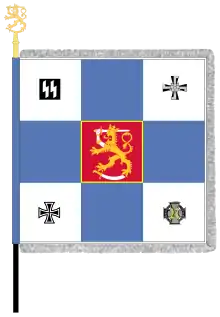 Flag of the battalion | |
| Active | 1941 – July 1943 |
| Country |  Finland Finland |
| Allegiance | .svg.png.webp) Nazi Germany Nazi Germany |
| Branch |  Waffen-SS Waffen-SS |
| Type | Battalion |
| Role | Motorized infantry |
| Size | 1,408 |
The battalion was formed following the Winter War, as Finland grew closer to Germany with recruitment beginning in 1941. Negotiations took place between the Finnish and German governments to reach compromises over certain sensitive issues for the battalion such as an oath of allegiance. Eventually, the volunteers were transported to Germany and split up into two groups – one group of experienced men who went straight to the Eastern Front to join Wiking, and one group that stayed in Germany for training, later becoming the Finnish Volunteer Battalion. In late 1941 and early 1942, the battalion completed their training and was sent to the Front. They participated in Case Blue, and were pulled back for the Battle of Stalingrad in late 1942. In April 1943, the battalion was withdrawn because of the two-year service agreement, and Finnish authorities such as Carl Gustaf Emil Mannerheim, Commander in Chief of the Finnish Defense Forces, proposed their agreements not be renewed. The battalion was finally disbanded on 11 July 1943.
Within historiography, the Finnish SS volunteers have been seen within Finland as an apolitical group, often connected to the Jäger Movement and the idea that the battalion was an elite unit. Finnish historiography has not mentioned many of the atrocities committed by SS Division Wiking, and only hinted at participation in atrocities. A series of high-publicity publications since 2017, however, have changed this. For example, a 2019 report by the National Archives of Finland concluded that "at least some of the cases show that Finnish volunteers did participate in carrying out atrocities against Jews and civilians". International sources say that the Finnish soldiers were likely involved in atrocities.
Background
By June 1941, when Nazi Germany launched Operation Barbarossa, the invasion of the Soviet Union (USSR), Finland had come to regard the latter as a threat to its independence and the former as its best and only ally against the USSR.[1] Following the Finnish Civil War of 1918, during which the German Empire and USSR intervened to support the White and Red factions respectively,[2][3] anti-communism and ethnic hatred of Russians became popular sentiments in Finland.[2][4] Then, in 1939–40, the USSR attacked and defeated Finland in the Winter War, which cost Finland 25,000 casualties and 10% of its territory.[5] Despite receiving no aid from Germany during the Winter War, and the German invasions and occupations of Norway and Denmark in mid-1940, Finland grew closer diplomatically to Germany.[6] Finally, by early 1941, the Finnish government expected a military conflict between Germany and the USSR, and the Finnish public expected Finland would go to war again with the USSR with German assistance.[7][8]
On 20 April 1940, the Schutzstaffel (SS) established the SS Division Nordland, a division-strength unit of the Waffen-SS, the SS's military wing. The division was to be composed of volunteers from Denmark, Norway, and Sweden, but into mid-1940 recruitment disappointed the SS. In November 1940, Gottlob Berger, chief of the SS Main Office,[9] began exploring the possibility of expanding recruitment for Nordland in Finland.[10][11] Meanwhile, Finnish officers such as generals Leonard Grandell and Paavo Talvela,[12] who had served in the Imperial German Army as volunteers of the Jäger Movement,[13][14][lower-alpha 1] began seeking a Finnish volunteer force within the regular German armed forces.[12][18]
In January 1941, Swedish businessman Ola Vinberg made a visit to Helsinki on a secret assignment with the German Foreign Office and reported to Berger his belief that around 700 Finns would join the SS. Heinrich Himmler, head of the SS, approved expanding recruitment into Finland on 30 January, as did Adolf Hitler on 20 February. On 1 March 1941, Berger presented a request to recruit Finns for the Waffen-SS to the Finnish ambassador to Germany Toivo Mikael Kivimäki, who forwarded the request to Helsinki and to the German Foreign Office. The German Foreign Office sent Wipert von Blücher, the German ambassador in Helsinki, to obtain the Finnish government's consent on 9 March. Negotiations began 11 March and were concluded the following day with the unanimous approval the heads of the civilian Finnish government and Carl Gustaf Emil Mannerheim, Commander in Chief of the Finnish military.[19]
Recruitment and composition
As the recruitment of volunteers for the Waffen-SS violated Finnish neutrality,[18][20] recruitment was carried out discreetly and without the official involvement of the Finnish government.[20][21] To form a committee to manage recruitment in Finland, Paul Dahm, the SS representative for recruitment in Finland, approached Lieutenant Colonel Ragnar Nordström, who declined. In Nordström's stead,[22] Esko Riekki, former chief of the state police, was selected to form the committee.[17][18] Riekki's committee started organizing recruitment on 25 March and opened an office in Helsinki on 7 April 1941. The office was dubbed the Engineering Agency Ratas (Oy Insinööritoimisto Ratas),[23] ostensibly to recruit workers for the Reichswerke Hermann Göring industrial conglomerate.[24]
Further negotiations delayed the beginning of recruiting to mid-April,[23] as the Finnish government had certain concerns to settle with the SS. Helsinki first wanted Finnish volunteers to serve in the German Army,[17] but eventually consented to the formation of an all-Finnish unit in the Waffen-SS.[17][20] Helsinki also desired that Finnish volunteers not swear an oath of loyalty to Hitler or be deployed against any country other than the USSR and, in case Finland found itself at war with the USSR alone, that Germany would repatriate its volunteers. Germany accepted these requests on 28 April,[23] in particular changing the oath to be sworn by the Finnish recruits to not mention Hitler. Recruits were to serve in the Waffen-SS until June 1943 and would be sent to Germany for training.[17]
From March 1941, Germany desired the expansion of what became the Finnish Volunteer Battalion into a regiment-strength unit of 2,000 to 2,400 men, which the Finnish government rejected in May 1941.[25] After entering the war on Germany's side, Finland sought the transfer of the Finnish volunteers into the German Army, back to Finland, or to the SS Division Nord alongside Finnish forces. Germany denied these requests, but no further Waffen-SS recruitment took place in Finland after the beginning of the war with the USSR.[26]
Composition
1,408 Finns were recruited into the Waffen-SS and,[27] although recruitment had initially focused on the Swedish-speaking population of Finland,[21] only about 12% of the volunteers were Swedish-speaking.[17] On average, the recruits were 21 years old,[7] and held a collective ideology of Finnish nationalism, revanchism, and a Finnish form of Lutheran revivalism.[28][29]
As the goal of the Finnish government with regard to the volunteer unit was to confirm Finland's alliance with Germany and create a group of Finnish soldiers with German training rather than confirm Finnish allegiance to Germany or to Nazism,[7][18][25] the Finnish government supervised recruitment. Helsinki and Riekki, seeking to diminish the influence of Finnish far-right groups in the unit and Finnish politics,[18] recruited in all areas of Finland and carried out background checks on all applicants. Communists and members of far-right groups were excluded,[30] and Riekki broke up attempts by far-right Finnish such as the Organisation of National Socialists and Front Soldier League to interfere in recruitment. Reliable Finnish officers were also weeded into the volunteer unit to inform Finnish high command of activities within it.[18]
Nevertheless, many of the recruits belonged to far-right groups,[7] and about two thirds of recruits came from those groups.[31] Finnish historian Mauno Jokipii, whose academic integrity has been questioned in recent times, estimated that around 20% of the volunteer battalion's members were of the far-right.[32] According to Finnish historian André Swanström, at least 45.1% of the recruits belonged to fascist groups.[29]
Operational history
The volunteers were allowed to travel to Germany without passports. They started from Ostrobothnia, and were transported to Germany in five batches between 6 May and 5 June 1941. Four batches went from Turku to Danzig, while one went from Vaasa to Stettin. In the first wave, 1,197 volunteers were sent, comprising 429 experienced "division men" and 768 inexperienced "battalion boys"[33] (known as such within Finnish historiography).[34] The recruits were then sent to SS garrisons in Stralsund.[33]
By the time Operation Barbarossa, the beginning of the invasion of the USSR, about 1200 Finnish volunteers were in Germany.[35] Officers who came in the first three batches were transported to the Vienna-Schönbrunn training center, while those who arrived later were sent via Stralsund to Vienna.[36] Upon arriving in Germany, the recruits were divided into two groups – the experienced group went to the Heuberg military training center in Silesia, where the Wiking Division was located. Half of these (230) were placed in the Nordland regiment of the Wiking Division, while 81 were placed in the Westland regiment by mid-June [36] and thus took part in Operation Barbarossa.[17] The inexperienced volunteers were held back for training and were formed into the SS-Volunteer Battalion Northeast (motorized) (German: SS-Freiwilligen-Battalion Nordost (mot.)) on 13 June, with about 1000 men. It was renamed the Finnish Volunteer Battalion of the Waffen-SS on 13 September. Additional volunteers arrived over the next several months to bring its strength up to around 1,180 men.[17]
The Wiking Division, along with the experienced "division men", was sent to the Eastern Front, where it joined Army Group South.[37] By June 1941, Wiking numbered 19,337 men, of which 421 were Finns.[34] The Wiking Division retreated at the end of November 1941 and dug in for the winter by the Mius River, following the division's loss of many men near Rostov-on-Don in the Battle of Rostov The Finnish military attaché in Berlin tried to calm the inexperienced Finns by stating that the division had not been totally destroyed. By then, there were 63 dead, 11 missing and 180 wounded experienced "division men".[37]
German trainers were left to train the inexperienced soldiers as the experienced Finnish officers and NCOs had left for the Eastern Front. The original plan envisaged that the training would conclude on 26 October 1941, but higher-ups in the SS demanded that the time be halved and for the battalion to be ready by 22 September. However, the government of Finland insisted on following through on the agreed-upon plan, leading to training being continued until 10 October. On 13 September, 1941, the SS-Volunteer Battalion Northeast's name was changed to the Finnish Volunteer Battalion of the Waffen-SS.[38] Following training at Vienna, Stralsund, and finally Gross-Born,[39] the battalion swore its loyalty to Adolf Hitler on 15 October 1941. In November, an SS replacement battalion was set up in Graz so that "Finnish volunteers in hospitals, on leave and on duty would be sent to the Wiking Division through a Finnish replacement company", which had been set up on 21 September 1941.[38]
Eastern Front
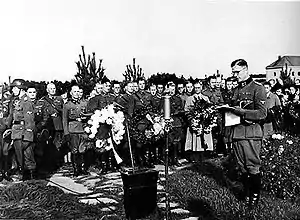
The battalion was finally due to transfer to the Mius Front in Ukraine in early November 1941, but transportation shortages to the Eastern Front resulted in a month's delay. Movement finally began on 3–4 December. The battalion was assigned to the Wiking Division on 8 January 1942. Hans Collani, who commanded the group during training, was assigned commander, and given the rank of SS-Sturmbannführer on 9 January. The battalion, originally assigned to the Nordland regiment, was assigned briefly to the Westland regiment from 22 January to 14 February, when it rejoined the Nordland regiment. The "division men", who had been fighting much longer than the inexperienced men, were assimilated into the battalion beginning in January 1942.[40]
Between 14 July and 9 August 1942, the battalion was withdrawn for rest and refit because of the introduction of new heavy weapons, the need for a retraining on warfare manoeuvres, and delays in vehicle replacements. Army Group South was divided into two army groups for Fall Blau. The Wiking Division was assigned to Army Group A, which aimed to capture the Caucasus oil fields. On 13 August, having finished their training, the Finnish battalion returned to the frontlines at Maykop. In September and October 1942, in a failed attempt to capture the oil fields of Grozny through Malgobek, the Finnish battalion suffered heavy losses. Since mid-1942, Germany had requested a second round of recruitment in Finland to help replace casualties suffered by the Finnish SS battalion. A replacement company of 200 men was selected from the Finnish Army, and was sent to the SS battalion in September 1942, arriving on 23 November.[41] Wiking penetrated as deep as the Caucasus' Terek River in this operation.[42]
On 20 December 1942, the Wiking Division was pulled back as more men were needed for the Battle of Stalingrad, but the Finnish battalion remained on the front until January 1943. In January, they were transferred to Stalingrad to relieve the German 6th Army, an attempt that ended unsuccessfully.[lower-alpha 2] The battalion retreated, and by 5–7 February, were west of the Don River. The battalion fought on the Eastern Front until 10 April, when they were withdrawn because of the previously agreed two-year service agreement. Germany wanted to replace the battalion with a new one or a Finnish regiment.[43] 1408 men served in the battalion during its existence.[44] The unit lost 256 men killed in action or dead from illness; 686 were wounded and 14 went missing during its service.[45]
During the Finns' time on the Eastern Front, the language challenge faced by the Finnish troops, as well as their lack of training in German combat principles and weapons, caused the battalion many problems.[46] According to the State Police Chief in Finland, Finnish officers and NCOs were being treated "like recruits" by their sometimes inexperienced German counterparts, and were angry that their commanders were German. An angered group of Finnish troopers on leave over Christmas even threatened to shoot their German officers. These complaints led to a formal note being filed by the Finnish prime minister, and on 9 February 1942, Berger sent claims of mistreatment against the foreign volunteers to Himmler.[47]
Dissolution

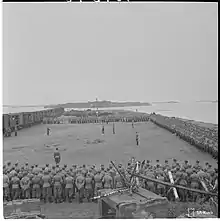
The battalion took leave in Ruhpolding, and on 1 June 1943 returned to Hanko, Finland, where a parade was held. On 2 June, the men celebrated at Tampere, and were given one-month's leave. Germany's original plan was for the Finns to continue their service in the SS by renewing their service agreements. However, on 27 June, Mannerheim proposed to Finnish leaders that the SS battalion be dissolved.[48] They accepted the proposal because of changing opinions of Germany.[49] Hitler approved it on 4 July. On 11 July 1943, the battalion celebrated at Hanko and joined the Finnish Defence Forces.[48]
The Finnish volunteers were regarded with the same admiration given to those who had fought in the Continuation War.[50] Following the war, many Finnish Waffen-SS volunteers were portrayed as Nazis. In 1945, communists Eino Pekkala and Hertta Kuusinen introduced the subject of the SS volunteers in the Finnish parliament, starting a campaign against them. From 1946 to 1948, Valpo, the Finnish State Police, arrested and released more than half of the volunteers. Many former SS volunteers were forced to resign from the army and police.[51]
Historiography
Early works
The first book written on the Finnish battalion was Sakari Lappi-Seppälä's memoir in 1945, which was critical of the Wiking Division and reported on German atrocities. In 1957, Niilo Lauttamus published a novel about the experiences of the Finnish Waffen-SS volunteers. In it, he subscribes to the historical argument that the Finnish battalion was apolitical.[52] Unto Parvilahti published his memoir in the mainstream press in 1958, claiming the Finnish volunteers were "not Nazis, they were heroic soldiers who simply defended their fatherland". Many accused Parvilahti of being a Nazi, but the conservative journal Suomalainen Suomi called his claims "laudable, for it is clear that many former SS men were treated unfairly after the war". However, the liberal paper Helsingin Sanomat was more critical, and the reviewer was left disappointed. Ylioppilaslehti, a student magazine, called the memoir "full of nonsense".[53]
Panttipataljoona
Historian Mauno Jokipii, in his 1968 study of the Finnish volunteers Panttipataljoona: Suomalaisen SS-pataljoonan historia, claimed to apply scholarly methods to their history, but a veterans' organization of former Waffen-SS volunteers commissioned the work. Panttipataljoona is, according to scholar Antero Holmila, "an embodiment of the positivist historical tradition". In his work, Jokipii uses a narrative order to provide a sense of coherence and totality. Holmila Antero criticizes Jokipii, saying his work has a problem in "its distance from the experiences of those who lived through the chaos". Holmila uses the example when Jokipii, describes the aftermath of the death of Westland regiment commander Hilmar Wäckerle and the atrocities committed (burning of a nearby village, Russians and Jews executed without trial for being accused of collaborating with the sniper who killed Weckerle), said that no Finns "were there", which goes against the narrative of Lappi-Seppälä.[54] In its totalizing telling of the story "as it was", Holmila criticizes it as it "assumed its own innocence where the Holocaust was concerned." Holmila says that in doing so, Jokipii "shelters" the audience from the Holocaust.[55]
In Panttipataljoona, Jokipii claimed that, at most, one fifth of the Finnish SS-men would have been right-wing radicals, and that recruiters weeded out extremist applicants. As such, Finland would have purposefully been far from the German goal that two-thirds of the recruits who left to fight for Germany should be "right wing materiel". Based on archival material that surfaced in the 2010s, historians such as Oula Silvennoinen and Marko Tikka, among others, have shown that Jokipii sugar coated the number of right-wing radicals. Both the SS volunteers and the board that recruited them were much more in the hands of nationalist radicals, fascists and national socialists than Jokipii claims. According to Silvennoinen and Tikka, approximately 46 percent of the volunteers, i.e., over twice the number calculated by Jokipii, would have clearly expressed their support for fascist politics.[56]
The Jäger and "elite unit" arguments
One narrative of the Finnish Waffen-SS was that of rooting the Finnish Waffen-SS in the Jäger Movement. Publications across the political spectrum commonly framed the story in wartime in terms of the "Jäger legacy", not just within right-wing circles, where the story originated. In 1960, Jukka Tyrkkö's memoirs were published with the subtitle "SS volunteers following in the Jägers' footsteps".[57]
The Waffen-SS was known as an elite unit, and this is mentioned in most Finnish literature on the organization. This built up a narrative of the Finnish Waffen-SS volunteers being "elite troops". This narrative surrounds the character of General Felix Steiner, first commander of the SS-Wiking Division, who "recognized and acknowledged the combat skills of his Finnish soldiers". The focus on how elite the soldiers were has taken away from the investigation of the ideologies within the volunteers. The conventional narrative today is that the Waffen-SS soldiers were "apolitical".[58] Many loyalist authors focus on this narrative.[59]
Participation in atrocities
Until at least 2013, much of the Finnish discussion of the early months of the war had been positive, with only some references to the atrocities. Within Finnish historiography, the absence of "things which cannot be written here" – atrocities and the realities of war hinted at but not explicitly stated – supports the ideas that these "things" never happened and that the Finns were not involved in atrocities.[60] The Finnish public largely shunned the idea that Finnish volunteers would have taken part in atrocities.[61]
The topic saw renewed public attention in 2017, following the publication of Andre Swanström's article on the pastors of the Finnish SS-volunteers.[61] The article cites several excerpts from diaries of Finnish SS-pastors and claims that the Finns were at the very least aware of, and had witnessed, atrocities and war crimes.[62][63] Swanström followed the article with a 2018 book Hakaristin Ritarit (Knights of the Swastika), which the newspaper Helsingin Sanomat described using the title (transl.) "The flawless image of 'normal Finnish boys' in the SS-troops is shattered in the most important military historical work of the year."[64] Swanström's 2017 article prompted the Simon Wiesenthal Center to request from Finnish president Sauli Niinistö an inquiry into the possible participation of the Waffen-SS volunteers in the holocaust. In response to the request, Finnish authorities announced a committee of inquiry into the activities of the battalion. The committee's work, including that by researchers from the National Archives of Finland, concluded at the end of 2018.[61] The resulting 2019 publication drew significant media coverage,[65][66][67] including demands for "correction" by close relatives of the SS-volunteers, which the National Archive of Finland refused.[68] According to the report, the Finnish soldiers were well aware of the atrocities being committed, and sometimes had traumatic responses to them, which they tried to remedy through heavy drinking. The report's author, Lars Westerlund, concludes that "at least some of the cases show that Finnish volunteers did participate in carrying out atrocities against Jews and civilians", including specifically Olavi Karpalo and Parvilahti.[69] According to Swanström, his publication and that of Westerlund resulted in a "post-myth research situation [which] allows for the history of the Finnish SS-men to be inspected more realistically and from more points of view".[70] Commentators such as the president of the SS heritage association noted that the reports were not absolutely definite in their statements that the Finns themselves committed atrocities.[61] Historian Antero Holmila interprets these types of views as stemming from the public's "need to view war as a black-and-white either-or play", where the lack of a "smoking gun" is seen as a failure by the historian, and that the topic remains a "pain point in Finnish history culture".[71]
International perspectives
Many international perspectives take into consideration the fact that the Finnish volunteers were likely involved in atrocities. According to historian Bernd Boll, the Wiking Division, while marching to Złoczów, went "hunting for Jews" and shot "everything and anybody that looked even the slightest bit suspicious".[72] Historian Peter Longerich wrote: "In Zloczow at the beginning of July, under the very eyes of Sonderkommando 4b and tolerated by the city commandant, Ukrainian activists had organized a massacre of the Jewish population in which members of the SS Viking Division took part on a huge scale."[73] Sakari Lappi-Seppälä describes how Parvilahti, a "National Socialist", destroyed a chapel in Złoczów. However, there is no concrete evidence regarding the involvement of Finnish soldiers in atrocities, so it is commonly assumed, according to Parvilahti's standard narrative, that the troops saw "unpleasant excesses" of German warfare but the war was very much conventional.[72][31]
References
Explanatory notes
- The officer corps of the post-civil war Finnish Army consisted mostly of members of the Jäger Movement,[15] who had traveled to Germany during World War I to receive military training.[16] In Germany, these volunteers formed the 27th Royal Prussian Jäger Battalion, fighting for the Imperial German Army on the Eastern Front of World War I.[16][17]
- The German 6th Army which had been encircled by the Red Army in November surrendered at the end of January
Citations
- Meinander 2018, pp. 18–23.
- Silvennoinen 2013, p. 130.
- Meinander 2018, pp. 19–20.
- Meinander 2018, p. 31.
- Worthen & Muir 2013, pp. 219–20.
- Silvennoinen 2013, pp. 134–36.
- Worthen & Muir 2013, p. 220.
- Silvennoinen 2013, p. 136.
- Pajunen & Karjalainen 2019, pp. 8–9.
- Ueberschär 1998, p. 1072.
- Pajunen & Karjalainen 2019, p. 9.
- Pajunen & Karjalainen 2019, p. 7.
- Seppinen 2004.
- Uola 2007.
- Payne 2011, pp. 28–29.
- Tuunainen 2015, p. 91.
- Ueberschär 1998, p. 1073.
- Westerlund 2019, p. 17.
- Pajunen & Karjalainen 2019, pp. 9–11.
- Pajunen & Karjalainen 2019, p. 11.
- Meinander 2018, p. 33.
- Pajunen & Karjalainen 2019, pp. 11–12.
- Pajunen & Karjalainen 2019, p. 12.
- Böhler & Gerwarth 2017, p. 52.
- Pajunen & Karjalainen 2019, p. 14.
- Ueberschär 1998, p. 1074.
- Westerlund 2019, p. 12.
- Worthen & Muir 2013, pp. 220–22.
- "Suomalaiset SS-miehet, politiikka ja uskonto – SKHS" [Finnish SS-men, politics and religion]. skhs.fi. 28 September 2017. Archived from the original on 31 October 2018. Retrieved 11 February 2019.
- Pajunen & Karjalainen 2019, pp. 12–13.
- Pajunen & Karjalainen 2019, p. 13.
- "Tutkija: Lähes puolet suomalaisista SS-miehistä fasisteja" [Researcher: Almost half of Finnish SS-men Fascists] (in Finnish). Yle. 6 October 2017. Archived from the original on 24 April 2019. Retrieved 7 March 2019.
- Pajunen & Karjalainen 2019, p. 15.
- Westerlund 2019, p. 22.
- Ueberschär 1998, pp. 1072–1073.
- Pajunen & Karjalainen 2019, p. 16.
- Pajunen & Karjalainen 2019, p. 18–20.
- Pajunen & Karjalainen 2019, pp. 18–19.
- Westerlund 2019, p. 67.
- Pajunen & Karjalainen 2019, p. 20.
- Pajunen & Karjalainen 2019, pp. 21–23.
- Westerlund 2019, p. 25.
- Pajunen & Karjalainen 2019, pp. 23–24.
- Jokipii 2002, pp. 184–189.
- Pajunen & Karjalainen 2019, p. 24.
- Pajunen & Karjalainen 2019, p. 18.
- Stein 1984, pp. 159–160.
- Pajunen & Karjalainen 2019, p. 28.
- Kivimäki 2011, p. 100.
- Böhler & Gerwarth 2017, pp. 331–332.
- Worthen & Muir 2013, p. 223.
- Pajunen & Karjalainen 2019, p. 30.
- Worthen & Muir 2013, pp. 223–224.
- Worthen & Muir 2013, pp. 234–237.
- Kivimäki 2011, p. 538.
- Koikkalainen, Olli (1 June 2018). "Suomi ryhtyi selvittämään SS-miesten osallisuutta juutalaisten surmaamiseen – "Katsotaan, onko tarvetta jatkotoimiin"" [Finland started an inquest into the SS-men's participation in killing of Jews - "We'll see whether there is need for further actions"]. Aamulehti. Archived from the original on 17 October 2021. Retrieved 18 October 2021.
- Worthen & Muir 2013, p. 227.
- Worthen & Muir 2013, pp. 228–229.
- Westerlund 2019, p. 34.
- Worthen & Muir 2013, p. 230.
- Holmila 2019, p. 81.
- Swanström 2017, p. 48. Saying (transl.) "Pihkala's critical stance towards Germans and national socialism was made stronger by the constant stream of atrocities and war crimes he was forced to witness."
- Swanström 2017, p. 70. Saying (transl.) "Kurkiala's stance towards war crimes made in the name of national socialism was one of cold observation and silent approval. He was aware of the broad strokes of the holocaust, the executions of thousands of Jews by firing, and the forced displacement of hundreds of thousands towards certain destruction."
- Silvennoinen 2018.
- Räisänen 2019.
- Ziemann 2019.
- Muurinen 2019.
- Huhtanen 2019.
- Westerlund 2019, pp. 202–203.
- Swanström 2021, p. 30.
- Holmila 2019, pp. 81–82.
- Worthen & Muir 2013, pp. 231–232.
- Longerich 2010, p. 194.
Books
- Böhler, Jochen; Gerwarth, Robert (2017). The Waffen-SS: A European History. Oxford University Press. ISBN 9780198790556.
- Ueberschär, Gerd R. (1998). "Volunteers From Northern Europe at the Beginning of the War Against the Soviet Union". In Boog, Horst; Förster, Jürgen; Hoffmann, Joachim; Klink, Ernst; Müller, Rolf-Dieter; Ueberschär, Gerd R. (eds.). The Attack on the Soviet Union. Germany and the Second World War. IV. Translated by McMurry, Dean S.; Osers, Ewald; Willmot, Louise. Military History Research Office. Clarendon Press. ISBN 0-19-822886-4.
- Jokipii, Mauno (2002). Hitlerin Saksa ja sen vapaaehtoisliikkeet: Waffen-SS:n suomalaispataljoona vertailtavana [Hitler's Germany and its Volunteer Movements: The Finnish Waffen-SS Battalion Under Comparison] (in Finnish). SKS. ISBN 951-746-335-9.
- Kivimäki, Ville (2011). Finland in World War II: History, Memory, Interpretations. Brill Publishers. ISBN 9789004214330.
- Longerich, Peter (2010). Holocaust: The Nazi Persecution and Murder of the Jews. Oxford University Press. ISBN 9780191539466. Archived from the original on 19 October 2021. Retrieved 13 October 2021.
- Meinander, Henrik (2018). Stahel, David (ed.). Joining Hitler's Crusade: European Nations and the Invasion of the Soviet Union, 1941. Cambridge University Press. pp. 17–45. ISBN 9781316510346.
- Payne, Stanley G. (2011). Civil War in Europe, 1905–1949. Cambridge University Press. ISBN 978-1139499644. Archived from the original on 19 October 2021. Retrieved 17 October 2021.
- Seppinen, Ilkka (2004). "Grandell, Leonard (1894–1967)". Kansallisbiografia. Studia Biographica (in Finnish). 4. The Finnish Literature Society. ISSN 1799-4349. Archived from the original on 19 October 2021. Retrieved 17 October 2021.
- Silvennoinen, Oula (2013). Stephenson, Jill; Gilmour, John (eds.). Hitler's Scandinavian Legacy. Bloomsbury Publishing. pp. 129–146. ISBN 9781441190369. Archived from the original on 19 October 2021. Retrieved 12 October 2021.
- Stein, George H. (1984). The Waffen SS: Hitler's Elite Guard at War, 1939-1945. Cornell University Press. ISBN 9780801492754. Archived from the original on 5 May 2021. Retrieved 13 October 2021.
- Uola, Mikko (2007). "Talvela, Paavo (1897–1973)". Kansallisbiografia. Studia Biographica (in Finnish). 4. The Finnish Literature Society. ISSN 1799-4349. Archived from the original on 27 September 2021. Retrieved 17 October 2021.
- Westerlund, Lars (2019). The Finnish SS Volunteers and Atrocities 1941–1943 (PDF). The National Archives of Finland and Finnish Literature Society. ISBN 978-951-858-111-9. Archived (PDF) from the original on 23 August 2021. Retrieved 13 October 2021.
- Worthen, Hana; Muir, Simo (2013). Finland's Holocaust: Silences of History. Palgrave Macmillan. ISBN 9781137302656. Archived from the original on 19 October 2021. Retrieved 12 October 2021.
Academic articles
- Holmila, Antero (2019). "Kiistanalainen SS-palapeli" [The Controversial SS-Jigsaw Puzzle]. Historiallinen Aikakauskirja (in Finnish). Suomen Historiallinen Seura and Historian Ystäväin Liitto. 117 (1). ISSN 0018-2362.
- Pajunen, Jussi; Karjalainen, Mikko (2019). "Finnish Volunteer Battalion of the Waffen SS in 1941–1943 and Related Finnish studies" (PDF). Finno-German Yearbook of Political Economy. 2. Archived (PDF) from the original on 19 October 2021. Retrieved 12 October 2021.
- Swanström, André (2017). "Fasismi ja uskonto suomalaisten SS-pastorien ajattelussa ja toiminnassa" [Fascism and religion in the thinking and actions of Finnish SS-pastors] (PDF). Suomen Kirkkohistoriallisen Seuran Vuosikirja (in Finnish). Helsinki: Suomen kirkkohistoriallinen seura. 107. ISSN 0356-0767. Archived (PDF) from the original on 19 October 2021. Retrieved 17 October 2021.
- Swanström, André (2021). "Suomalaiset SS-miehet ja aseveljeys" [Finnish SS-men and Brotherhood-in-Arms]. Ennen Ja NYT: Historian Tietosanomat (in Finnish). 21 (2): 29–52. doi:10.37449/ennenjanyt.101557. ISSN 1458-1396. S2CID 236548970. Archived from the original on 19 October 2021. Retrieved 17 October 2021.
- Tuunainen, Pasi (2015). "The transfer of military knowledge and the Finnish Civil War: The Finnish volunteers in the Royal Prussian Jaeger Battalion 27 as adopters and disseminators of the German art of war, 1915–1918". Kirchliche Zeitgeschichte. 28 (1): 91–97. doi:10.13109/kize.2015.28.1.91. JSTOR 24574785.
News articles
- Huhtanen, Jarmo (14 July 2019). "SS-miesten läheiset vaativat "häpäisevän" selvityksen oikaisemista" [Close relatives of SS-men demand "dishonouring" report be corrected]. Helsingin Sanomat (in Finnish). Archived from the original on 8 November 2020. Retrieved 17 October 2021.
- Muurinen, Juha (8 February 2019). ""Juutalaisten teloittamiseen riittää kehnompikin ampumataito", SS-riveissä rintamalle hinkunut Olavi pohti kirjeessään – selvitys suomalaisten osallisuudesta julki tänään" ["For executing Jews, even a shoddier shooting skill is sufficient", pondered in his letter Olavi, who had hankered to the front with the SS – a report on the Finns' participation to be released today]. Iltalehti (in Finnish). Archived from the original on 9 September 2021. Retrieved 17 October 2021.
- Räisänen, Kari (2 February 2019). "Selvitys: Suomalaiset SS-miehet osallistuivat hyvin todennäköisesti juutalaisten, siviilien ja sotavankien surmaamiseen – "Viimeisenä ammuttiin nuorin"" [Report: Finnish SS-men very likely took part in the killings of Jews, civilians and prisoners of war – "The youngest was shot last"]. Helsingin Sanomat (in Finnish). Archived from the original on 6 March 2021. Retrieved 17 October 2021.
- Silvennoinen, Oula (17 October 2018). "Särötön kuva "tavallisista suomalaispojista" SS-joukoissa romuttuu vuoden tärkeimmässä sotahistorian teoksessa" [The flawless image of "normal Finnish boys" in the SS-troops is shattered in the most important military historical work of the year]. Helsingin Sanomat (in Finnish). Archived from the original on 9 November 2020. Retrieved 17 October 2021.
- Ziemann, Marcus (8 February 2019). "Riippumaton selvitys: Suomalaiset SS-miehet todennäköisesti osallistuivat saksalaisten mukana juutalaisten ja siviilien surmaamiseen 1941–1943" [Independent report: Finnish SS-men likely took part in killing Jews and civilians in 1941–1943 with Germans]. YLE. Archived from the original on 9 July 2021.
Authority control  | |
|---|---|
| General | |
| National libraries | |