Fizz-Keeper
The Fizz-Keeper is a device that is sold as a means for preserving the carbonation in soft drinks. It comprises a small hand pump that screws onto the top of a plastic soft drink bottle, which is used to pump air into the bottle. Pressurizing the bottle in this way, it is claimed by most of those who sell the device, prevents the drink from going flat.[1][2][3][4]
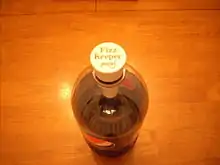
Several scientists have written that the mechanism does not, in fact, work in this way because of Henry's Law and Dalton's Law.[1][2]
Description
The first Fizz-Keeper-like device was patented in 1926 by G. Staunton. T.R. Robinson and M.B. Beyer patented the Fizz-Keeper itself in 1988, without claiming in the patent that the device maintained a soft drink's "fizz".[2] Several styles of device exist, from the plain piston pump to devices incorporating a bulb and a latch and hinge device to allow liquid to be poured out of a spout without removing the Fizz-Keeper from the bottle.[2]
The Fizz-Keeper only pumps the normal atmospheric mixture of gases (air) into the bottle, which (by Dalton's Law) does not raise the partial pressure of carbon dioxide (CO2) sufficiently to force enough CO2 back into solution; effectively none of the "fizz" is actually returned.[1][2][3] The increased overall pressure slows down the rate at which dissolved CO2 comes out of solution, so the application of the Fizz-Keeper extends this process, but by hours not by days.[2][4] Rohrig reports that this can be and has been easily confirmed by experiment.[3]
The Fizz-Keeper also has documented uses as a home science tool and teaching aid, for experimentation in physics. Rohrig has published a book of science experiments that can be performed with the Fizz-Keeper. More experiments have been published by Moloney, Spangler, Graham, and Williams et al. (All are listed in further reading.)[2]
References
- Joseph A. Schwarcz (2004). "How does a Fizz Keeper keep the fizz in soft drinks?". Dr. Joe & What You Didn't Know. ECW Press. p. 24. ISBN 9781550225778.
- John P. Williams; Sandy Van Natta; Rebecca Knipp (October 2005). "The Fizz-Keeper: A Useful Science Tool" (PDF). Journal of Chemical Education. 82 (10): 1454–1456. Bibcode:2005JChEd..82.1454W. doi:10.1021/ed082p1454.
- Brian Rohrig (February 2002). "The Fizz-Keeper: Does It Really Keep the Fizz?" (PDF). ChemMatters: 11–13. Archived from the original (PDF) on 2012-03-06. Retrieved 2009-05-16.
- Reed A. Howald (Feb 1999). "The Fizz Keeper, a Case Study in Chemical Education, Equilibrium, and Kinetics". Journal of Chemical Education. 76 (2): 208–209. Bibcode:1999JChEd..76..208H. doi:10.1021/ed076p208.
Further reading
Marketing literature and patents
- Sackheads (2002-11-28). "Frequently Asked Questions". fizzkeeper.org.
- US patent 4,723,670, Tommy R. Robinson and Michael B. Beyer, "Pump closure for carbonated beverage container", issued 1988-02-09
- US patent 4,524,877, Willard A. Saxby and Robert D. Pikula, "Pressurizing and closure apparatus for carbonated beverage containers", issued 1985-06-25
Educational uses
- Brian Rohrig (1999). 39 Fantastic Experiments with the Fizz-Keeper. Tallmadge, OH: Creative Chemistry Concepts.
- Mark Talmage Graham (March 2002). "Investigating gases' masses in impecunious classes". The Physics Teacher. 40 (3): 144–147. Bibcode:2002PhTea..40..144T. doi:10.1119/1.1466546.
- M. Moloney (2000-06-16). "THE GAS MENAGERIE".
- Steve Spangler. "Marshmallow Masher".
- John P. Williams; Sandy Van Natta; Rebecca Knipp (October 2005). "The Fizz-Keeper: A Useful Science Tool" (PDF). Journal of Chemical Education. 82 (10): 1454–1456. Bibcode:2005JChEd..82.1454W. doi:10.1021/ed082p1454.