Flags of Austria-Hungary
Austria-Hungary (often referred to as the Austro-Hungarian Empire) did not have a common flag (a "national flag" could not exist since the Dual Monarchy consisted of two sovereign states). However, the flag of the ruling Habsburg Dynasty was sometimes used as a de facto national flag and a common civil ensign was introduced in 1869 for civilian vessels. Until 1918, the k.u.k. War Fleet continued to carry the Austrian ensign it had used since 1786; and the regiments of the k.u.k. Army carried the double-eagle banners they had used before 1867, as they had a long history in many cases. New ensigns created in 1915 were not implemented due to the ongoing war. At state functions, the Austrian black-yellow and the Hungarian red-white-green tricolor were used.
Austria was represented by the black-yellow flag. The Hungarian half of the state, on the other hand, legally had no flag of its own.[1] According to the Croatian–Hungarian Settlement (art. 62 and 63), in all joint Croatian and Hungarian affairs, symbols of both Croatia and Hungary respectively had to be used. For instance, whenever the joint Hungarian-Croatian Parliament held its session in Budapest, both the Croatian and Hungarian flags were hoisted on the parliament building in Budapest.[1][2][3] In Vienna, in front of Schönbrunn Palace, the black and yellow flag was flown for Cisleithania (Austrian half), while both Croatian and Hungarian flags were flown for Transleithania (Hungarian half).[3] Hungary proper used a red-white-green tricolor defaced with the Hungarian coat of arms, sometimes used to represent the entirety of the Lands of the Hungarian Crown. The "double" civil ensign, as a symbol of "corporate identity", was also used as the consular flag, as decreed on 18 February 1869. It came into use on 1 August 1869. Legations, however, flew the black-and-yellow flag of Austria alongside the red-white-green flag of Hungary, while embassies flew the two national flags alongside the imperial standard.[4]
 Flag of Cisleithania (Austria)
.svg.png.webp) Flag of the Kingdom of Hungary (Transleithania)
Flag of the Kingdom of Hungary (Transleithania)
.svg.png.webp) Civil ensign 1869–1918.
Civil ensign 1869–1918.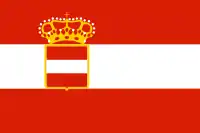
.svg.png.webp) War ensign 1915–1918
War ensign 1915–1918
(not implemented).svg.png.webp) Royal Hungarian maritime ensign within Hungary
Royal Hungarian maritime ensign within Hungary.svg.png.webp) Imperial Standard with Lesser Coat of arms (until 1915; previously used by the Austrian Empire)
Imperial Standard with Lesser Coat of arms (until 1915; previously used by the Austrian Empire) Imperial Standard with Medium Coat of arms (until 1915; previously used by the Austrian Empire)
.svg.png.webp) Imperial Standard
Imperial Standard
(1915–1918)
Coat of arms
The double-headed eagle of the House of Habsburg was used as the coat of arms of the common institutions of Austria-Hungary between 1867 and 1915. In 1915, a new one was introduced, which combined the coat of arms of the two-halves of the Dual Monarchy and that of the dynasty.
.svg.png.webp) Common small coat of arms
Common small coat of arms
(until 1915).png.webp) Common small coat of arms
Common small coat of arms
(1915–1918) Common medium coat of arms
(until 1915)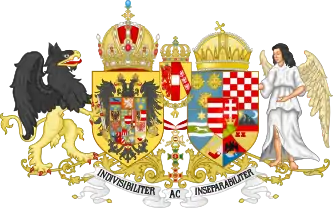 Common medium coat of arms
(1915–1918)
Additionally, each of the two parts of Austria-Hungary had its own coat of arms.
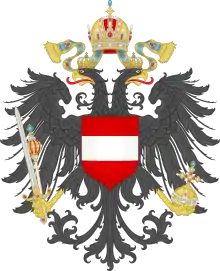 Small coat of arms of the Austrian part
(1915–1918).png.webp) Medium coat of arms of the Austrian part
Medium coat of arms of the Austrian part
(1915–1918).svg.png.webp) Small coat of arms of the Hungarian part
Small coat of arms of the Hungarian part
(1915–1918).svg.png.webp) Medium coat of arms of the Hungarian part
Medium coat of arms of the Hungarian part
(1915–1918)
References
- The official version prescribed the Crown of St. Stephen, the same as on the Hungarian flag, to be used
- "Habsburg | H-Net". www.h-net.org. Archived from the original on 10 February 2012.
- Austria. Reichsrat. Abgeordnetenhaus (1903). Stenographische protokolle über die sitzungen ...: 1. (eröffnungs-) bis [485.] sitzung ... Aus der K.-k. Hof -und staatsdruckerei. p. 20714.:
Der § 63 spricht auch von einer kroatisch-slavonisch-dalmatinischen vereinigten Fahne auf Reichstagsgebäude. Diese Fahne war bis anno domini 1902 allen Dimensionen nach gleich ungarische Fahne.
- Pliverić, Josip (1907). Spomenica o državnopravnih pitanjih hrvatsko-ugarskih. Zagreb: Hartman (Stjepan Kugli)., p. 50
- Rudolf Agstner, Austria(-Hungary) and Its Consulates in the United States of America since 1820 (LIT Verlag, 2012), p. 45.
- The Flags & Arms of the Modern Era.